Biography
Nykyta Budka
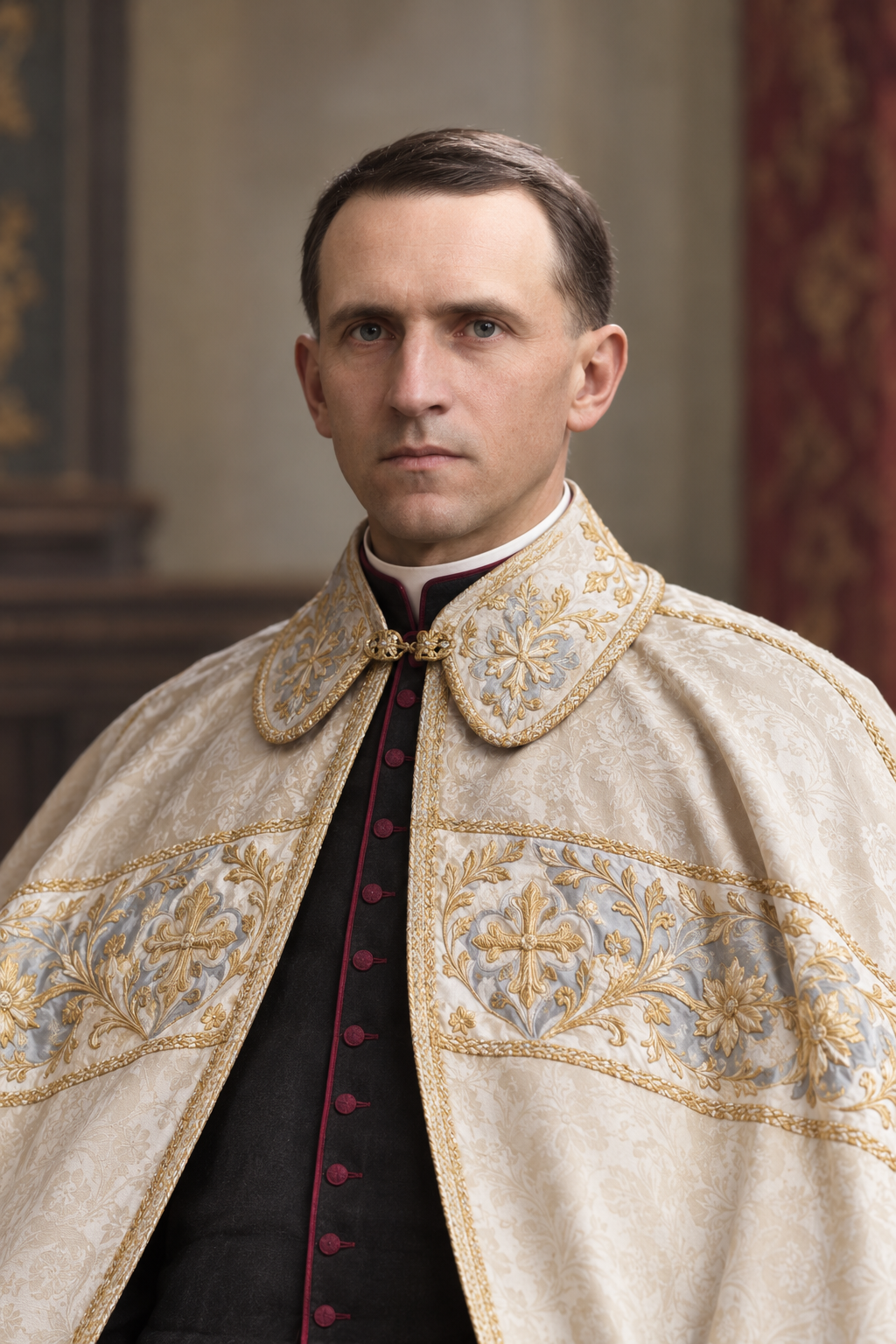
About Nykyta Budka
Historian Athanasius McVay dates Nykyta Budka’s birth at Dobromirka in Austrian Galicia to June 7, 1877. The Internet Encyclopedia of Ukraine instead gives September 7; the birth month is not consistent across the published accounts. He studied law at Lviv before completing military service and pursuing priestly formation at Innsbruck. Historian Athanasius McVay explains that his academic records there used Viktor, a Latin equivalent of his name. This was an academic naming practice, not entry into a religious order.
He had graduated with honors from the Ternopil gymnasium in 1897. His formation took place amid conflict over Ukrainian students’ treatment at Lviv University. McVay describes how Metropolitan Andrei Sheptytsky withdrew his seminarians after a student protest in 1901 and sent them to the Jesuit college at Innsbruck. Budka joined that college after military service, entering a community of Ukrainian seminarians that included future leaders of his church.
Ordained a priest in 1905, Budka worked in seminary education and matters concerning Ukrainian emigration. He ministered to migrant workers in Prussia and Bosnia before being appointed bishop for Ukrainian Greek Catholics in Canada in 1912. He arrived that December and was enthroned at Winnipeg.
The Canadian assignment required him to organize a scattered immigrant church. According to McVay’s study, Budka encouraged Ukrainians to learn English and participate in Canadian life while preserving their religious and cultural traditions. That approach encountered opposition from people who favored assimilation and from rival religious and political movements.
He travelled extensively to celebrate the sacraments and visit settlements. He recruited priests from Europe, ordained local candidates and supported bilingual Catholic education. He also obtained legal recognition for the church in Canada. His administration nevertheless faced serious financial difficulties, including repeated threats of bankruptcy.
Historian Stella Hryniuk describes his first western Canadian visitation as a winter journey by train, horse and foot. His pastoral instructions addressed practical details of worship: the placement of altars and icons, candles and singing. He also encouraged family prayer and children’s participation in church. Priests remained scarce, and he defended clergy of non-Ukrainian origin who had adopted the Byzantine rite against criticism from some parishioners. Church ownership posed another difficulty. Congregations that had organized themselves during years without resident clergy could resist transferring property to episcopal corporations. Their experience of managing their own affairs complicated his efforts to establish a unified diocesan administration.
His ministry also reached communities in eastern Canada. Toronto’s eparchial history records his blessing of Holy Transfiguration Church in Fort William, now Thunder Bay, around 1917. It also records his visit to Windsor on December 26, 1926, when he blessed a church site and named the church for Saints Volodymyr and Olha. These local memories place his work in particular congregations as well as in the wider organization of the Canadian church.
In July 1914, before Britain entered the war, Budka issued a letter advising Austrian subjects who had been called up to return for military service. After the international situation changed, he withdrew that letter and issued another on August 6 supporting the British Empire. McVay argues that the controversy damaged Budka’s reputation but did not determine the Canadian government’s internment policy. His study also describes the church’s efforts to provide pastoral care and material help to interned Ukrainians.
Other disputes divided the Ukrainian community. The Internet Encyclopedia of Ukraine describes conflict with secular leaders over the Mohyla Ukrainian Institute at Saskatoon. That dispute contributed to the emergence of the Ukrainian Orthodox Church of Canada. The same reference records Budka’s later support for the Hetmanite political movement, which he hoped would strengthen respect for church authority.
Ill health and the demands of his Canadian work led him to seek assistance. He resigned in 1928 and later served in Lviv. Soviet authorities arrested him in April 1945. He was eventually sent to a prison camp near Karaganda in Kazakhstan.
After his arrest in Lviv, Budka was taken to Kyiv, where he underwent interrogation and trial before being sent to Kazakhstan. McVay describes a long silence during which people outside the camps did not know whether he remained alive. Survivors released after Stalin’s death helped bring accounts of the prisoners to light. Soviet authorities confirmed Budka’s death in 1958; his political rehabilitation followed in 1991.
Older accounts placed his death on October 1, 1949. McVay reports that information obtained from Kazakh authorities instead established September 28. He also identifies disagreement in the records about whether Budka died at a nearby hospital or at the camp itself. The precise location therefore remains uncertain.
Budka was among the Ukrainian Greek Catholic martyrs beatified by Pope John Paul II on June 27, 2001. In the ceremony’s homily, the pope remembered the persecuted bishops, priests, religious and lay people as witnesses to their faith. He also linked the memory of Christians persecuted across denominational boundaries with the need for reconciliation.
Wondering how to weigh the stories and sources? Learn how to read a saint biography.