Biography
Odile of Alsace
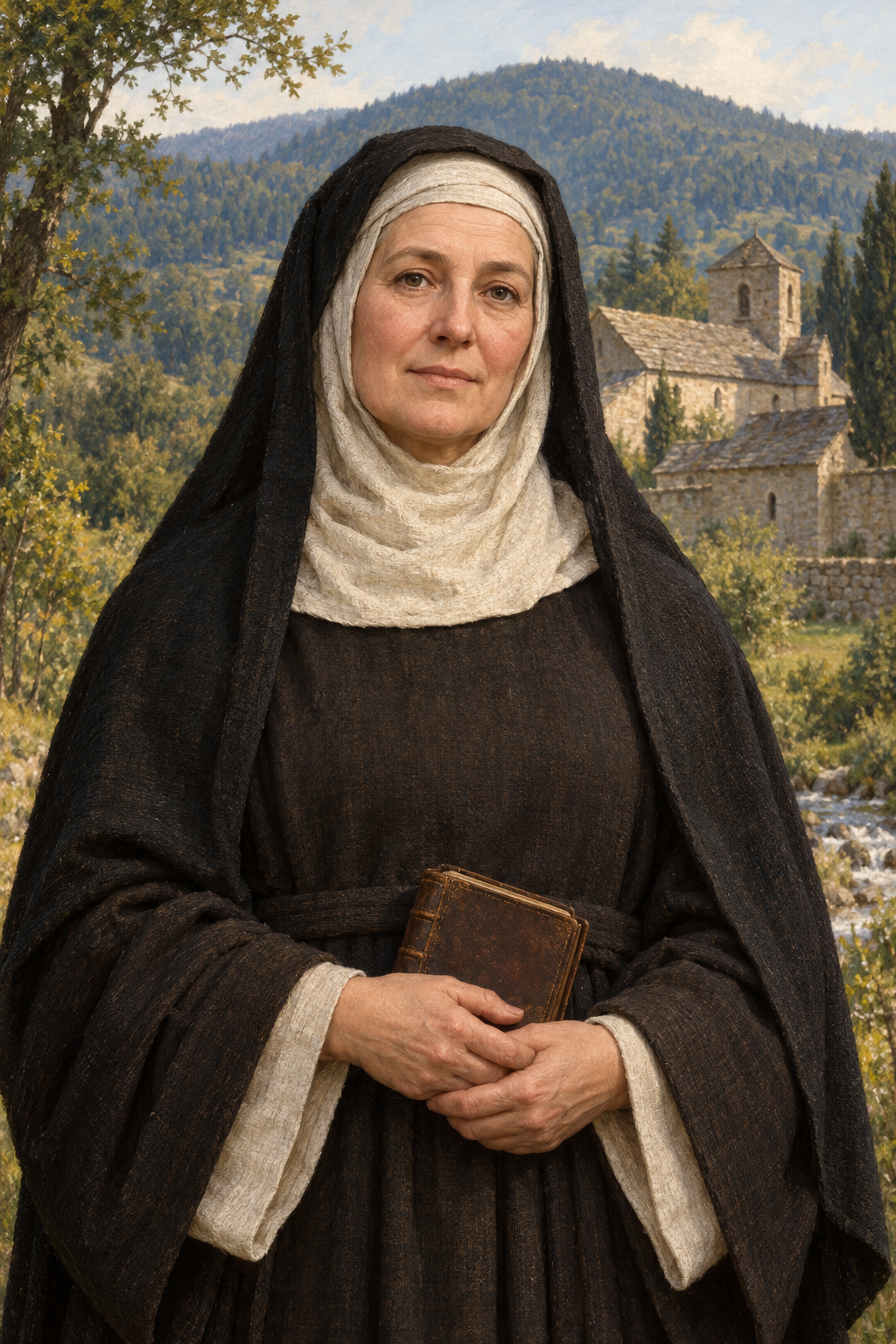
About Odile of Alsace
Odile of Alsace was an abbess associated with Hohenbourg, the religious community on the mountain now called Mont Sainte-Odile. René Bornert places her life approximately between 660 and 720, while stressing how few dependable records survive. Tradition identifies her parents as the Alsatian duke Adalric, also called Etichon, and Bereswinde. Her family belonged to the region’s powerful aristocracy, whose foundations supported religious life while strengthening its own local influence.
The earliest surviving account of her life is separated from her lifetime by generations. Bornert dates its composition around 900 and describes it as a mixture of community memory, plausible historical material and legend. He also warns against reading later religious arrangements back into her lifetime. A passage allowing her companions to choose between monastic and canonical life reflects distinctions clarified only in the ninth century. The narrative therefore needs to be read with attention to when each part could have taken shape.
The best-known story concerns her sight. In the traditional account, Odile was born blind, rejected by her father and protected by her mother. Raised away from home, she received baptism from Bishop Erhard and was said to regain her sight. The sanctuary still tells this story as part of her religious memory. It also recounts her refusal of an arranged marriage and her father’s eventual gift of Hohenbourg. These episodes belong to a devotional life written long after the events, rather than a contemporary record of childhood.
Within that tradition, her religious household is remembered for welcoming people in need. Niedermünster, below the mountain, provided a place for poor and infirm visitors. The sanctuary presents this welcome as a pattern it continues today, inviting people of different ages and circumstances, including visitors who do not share its faith. Since 1931, parish groups have also taken turns maintaining perpetual adoration there. The modern practices document the continuing life of the pilgrimage center, rather than supplying missing evidence about the early abbess.
The historian Marie-Thérèse Fischer draws attention to the long life of Odile’s cult. Writing for the 2020 anniversary, she explains that popular recognition of her holiness preceded formal papal canonization procedures. Her veneration was accepted as immemorial; a precise canonization ceremony should not be invented for it. Fischer notes that the pilgrimage was already known far away in Westphalia around 980. Fire and political upheaval repeatedly damaged the monastery, but devotion to Odile continued. Her story thus became part of a community’s memory across many changes in the buildings themselves.
Fischer also distinguishes early tradition from later additions. Among the legends she discusses is Odile’s prayer for her father after his death, remembered at the Chapel of Tears. She rejects the supposed prophecy attributed to the saint as a later mystification. The title patron of Alsace appears by the early seventeenth century, before its subsequent papal confirmation. These layers help explain why the saint known to later pilgrims cannot simply be equated with everything that was written about her.
Older scholarship preserves other useful landmarks. Wilhelm Wiegand points to a privilege issued by Leo IX in December 1050 that names Odile’s resting place at Hohenbourg and an altar dedicated to her. Such a document establishes recognition of her cult at that time. It does not, by itself, establish the date or form of a canonization. Wiegand also discusses medieval sandstone reliefs showing her receiving a book from Duke Etichon, an image interpreted as the transfer of the foundation. The sculpture is evidence for how the community later represented its origins.
Wiegand further notes that a supposed early account, once accepted by respected historians, was exposed as a seventeenth-century fabrication. He also identifies the testament attributed to Odile as medieval rather than original. These discoveries do not erase the abbey’s history, but they change which documents can support it. A text claiming to speak in her voice is not necessarily a surviving work of the abbess herself.
Her familiar artistic attribute is a book bearing two eyes. The Catholic Encyclopedia records this image alongside her feast on December 13 and her tomb near the convent church. The attribute connects her with prayers concerning sight and with the baptismal healing story. It is symbolic religious imagery, not an authenticated portrait. Like a feast day or a pilgrimage route, it provided a recognizable way for people who had never read her life to identify the saint.
Devotion also traveled beyond Alsace. In Paris, Eugène Edmond Loutil chose Odile as patron of a new church begun in the 1930s, intending a sanctuary that remembered Alsatians and their suffering. The parish’s history explicitly calls her protector of blind people. Its sculpted entrance presents the saint with symbols of her religious community, including a book, a church model and an abbess’s staff. Sainte-Odile became a separate parish in 1953, preserving that regional devotion within another city.
Wondering how to weigh the stories and sources? Learn how to read a saint biography.