Biography
Odilo of Cluny
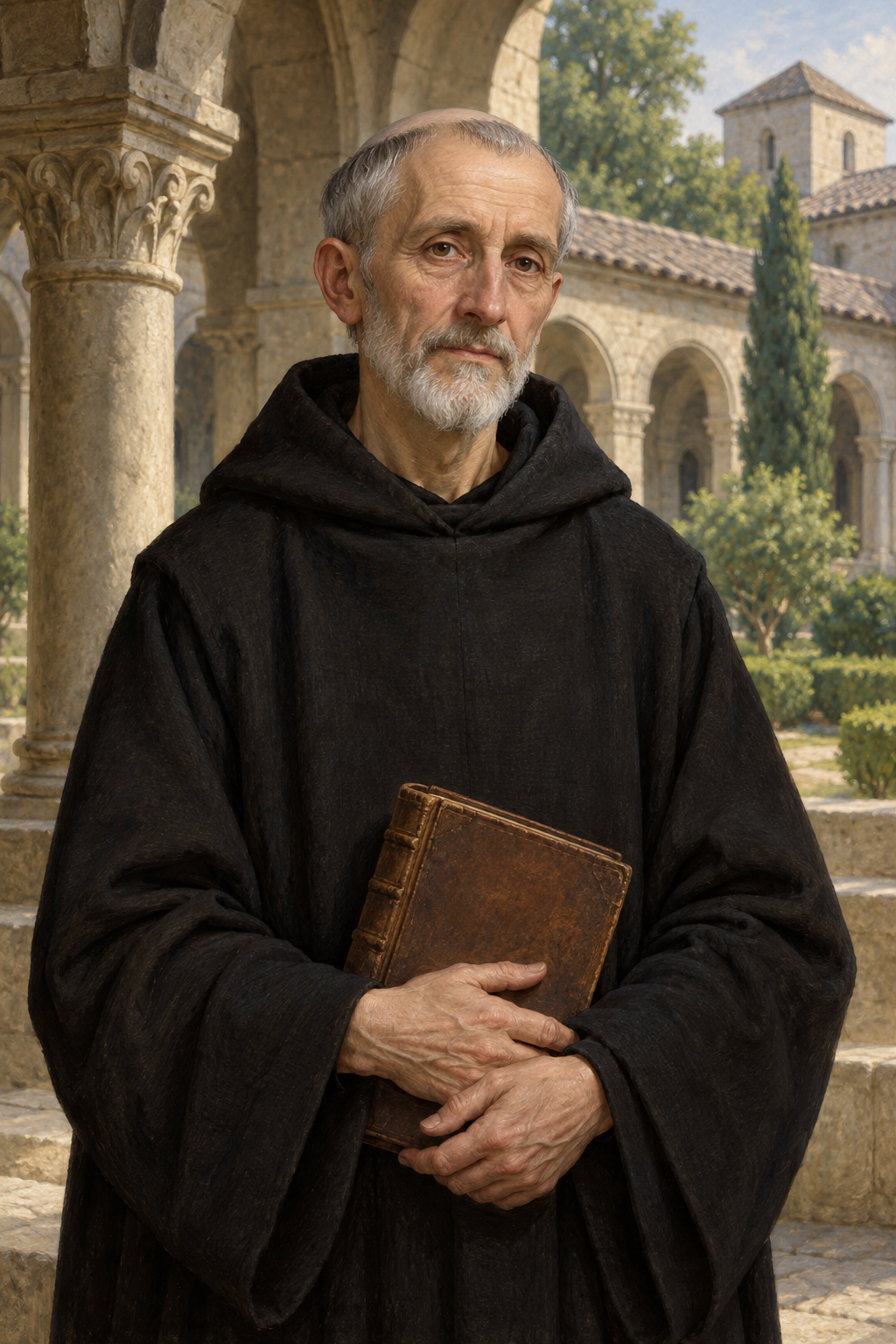
About Odilo of Cluny
Odilo of Cluny led one of medieval Europe’s most influential monasteries from 994 until 1049. A member of the Mercœur family in Auvergne, he entered religious life at Brioude before joining Cluny. The accounts differ over who drew him there: Jotsald credits his predecessor Majolus, while Raoul Glaber emphasizes William of Dijon. What followed was a long abbacy in which Cluny’s network expanded and its shared religious practices became more closely organized.
One record of that organization is the Liber tramitis, a collection of customs prepared between 1027 and 1033 for Farfa in Italy. It describes buildings, church decoration, singers and the observance of feasts. Such details show the practical work behind a monastery’s ordered prayer. Odilo also wrote about Majolus and Adelaide of Burgundy, as well as preaching on the Assumption and the Cross. His own earliest life was composed by Jotsald soon after his death, between 1049 and 1053. Those customs made shared observance visible in ordinary tasks, including the preparation of music and the care of worship spaces.
His responsibilities extended into what is now Switzerland. Alexandre Pahud records the incorporation of Bevaix into Cluny in 998 and Saint-Victor in Geneva around 1000. Odilo also oversaw the rebuilding of the monastery churches at Romainmôtier and Payerne. He administered Romainmôtier’s property as its abbot and maintained close ties with King Rudolf III of Burgundy and the royal family. These connections placed him among rulers and landholders as well as within the cloister.
The New Catholic Encyclopedia describes his counsel to Emperor Henry II and his mediation between Conrad II and Robert II of France. It also places his establishment of the commemoration of All Souls for Cluny and its dependent houses around 1030–1031. The observance later spread more widely. During the famine of 1033, he sold monastic treasures to help people in need. His support for the Truce of God sought limits on warfare, while his diplomacy remained closely connected with the political order of his time.
Papally protected exemptions helped Cluny gather dependent monasteries under its authority, sometimes producing disputes over jurisdiction. Religious renewal therefore involved negotiations about power as well as observance. Odilo also directed extensive rebuilding at Cluny itself. His biographer’s praise of these works emphasizes how much of the monastery changed under him. By about 1042, the community numbered roughly seventy-five monks, giving a sense of the household whose worship, resources and daily life he had to oversee.
That connection included forms of domination that a simple account of charity would miss. A surviving charter notice names Odilo and the monks in an exchange of serfs with Adalbertus and Eldinus. The people transferred to the monastery include Teutelt and her children. The record, dated by its modern editors to after 994 and before 1005, speaks of their transfer as an enforceable transaction. It preserves no account of their wishes. This evidence shows the monastery participating in the treatment of dependent people as property; it should remain part of the history alongside the abbot’s care for the hungry.
Odilo died at Souvigny on January 1, 1049. The date is given by the Historical Dictionary of Switzerland, which also records his later recognition as a saint. The precise year assigned to that recognition differs among reference works, so a single canonization date cannot safely be supplied here. His death brought to an end more than half a century of leadership, spanning several communities whose churches and properties he had helped shape.
His association with prayer for the dead remains especially visible in Berwyn, Illinois. Saint Odilo Parish explicitly names him as its patron and identifies its church as the National Shrine of the Poor Souls, founded under Cardinal George Mundelein in 1928. A stained-glass window portrays Odilo celebrating Mass, surrounded by imagery of angels and souls awaiting heaven. This is a later devotional representation of the abbot’s legacy, rather than a portrait made during his lifetime.
The same church gives that remembrance a practical setting. Its side altar includes a book in which the faithful departed are remembered, together with votive candles for visitors. Parishioners and pilgrims can bring the names of people they have lost into communal prayer. The shrine’s own description connects this continuing practice with its patron. It shows how a medieval monastic commemoration came to be expressed in the life of a much later parish.
In France, Odilo is also the documented patron of Saint-Odilon Church at La Charmée. A diocesan guide records that the present church was rebuilt between 1818 and 1824. Villagers organized an association to restore its interior between 1983 and 1993, uncovering architectural features hidden by earlier plaster. A statue of the saint stands in the nave. This local dedication is another concrete trace of his continuing veneration: people inherited a place under his name and took responsibility for its upkeep.
Wondering how to weigh the stories and sources? Learn how to read a saint biography.