Biography
Oswald of Worcester
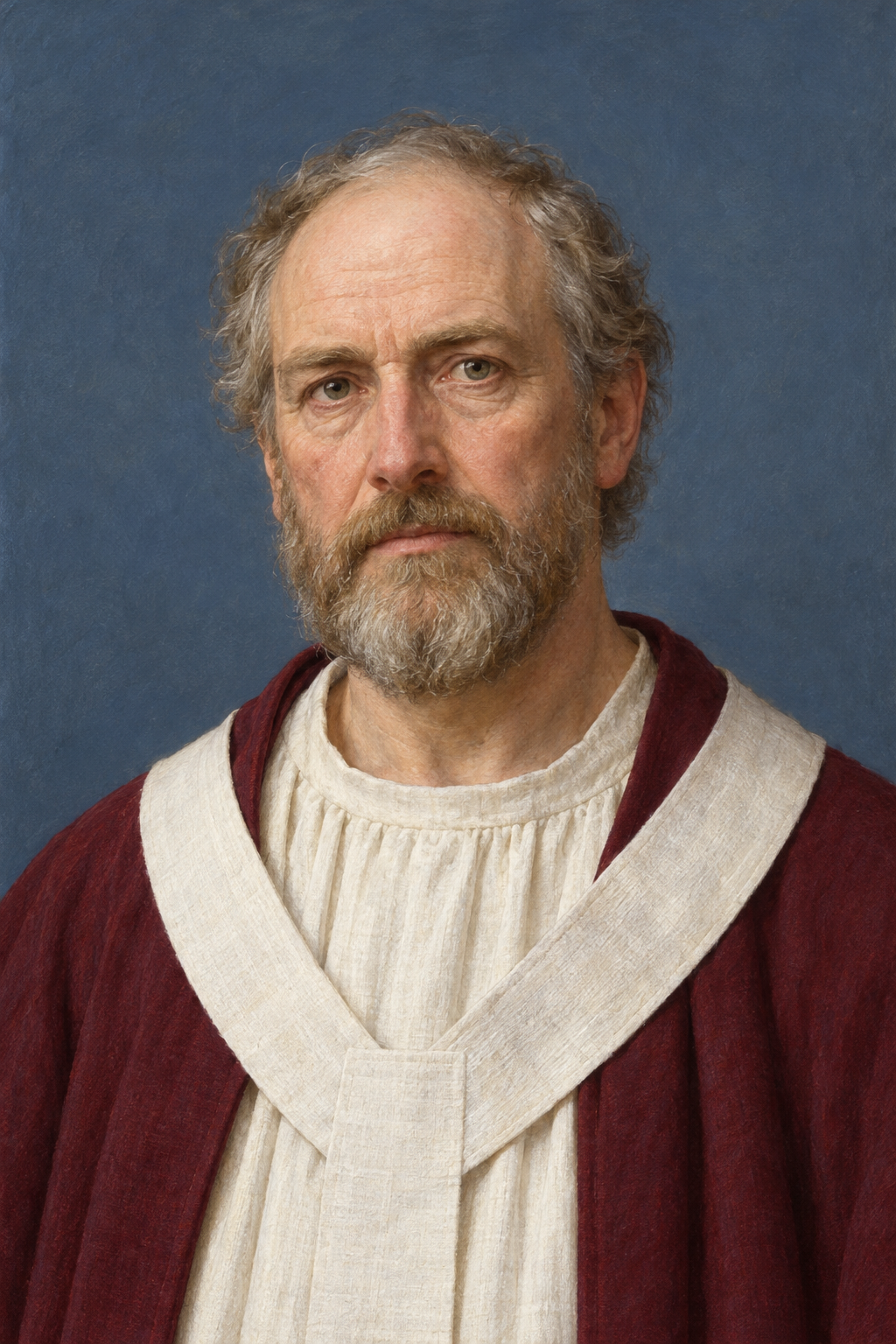
About Oswald of Worcester
Oswald served as bishop of Worcester from 961 and also as archbishop of York from 972. He came from a family of Danish ancestry and was brought up by his uncle Oda, archbishop of Canterbury. Holding both sees connected his work in northern England with a continuing commitment to Worcester.
Before becoming a bishop, Oswald had been a canon at Winchester and a Benedictine monk at Fleury in France. He supported Dunstan’s reforms with King Edgar’s backing. This program replaced secular canons with monastic communities and changed who controlled religious properties. Ramsey became his best-known foundation. He also encouraged learning by bringing scholars from Fleury to England.
The foundation at Ramsey grew from a smaller community at Westbury-on-Trym. In the early Life, as discussed by its editor Michael Lapidge, clerics approached Oswald seeking instruction in Benedictine discipline. He needed a permanent home for them. Æthelwine, ealdorman of East Anglia, offered the site at Ramsey, and Oswald sent Eadnoth to prepare buildings. The monks first occupied temporary accommodation; construction of a stone church followed. Oswald remained the monastery’s titular abbot until his death, while Eadnoth supervised the resident community.
His ties with France supplied teachers as well as a pattern of monastic observance. At the invitation of Oswald and Dunstan, Abbo of Fleury taught at Ramsey from 985 to 987. His learning included grammar, logic, arithmetic and astronomy, and he brought books needed for instruction. Byrhtferth, one of his pupils, became an important writer and later composed Oswald’s Life. The biography therefore emerged from a community whose intellectual life Oswald had helped support.
Ramsey’s library continued to develop after its founder’s lifetime. By the early eleventh century, Byrhtferth could draw on more than a hundred works. This does not mean that Oswald personally acquired each book, or that a complete early inventory survives. Lapidge emphasizes how little direct evidence remains for the library’s first acquisitions: no pre-Conquest inventory is known, and no manuscript can securely be identified as a library book copied at Ramsey. The scale of the collection must instead be reconstructed from the works its readers used.
The institution also depended on continued material support. Legacies, particularly from Æthelwine’s family, enlarged its endowment through the next century. By the Domesday survey of 1086, Ramsey ranked among England’s wealthiest abbeys, long after the deaths of its two founders.
The manner of reform at Worcester is less certain than older biographies sometimes suggest. An influential interpretation presented Oswald as a patient reformer who gradually won over the cathedral clergy without expulsions. Eric John challenged that reconstruction, questioning both the late narratives and the use of charter witness lists to fill their gaps. The contrast between a gentle Oswald and a forceful Æthelwold is consequently an interpretation to examine, rather than a secure account of each stage of institutional change.
A surviving charter offers a more concrete glimpse of his administration. In 969 he leased land at Teddington and Alstone to his kinsman Osulf for three lives. Its provisions included Osulf’s wife Eadleofu and members of her family, while preserving the church of Worcester’s eventual right to recover the property. The document records family interests within the management of ecclesiastical estates.
The Osulf grant belongs to an unusually substantial documentary record. Robert Gallagher and Francesca Tinti examine seventy-six surviving leases from Oswald’s episcopate, issued between 962 and 991. Their recipients included relatives, cathedral members and lay associates. Almost a quarter of the land, measured by recorded hidage, went to his kin. This placed family connections within the church’s economic administration, even where eventual reversion protected ecclesiastical ownership.
The leases also reveal the work of bilingual scribes. Some used Latin, some Old English, and many moved between both languages within the main text. The choice cannot simply be explained by supposing that lay recipients understood no Latin: different grants to the same person could use different combinations. These documents preserve an active written culture alongside the more familiar stories of monastic reform.
Oswald died at Worcester on February 29, 992. Tradition places his death while washing poor people’s feet, a service associated with his Lenten practice. He was buried in the church of Saint Mary. The cathedral library’s account reports that his bones and Wulfstan’s were reburied near the high altar when their shrines were dismantled during the Dissolution.
Worcester remembered him as a protector of its religious community and town. Medieval stories describe his shrine being carried through the streets during fire and plague, with deliverance attributed to his intercession. These narratives express the community’s trust in its patron; they do not independently establish miraculous causes.
After the cathedral suffered fire in 1202, its dedication included Oswald and Wulfstan alongside Mary and Peter. A German Catholic calendar also records him as a patron of livestock.
Worcester Cathedral commemorates him on February 28.
Wondering how to weigh the stories and sources? Learn how to read a saint biography.