Biography
Pacian
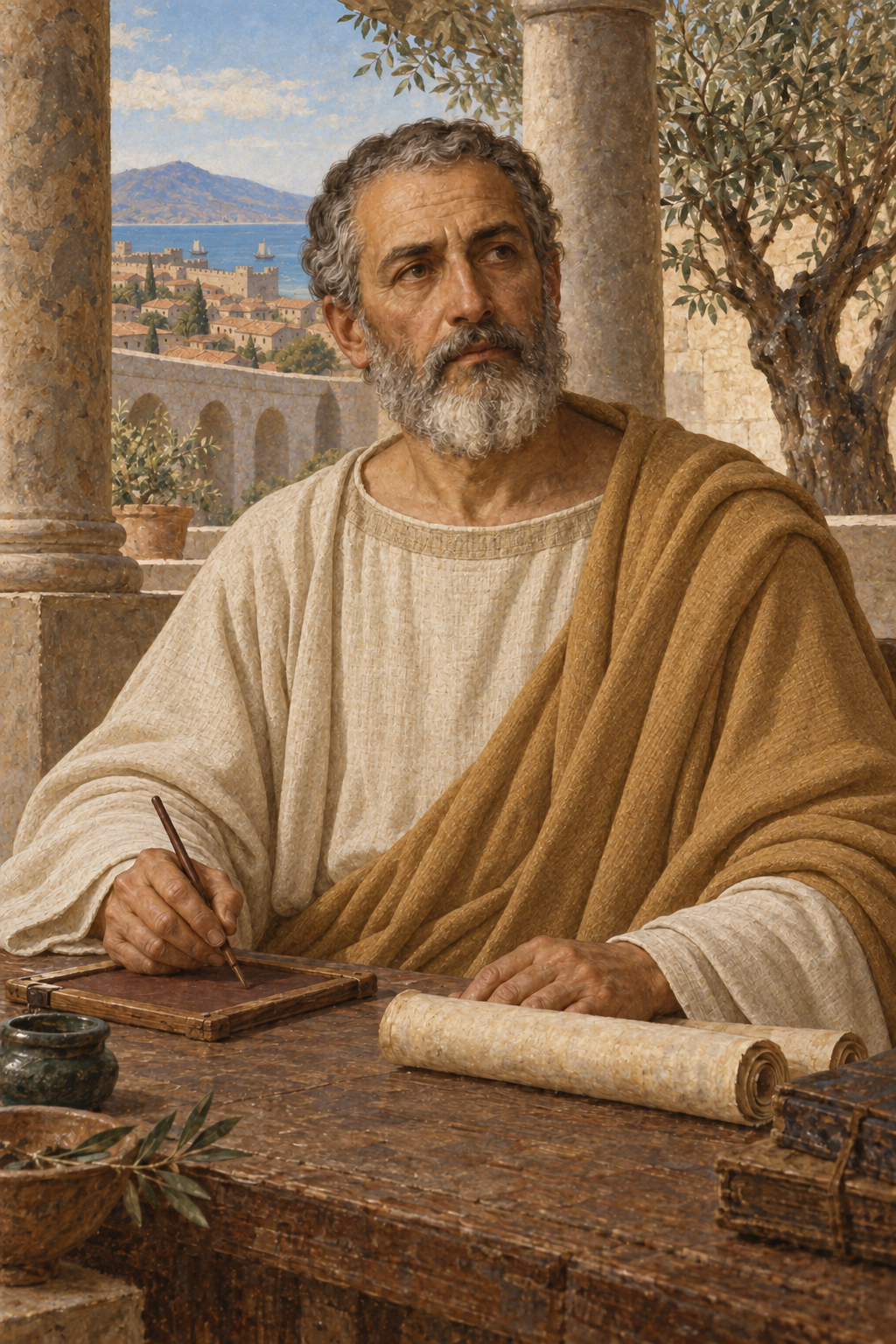
About Pacian
Pacian served as bishop of Barcelona in the later fourth century, when the Roman city was known as Barcino. The most important ancient notice about him is short: Jerome calls him a bishop there, praises his manner of life and expression, names works against the Novatianists, and says he died in old age during the reign of Theodosius. That notice does not give a birth date, an exact death date, or the year he became bishop. Modern references propose differing ranges, and the Catalan encyclopedia marks even Barcelona as a possible rather than certain birthplace. His see is clear; the details of his childhood are not. The writings he left tell us more about his concerns than later chronological guesses do.Pacian's education was shaped by both classical literature and Christian authors. The Catalan encyclopedia finds allusions to writers such as Virgil in his surviving prose, alongside Scripture and earlier Latin Christian teachers. It also identifies Dexter as his son and says Pacian had been married. The surviving evidence does not permit a detailed account of his household or a precise sequence by which he entered ministry. What can be said is that he wrote as someone practiced in argument and public instruction. His work moved from the ordinary tasks of teaching new Christians to one of the most painful pastoral questions of his time: what should happen after a baptized person had committed a grave sin?Three surviving letters address Sympronian, a critic associated with the Novatianist position. Those Christians maintained a stricter boundary around reconciliation after serious post-baptismal wrongdoing. In the first letter, Pacian asks Sympronian to state his position more plainly before they argue over it. He also defends the name Catholic as a way of describing the church's unity amid competing Christian groups. His famous formulation linking the names Christian and Catholic belongs to this dispute, not to a detached slogan. The letter's tone can be sharp, but it is also an attempt to bring a named correspondent back into a shared community. Pacian's own words are the principal evidence for the exchange; Sympronian's side survives only through them.Pacian did not present repentance as permission to sin casually. The first letter says the remedy is for someone already wounded, not an inducement for those who have not fallen. It uses Scripture to argue that God calls sinners to turn back. Pacian then defends the bishop's role in receiving penitents, while warning that forgiveness should follow careful discernment, the person's genuine sorrow, and the prayer of the wider church. He explicitly leaves final judgment with Christ. This combination matters: his response to rigorism offered a path home but did not promise automatic restoration. The language belongs to a particular fourth-century debate, and its procedures should not be read as a complete description of every Christian community's practice.The disagreement continued into a second and third letter. Pacian's second reply responds to Sympronian's criticism of his tone and of the church's name. In the third, he argues directly that repentance after baptism is possible. He rejects the objection that offering a remedy will encourage repeated sin: a physician who treats an injury, he reasons, does not encourage the injury. He asks what becomes of a person in despair if every path of return is shut. Those are arguments from Pacian's own side of a contested conversation, and his polemical labels for opponents should not be mistaken for neutral descriptions. They show a bishop trying to make the mercy he preached credible without denying the gravity of wrongdoing.Pacian also wrote an exhortation to penitents, a work the Catalan encyclopedia calls the Paraenesis. Its purpose was to urge people who had sinned to acknowledge the wrong and pursue a changed life. His concern appears again in a different setting in the sermon On Baptism, addressed to believers and candidates preparing for baptism. There he explains baptism as a new birth and renewal in Christ. The text speaks directly to hearers rather than presenting an abstract outline of doctrine. Together these works show both sides of his pastoral teaching: entry into Christian life and the difficult restoration of those who had failed to live by it. They are among the securely identified writings preserved under his name.Jerome also names a work called Cervus, or Cervulus in other references. It has not survived. The Catalan encyclopedia connects it with Pacian's criticism of New Year festivities that he regarded as unsuitable for his Christian community. Because the work itself is lost, we cannot reconstruct its arguments or repeat later claims about its details as though Pacian's text were available. Nor should every writing later assigned to him be accepted without scrutiny: the encyclopedia notes that modern criticism rejects some attributions. The preserved letters and sermons therefore deserve more weight than uncertain titles when describing his thought. They provide the strongest view of his voice and the work of a bishop teaching amid disagreement.Pacian died in old age under Theodosius, according to Jerome. That is a historical limit, not an exact year. The Catalan encyclopedia also places his life broadly around the later fourth century and records his feast on March 9. The day of remembrance does not establish the day he died, just as the debated year of his accession should not be converted into a precise date in the catalog. His enduring importance lies in writings that remain readable: a bishop explaining baptism to new believers, asking an opponent to consider the church's unity, and insisting that a fallen Christian could seek reconciliation through serious repentance. Those texts preserve a pastoral argument, while the missing biographical details remain honestly unknown.
Wondering how to weigh the stories and sources? Learn how to read a saint biography.