Biography
Pantaleon
About Pantaleon
Pantaleon, usually called Panteleimon in Eastern Christianity, is remembered as a physician and martyr of Nicomedia. Unlike many saints surrounded by elaborate passions, he has an identifiable ancient core. John Malalas, writing in the mid-sixth century, names Pantoleon among martyrs killed at Nicomedia under Maximian Galerius. An early Jerusalem lectionary also records his commemoration. These witnesses do not come from his lifetime, but they establish that his cult and association with Nicomedia were already present in late antiquity. They do not document his parents, education, patients, conversion, spoken words, exact torments, or precise death date.
Nicomedia was an imperial center in Bithynia and a major setting of persecution during the early fourth century. Malalas places Pantaleon's martyrdom under Galerius, whose rule provides a broad historical frame rather than a day-by-day chronology. The traditional year 305 appears in modern calendars, but no source close to the event establishes January 1 or another exact civil date. The catalog removes its former January 1 placeholder and keeps the death year unset. It retains Nicomedia at settlement precision without coordinates, since the city association is strong while no house, clinic, prison, arena, shoreline, tree, or grave can be securely located from the surviving evidence.
Later tradition gives him the birth name Pantoleon and the baptismal name Panteleimon. It interprets the first as ‘lion in everything’ and the second as ‘all-merciful.’ The names shaped his reception as both steadfast martyr and compassionate healer, but etymology is not biography. The Orthodox Church in America's life calls his father Eustorgius, a pagan, and his mother Euboula, a Christian who died while he was young. It says his father sent him to school and then to study medicine under Euphrosynus. None of these family and educational details is independently confirmed by the ancient cult evidence.
The passion says the emperor noticed the gifted student and considered making him a court physician. Meanwhile, the priest Hermolaus lived in hiding with Hermippus and Hermocrates after violence against Christians in Nicomedia. Hermolaus met Pantoleon and taught him Christianity. A miracle then becomes the turning point: Pantoleon finds a child dead beside a snake, prays that the child live, and sees the prayer answered. He receives baptism and the name Panteleimon. This episode joins healing, conversion, and victory over death in a compact sacred narrative. It is not clinical testimony or a documented conversion record.
Another received episode says Panteleimon restores a blind man's sight by invoking Christ. His father and the healed man then accept baptism. After his father's death, Panteleimon treats sick and poor people without charge and visits wounded Christians in prison. Eastern devotion therefore counts him among the holy unmercenary physicians. The moral action is specific: medical skill is directed toward people who cannot repay it. Historically, physician is an old and stable part of Pantaleon's reception, also preserved by the Roman Martyrology and Vatican News. The individual cures, family conversion, and complete refusal of payment remain traditional or legendary rather than documented case histories.
The passion attributes his arrest to other physicians who resent losing patients. Brought before Maximian, Panteleimon confesses Christianity and proposes a test involving a paralyzed man. Pagan priests fail to heal him; Panteleimon prays, and the man rises. The emperor orders the healed man killed and turns Panteleimon over to torture. The scene condemns professional jealousy, coercive religion, and power that answers healing with violence. It also follows a familiar hagiographic contest pattern. There is no independent court transcript, patient record, or imperial document confirming the accusation, demonstration, dialogue, or execution of the healed man.
Accounts enumerate scraping with hooks, burning, stretching, immersion in boiling liquid, being cast into water with a stone, and exposure to wild animals. They repeatedly say divine help prevents injury. The violence must not be hidden behind a vague statement that Pantaleon suffered, but neither should miraculous invulnerability be treated as forensic history. These scenes intensify the tradition's claim that imperial force could not obtain apostasy. Hermolaus, Hermippus, and Hermocrates are brought into the same narrative and beheaded after confessing Christianity. Their relationship to Pantaleon is received tradition; Malalas names the group in close connection but does not supply the passion's full sequence.
The final scene takes Panteleimon to an olive tree for beheading. A soldier's sword becomes soft, a heavenly voice calls the martyr by his new name, and the soldiers hesitate. After Panteleimon urges them to carry out the sentence, the tree bears fruit, blood and milk are reported at the wound, and fire does not consume his body. These are transparent miracle traditions, not observations that can be independently tested. Execution by the sword is consistent across old Western commemoration and the passion, while the ancient Malalas notice supports martyrdom under Galerius. The extraordinary details explain iconography and devotion but cannot establish an execution site or biological event.
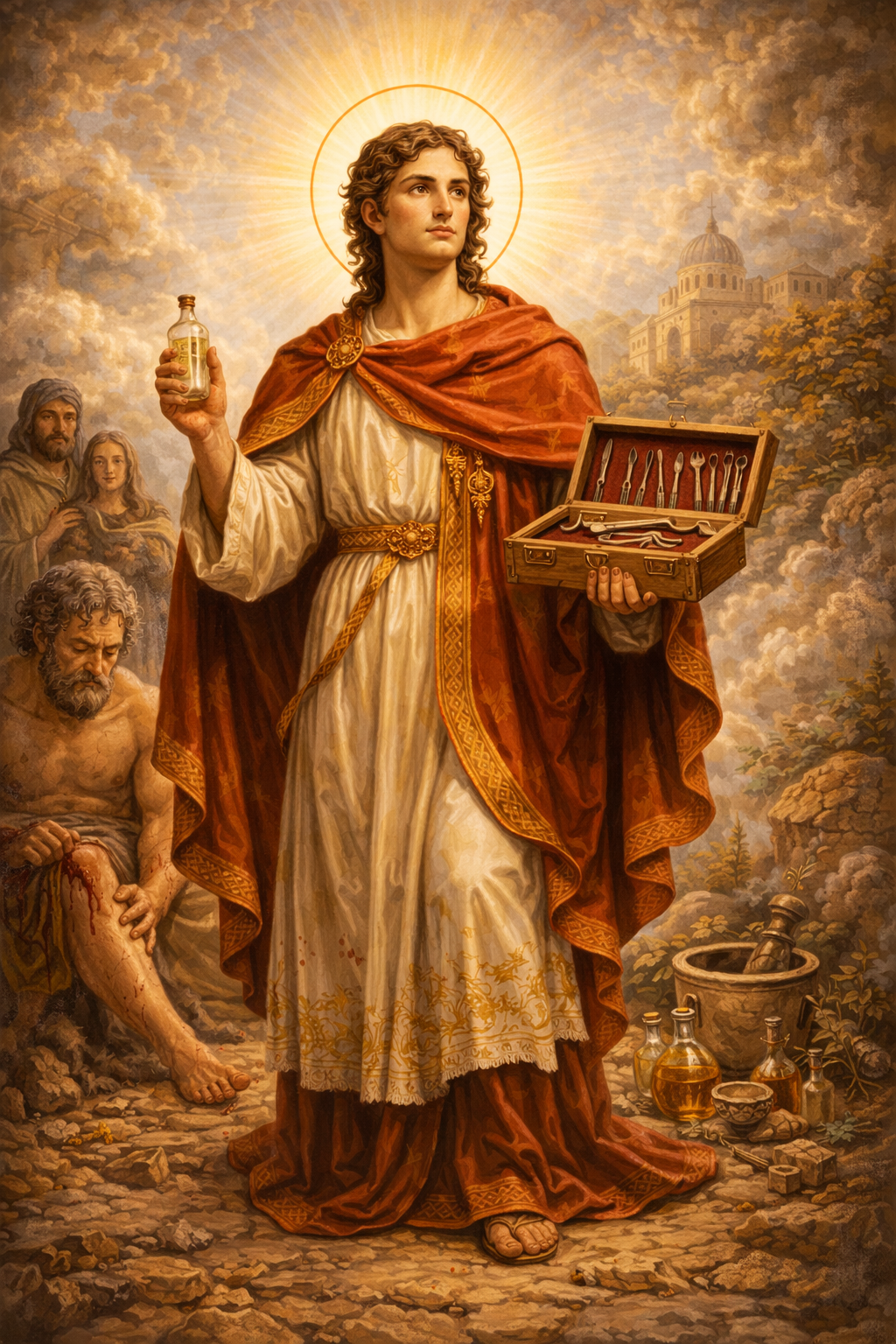
Pantaleon's cult spread widely in Eastern and Western Christianity. Churches and monasteries bear his name, relic traditions developed in many places, and his image commonly includes a medicine chest or spoon. In Eastern practice he is invoked in services connected with sickness and anointing. These facts describe reception, not proof that surviving relics can be forensically authenticated or that a particular object belonged to him. The page's artwork follows this devotional iconography. It is AI-generated and offers no evidence for Pantaleon's face, clothing, medical instruments, or the physical setting of Nicomedia.
The Orthodox Church in America and Vatican News both commemorate Panteleimon or Pantaleon on July 27. Vatican News identifies him concisely as physician and martyr; the Roman Martyrology places his martyrdom at Nicomedia and remembers death by the sword. A calendar date documents continuing observance, not an independently verified death anniversary. No historically certain first-person speech survives. The quotation ‘I am a Christian’ is included only as the confession assigned to him in the later passion. Its confidence and attribution prevent a literary line from being mistaken for testimony recorded at his trial.
Pantaleon remains significant where the evidence is strongest and where tradition is most transparent. Late-antique witnesses preserve a martyr of Nicomedia under Galerius; longstanding calendars remember him as a physician. Later Christians shaped that core into stories of learning, conversion, free care, solidarity with prisoners, public confession, torture, miracle, and execution. Those stories make mercy practical rather than abstract, while their legendary character must be stated. An honest account can honor a durable healing tradition, acknowledge imperial violence, and refuse invented precision. Pantaleon's enduring image is thus a healer whose skill serves vulnerable people and a martyr whose ancient remembrance outlasted the empire that condemned him.
Wondering how to weigh the stories and sources? Learn how to read a saint biography.