Biography
Paschasius Radbertus
About Paschasius Radbertus
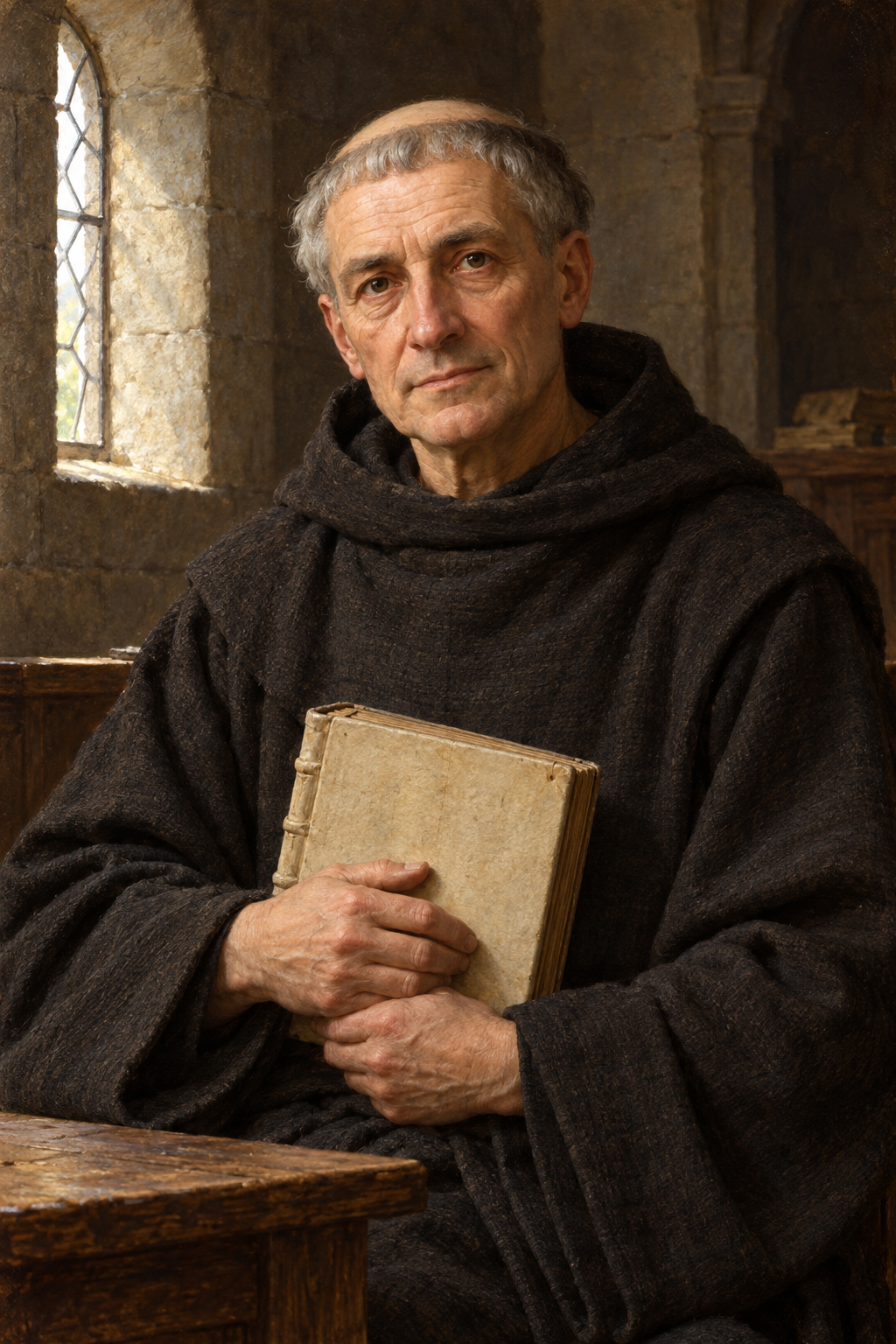
Paschasius Radbertus was a Benedictine monk, abbot of Corbie and an influential writer in the ninth-century Frankish world. His work grew out of teaching, biblical study and disputes about Christian belief. Although he led a monastery, he remained a deacon. His writings include accounts of earlier abbots, theological treatises, letters and poetry, as well as extensive explanations of Scripture. The dates assigned to his birth and death vary, and neither can be fixed with confidence.
His early years were connected with the women’s community of Notre Dame at Soissons. Mayke de Jong cautions that his parentage is unknown and treats his childhood there as probable rather than fully documented. After a period outside religious life, he entered Corbie. His loyalty to its abbots Adalhard and Wala drew him into the political struggles surrounding Louis the Pious. He later defended Wala’s memory in a literary account that also reflected his own commitments.
Radbert became abbot in 843 but had resigned by 851. The reasons remain uncertain: age, health and tensions with royal power have all been considered. De Jong notes that he maintained friendly relations with his successor, Odo, which complicates a simple story of expulsion by hostile monks. At Saint-Riquier he continued writing, completing his lengthy commentary on Matthew. Evidence from a late dedication places his death somewhere between 853 and 860 in her reconstruction, rather than establishing an exact year.
His best-known treatise concerns Christ’s body and blood in the Eucharist. Pohle dates its first version to 831, written for Warin and the monks of Corvey, and its revision for Charles the Bald to 844. The work prompted debate involving Ratramnus of Corbie and Rabanus Maurus. It sought to explain what Christians receive in communion, drawing on earlier church writers and distinguishing what the senses perceive from what faith understands.
His interests extended beyond this controversy. He wrote on faith, hope and charity, interpreted Lamentations, and revised an account of the martyrs Rufinus and Valerius for readers of sacred history.
Radbert emphasized the identity of the Eucharistic body with the body born of Mary, crucified and risen. Critics regarded his presentation as excessively material. In a letter to Frudegard, he defended his account as consistent with the Church Fathers. His later influence was complicated by the circulation of passages under Augustine’s name, giving his words an authority their readers might not have realized belonged to a much later author.
Modern interpretation has also changed the terms of the debate. Owen Phelan argues that Radbert and Ratramnus need not be read as simply contradicting one another. Radbert’s central concern was the sacrament’s power to unite a community, while Ratramnus gave greater emphasis to salvation. This reading places their differing interests within their own religious and social setting. It cautions against treating their works merely as early statements of positions defined in much later controversies.
The nuns of Soissons remained important to Radbert’s writing. Hannah Matis describes his continuing affection and respect for the abbesses Theodrada and Imma, and for the community’s learning. He addressed three substantial works to them: a sermon on Mary’s Assumption, a treatise on her virginity and a commentary on Psalm 44, numbered 45 in many modern Bibles. These were responses to women’s requests and concerns, not simply instruction delivered to a passive audience.
Matis reads these works against efforts to impose stricter enclosure on religious communities. Radbert emphasized the nuns’ contribution through prayer, liturgy and sound doctrine, while encouraging younger members to remain within religious life. His Assumption sermon adopted the voice of Jerome addressing Paula and Eustochium. The literary model helped shape a conversation with women he knew, but it also helped obscure the work’s authorship for later readers.
The Psalm commentary also carried a personal remembrance. Radbert opened it by recalling Theodrada to her successor Imma and apologizing for taking so long to finish what she had requested. Matis therefore places it after Theodrada’s death in 846.
His biblical interpretation also carried serious limitations. Lukas Dorfbauer discusses a passage in the Matthew commentary in which Radbert portrayed Muslims as followers of deceptive teachers who had distorted biblical teaching. Dorfbauer warns that such language does not show a realistic understanding of Islam. The passage belongs to the history of Christian polemic, rather than providing a reliable description of Muslim belief. A balanced account of Radbert’s learning must acknowledge this boundary to his knowledge.
His memory was preserved at Corbie. Pohle records his original burial in the church of Saint John and the transfer of his remains to Saint Peter’s on July 12, 1073, following reports of miracles and a papal order. These are records of later veneration, distinct from a securely dated account of his death. His commemoration falls on April 26. His surviving writings remain central to understanding the theological work of the Carolingian monasteries.
Wondering how to weigh the stories and sources? Learn how to read a saint biography.