Biography
Paul Miki
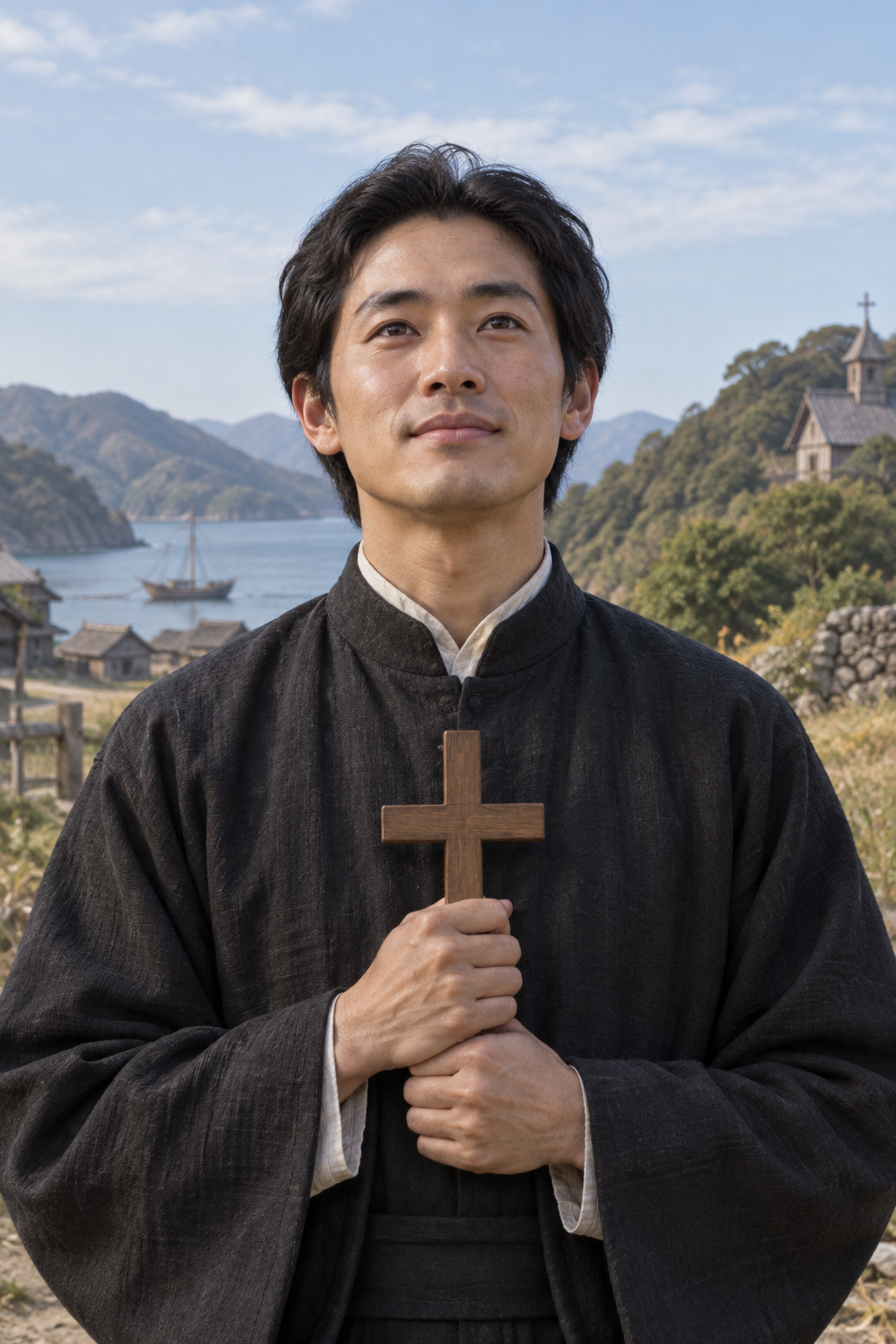
About Paul Miki
Paul Miki made speaking about his faith the work of his life, and continued that work when it became dangerous. A Japanese Jesuit and catechist, he is remembered for bringing religious conviction into the language and culture of his own people. For Miki, that connection eventually meant speaking openly about Christ on the journey toward execution, rather than abandoning the preaching to which he had devoted himself.
He came from a prosperous family near Osaka and was born around 1564. His family became Christian while he was young. He studied at the Jesuit seminary in Azuchi and later entered the Society of Jesus. The Society's biography remembers him as an effective speaker who attracted Buddhist listeners to Christianity. He was still preparing for ordination when he was arrested, not an ordained priest.
His preparation included serious study of Buddhist teaching, so that he could debate with Buddhist priests. Bert Ghezzi's account places his baptism at about five years old and his entry into the Jesuit novitiate at twenty-two. This was therefore a vocation developed through education and years of preparation, not a role he first assumed in prison. Learning the beliefs of the people he addressed formed part of his training as a preacher.
Japan's ruler, Toyotomi Hideyoshi, had ordered foreign missionaries to leave in 1587, but enforcement was uneven. Jesuits continued their work under the threat of persecution. Miki's preaching therefore developed in a setting where religious activity could continue without any lasting assurance of safety.
Miki lived amid tensions that involved foreign trade and political power as well as religious belief. In 1593, Peter Baptist and other Franciscans had arrived as ambassadors from the governor of the Philippines. They established convents, schools and hospitals in Japan. The Catholic Encyclopedia connects the subsequent arrests with the stranding of the Spanish vessel San Felipe in 1596 and its captain's claims about missionaries preparing the way for conquest. In that account, suspicions about foreign ambitions helped turn the authorities against people whose work had previously been tolerated. Miki was caught in the resulting action against Christians, alongside members of another religious order and Japanese lay believers. The condemned group included six Franciscan friars, three Japanese Jesuits and seventeen Japanese Franciscan tertiaries. The group brought together ordained ministers, religious who were not priests, and laypeople.
The prisoners were publicly humiliated in Kyoto. Their left ears were mutilated and they were paraded before the crowd. Ghezzi describes Miki wearing a plain black cassock, in striking contrast to the privileged life his family background might have offered. The display intended to disgrace the prisoners also stirred compassion among spectators. They were then taken to Nagasaki, where crosses and executioners awaited them.
The journey took about a month. Along the way Miki continued preaching despite insults. Before the execution, he renewed his religious vows.
A contemporary account preserved in the Office of Readings describes his final preaching. Raised on the cross, he identified himself as Japanese and a Jesuit, and explained that he was dying for the Gospel he had taught. The account presents his faith not as a reason to hate his persecutors but as the reason to forgive them. He pardoned those responsible for his death and urged them toward Christian baptism. He then turned to encourage his companions. These remembered words belong to an account of the execution, rather than a surviving manuscript written by Miki himself.
Miki and his companions died on 5 February 1597 at Nagasaki. Centuries later, Pope Francis recalled that date while praying at their monument on Nishizaka Hill. The place remained a gathering point for the memory of their deaths.
Their fellow Christians began seeking formal recognition long before the eventual canonization. The Japanese bishops' historical statement records a petition to Rome from twelve representatives of Japanese believers in 1604. Pius IX canonized the twenty-six martyrs on 8 June 1862. A church dedicated to them at Oura later became the meeting place where Christians from Urakami disclosed their continuing faith to a missionary in 1865. The martyrs' memory thus belonged both to local believers and to the wider Church. The bishops also note how the campaign for recognition was interrupted when prohibitions on missionaries cut off information from Japan. Their statement recalls that believers who welcomed renewed missionary contact were themselves exposed to further persecution. Remembering Miki therefore includes remembering communities that continued to bear the consequences of publicly professing Christianity.
When Francis visited in 2019, he connected that memory with quiet service to people in need and with Christians suffering persecution in the present. He asked his listeners to defend religious freedom for everyone. His tribute placed the martyrs' courage alongside a responsibility to protect life, rather than treating their deaths only as a distant heroic episode.
The Jesuit liturgical calendar commemorates Miki with his companions on 6 February.
Wondering how to weigh the stories and sources? Learn how to read a saint biography.
Explore similar vocations
Prayers for Paul Miki
Paul Miki: sourced prayer excerpt
Lord, have pity on the multitude of peoples on whom the light of your Gospel has yet to dawn.