Biography
Paula Montal Fornés
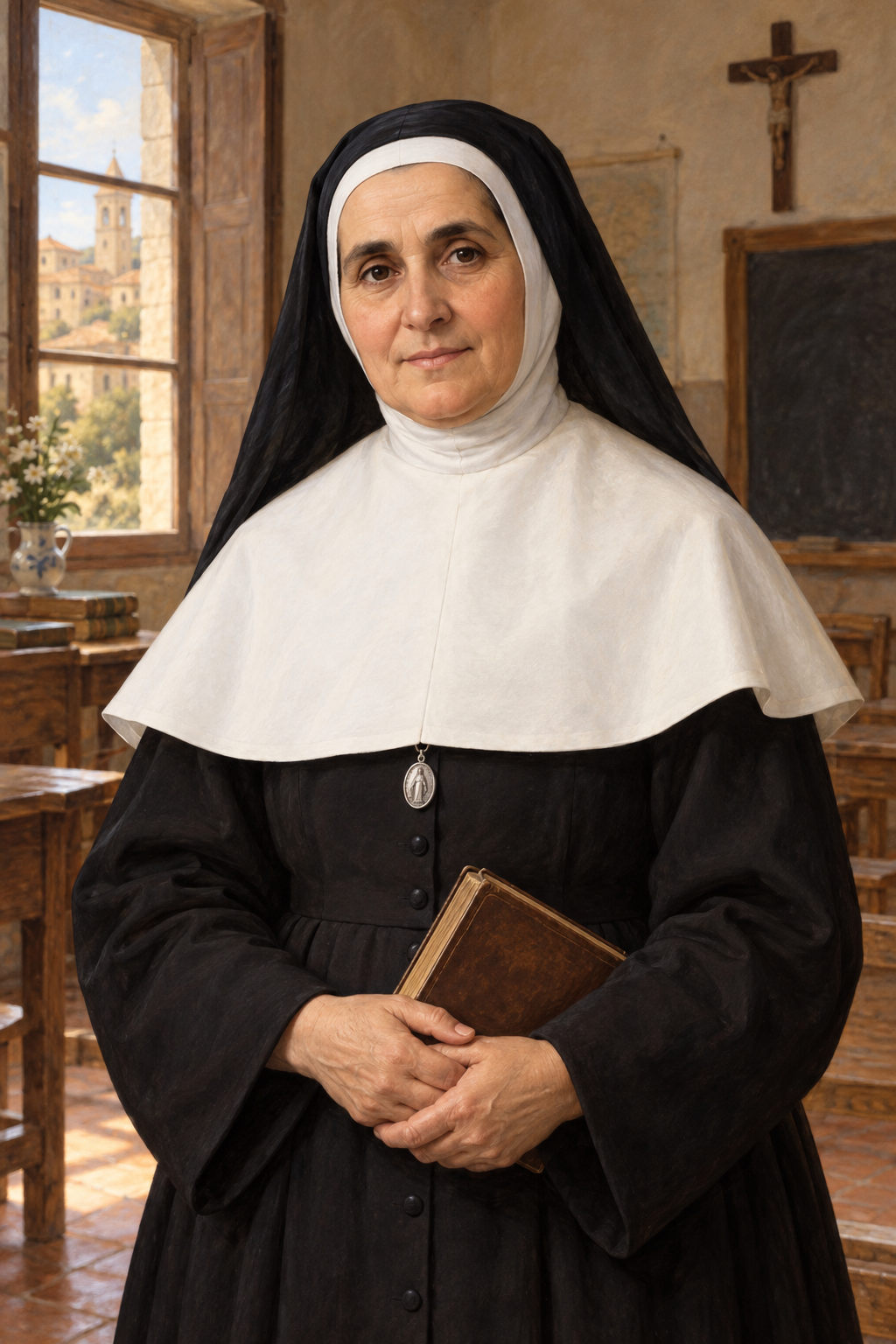
About Paula Montal Fornés
Paula Montal Fornés devoted her life to opening education to girls with limited opportunities. Born in Arenys de Mar on October 11, 1799, she grew up in a modest household and began helping support her widowed mother at ten. Her educational work took shape in Figueras, where she opened a girls’ school with Inés Busquets in 1829. Its program went beyond the education ordinarily expected for girls. Teaching became her congregation’s defining work.
Her congregation remembers an unpromising material beginning: the two women arrived with modest luggage and forty reales. Paula had already worked with children as a parish catechist. The first school occupied a small house, and the teachers’ sustained attention to pupils helped it grow. She later opened schools in Arenys de Mar and Sabadell. This expansion depended on women prepared to make teaching their continuing responsibility, rather than on a single founder visiting different towns.
At Sabadell, Paula and three companions made their religious profession on February 2, 1847. They became Daughters of Mary, Sisters of the Pious Schools, drawing on Joseph of Calasanz’s spirituality. Yet the chapter held the following month elected her neither superior general nor assistant. Foundership did not give her the highest office. She continued contributing through schools and the formation of sisters, spending her last thirty years at Olesa de Montserrat, where she died on February 26, 1889.
The community’s rules developed through consultation and revision. María Luisa Labarta’s historical account, reproduced in a study of the constitutions, describes an initial extract sent by Jacinto Feliu in 1847 and a fuller compendium the following year. Paula asked Felicia Clavell to join her in examining the proposed rules with the Piarist fathers. The fathers prepared these early texts, but Paula decided to adopt them. Her commitment to the Calasanz tradition involved deliberation, rather than simply receiving a finished institution.
The constitutions printed in 1853 required further adaptation. A rule written for a male order of priests and brothers could not be transferred unchanged to a congregation of women taking simple vows. Paula and Felicia worked on the adaptations; Agustín Casanovas apparently drafted the text. Different bishops reviewed it before publication. Papal approval of the constitutions came provisionally in 1870 and definitively under Leo XIII in 1887, near the end of Paula’s life. The revisions addressed government as well as spiritual practice. They acknowledged the different legal character of the women’s congregation and the changed historical setting, while preserving the educational purpose that had drawn Paula to the Piarist tradition in the first place.
Her educational ideal brought religious formation and learning together. The Olesa school’s account describes careful preparation by teachers, kindly treatment of pupils, cooperation with families and preventive discipline. A fourth vow committed the sisters to teaching. Their purpose was explicitly Christian: education would help girls participate in family and social life through both knowledge and faith. Paula’s later work as novice mistress also made the preparation of future teachers part of her service. The congregation’s account dates that responsibility to 1852.
The personal record has limits. In his preface to María Dolores Pérez Marín’s biography, historian Fernando López Mora observes that Paula was not inclined to leave intimate confidences or the diaries that often illuminate a person’s inner life. Her educational work is more accessible than a continuous account of her private thoughts. This makes the surviving institutional record especially important: it traces responsibilities, decisions and lasting commitments without supplying every conversation or motive. López Mora also places her achievement within the history of women’s religious communities, whose contributions were often treated as secondary in accounts centered on men. He interprets their educational initiatives as a significant form of women’s social participation. His interpretation also draws attention to the difficult relationship between Catholic education and the state. Paula’s project belonged to that changing landscape, offering a religious contribution to schooling during a period of institutional change. Its place in educational history cannot be understood solely through the boundaries of convent life. This perspective restores women’s work to the broader historical account.
John Paul II canonized Paula on November 25, 2001. His homily emphasized the connection between her concern for women, her understanding of family life and the long, quieter period at Olesa. He presented her educational mission as continuing to matter beyond the circumstances of nineteenth-century Spain. Her Catholic remembrance therefore encompasses both the founding of schools and the less visible perseverance of her later years.
That remembrance remains concrete in schools bearing her name. The Piarist Sisters school in Rzeszów honors Paula as its patron, connecting its celebration with gratitude for teachers and encouragement of pupils. Colegio Paula Montal in San Clemente, Chile, likewise calls her its patron and commemorates her on February 26.
Catholic writer Dolors Massot also identifies Paula as a patron of lacemakers, including those working with bobbins. This devotional association recalls the working world from which she came.
Wondering how to weigh the stories and sources? Learn how to read a saint biography.