Biography
Pauline of the Agonizing Heart of Jesus
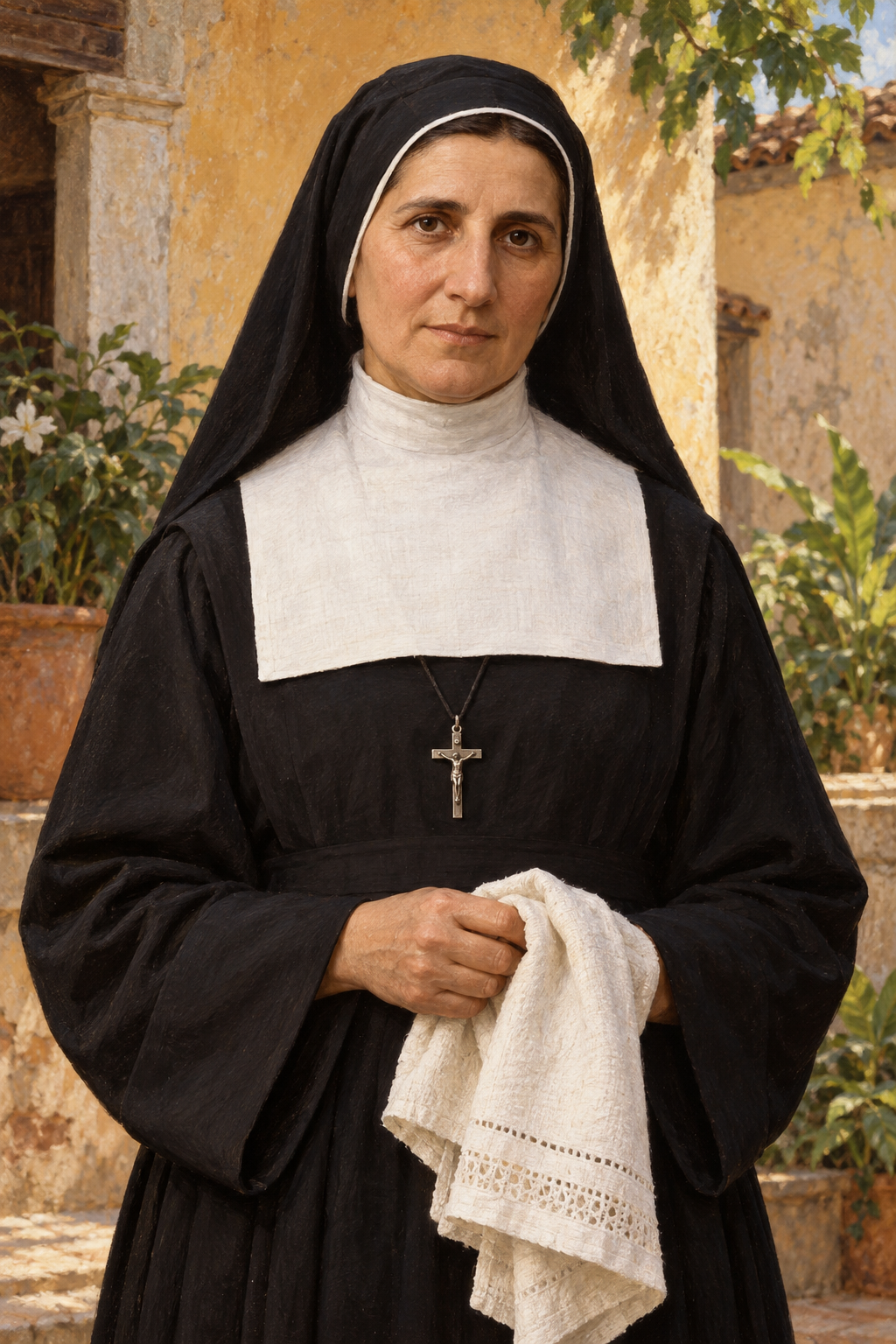
About Pauline of the Agonizing Heart of Jesus
Pauline of the Agonizing Heart of Jesus was born Amabile Lucia Visintainer in Vigolo Vattaro on December 16, 1865. Her birthplace was then under Austrian rule. Poverty shaped her childhood: Andreas Resch records that she sorted silkworm cocoons in a silk workshop before her family emigrated to Brazil in 1875. The migration placed her among other families from the Trentino who established communities in Santa Catarina. Practical work and the demands of family life preceded the religious community for which she became known.
On July 12, 1890, Amabile and Virginia Rosa Nicolodi began caring for a woman with cancer. Their undertaking became the beginning of the Little Sisters of the Immaculate Conception. Episcopal approval followed in 1895, and Amabile professed religious vows that December with Virginia and Teresa Anna Maule. She received the name Pauline of the Agonizing Heart of Jesus. The sisters’ work joined care for vulnerable people with prayer and teaching.
A later account by Sister Célia Cadorin recalls the parish tasks entrusted to Amabile and Virginia: teaching catechism, visiting sick people and caring for the chapel. Cadorin draws on testimony from Pauline’s beatification process to describe her insistence that the sisters prepare themselves for religious instruction. Their teaching was to reach outlying neighborhoods and chapels, including on Sundays. Catechesis was therefore part of a wider pattern of presence among children, parents, sick people and elderly people, rather than an activity separated from everyday care.
The congregation’s move to São Paulo in 1903 brought different, increasingly demanding responsibilities. Its institutional history describes Pauline traveling with two sisters and a postulant, first by cart to Itajaí, then by ship to Santos and by train to São Paulo. They initially stayed with the Good Shepherd Sisters. In December they moved to a house behind the Sagrada Família chapel in Ipiranga. Their mission included welcoming elderly people who had been enslaved and orphaned children of formerly enslaved families. The Sagrada Família institution initially received orphaned girls. The charitable institution continued beyond its original form: the congregation’s 2023 account describes its later educational work with children and adolescents facing social vulnerability, alongside its continuing place within the congregation’s network of social assistance.
The new work also depended on benefactors. Historian Isabella Tritone Medeiros, drawing on the canonization dossier, examines a dispute over the authority of donor Anna Brotero de Barros after she became honorary president of the Sagrada Família institution. Pauline complained to Archbishop Duarte Leopoldo e Silva about interference in the sisters’ administration. The archbishop did not support her. In 1909, the congregation’s rules were changed to replace life tenure for the superior with shorter terms, and Pauline lost her position.
Medeiros places this conflict within the Church’s dependence on wealthy patrons and the limits imposed on women’s authority. She cautions against reading the episode only as a devotional lesson in obedience. This is a modern scholarly interpretation of the institutional circumstances; it does not establish every participant’s private motive. The conflict nevertheless belongs to Pauline’s history alongside the charitable work, because it changed her responsibilities and her place within the congregation she had helped establish. Her replacement was another woman, but the archbishop controlled the decision. The episode thus involved both disagreement between women and the decisive power of the male ecclesiastical hierarchy.
Pauline was sent to Bragança Paulista, where she cared for sick and elderly people. In 1918, her successor called her back to the motherhouse in Ipiranga with the archbishop’s consent. She prayed and assisted sick sisters. Recognition as foundress did not erase the earlier dismissal: the Holy See’s biography presents her later years as service without renewed leadership. The congregation received a decree of praise in 1933 and celebrated its fiftieth anniversary in 1940.
Her own health deteriorated. From 1938, complications associated with diabetes led to the amputation of a finger and then her right arm; she also lost her sight. Resch records her final exhortation to the sisters as a call to humility, trust and particular charity toward sick and elderly people. She died in São Paulo on July 9, 1942. Those final years placed the founder who had cared for others in need of care herself.
She was canonized on May 19, 2002, and her liturgical memorial is July 9.
Her patronages preserve specific connections with migration and service. Her shrine identifies her as patron of Italian immigration in Nova Trento. In São Paulo, the vicariate responsible for pastoral care of health and sick people honors her as its patron.
The parish in Heliópolis chose Pauline because of her care for poor people and her long association with Ipiranga. Founded in 2003, it connects her remembrance with local pastoral and social work.
Santa Paulina parish in Embu das Artes also celebrates her as its patron. Its community observance includes prayer, procession and a shared meal, keeping her remembrance within the ordinary life of a parish.
Wondering how to weigh the stories and sources? Learn how to read a saint biography.