Biography
Peter of Atroa
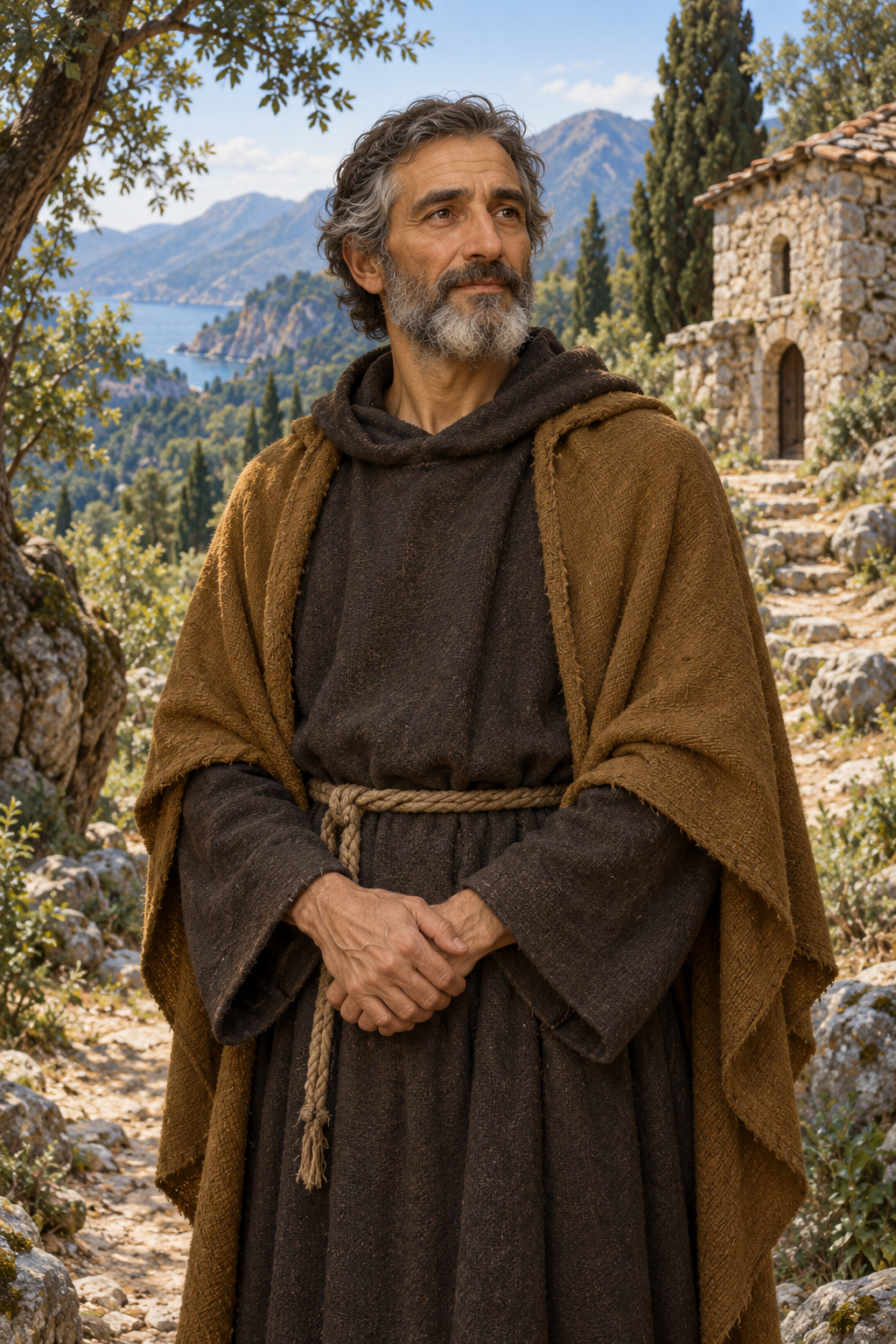
About Peter of Atroa
Peter of Atroa led a network of monasteries in northwestern Asia Minor during the Byzantine disputes over religious images. He sought periods of solitude but continued moving among communities that depended on him. Resistance to imperial restrictions on icons brought persecution and the temporary scattering of his monks.
Born at Elaia, south of Pergamon, around 773, he was baptized Theophylaktos. His Life names his parents as Kosmas and Anna and describes his mother presenting him to the bishop while he was still a boy. He later followed the monk Iakobos toward Mount Olympos and became a disciple of the hermit Paulos in Phrygia. Paulos gave him the monastic name Peter. These early episodes come through a devotional biography that also reports visions guiding his choices.
Peter was ordained a priest after Patriarch Tarasios referred him to a bishop. He and Paulos began a pilgrimage toward Jerusalem but returned to establish a monastery dedicated to Saint Zacharias near Atroa. Peter succeeded his teacher as abbot in 805 or 806.
When imperial opposition to icons resumed in 815, Peter sent the monks away in groups of two or three. He traveled with a companion through Ephesos and Chonai and spent ten months on Cyprus before returning to the region of Olympos. His brother Christophoros joined him as a monk, taking the name Paulos.
Sabas’s account of the dispersal preserves the advice Peter is said to have given his community. He urged the monks not to seek danger deliberately. They should withdraw together in small groups, maintaining both their faith and their shared monastic commitment. The narrative describes them taking shelter in places thick with vegetation. Peter himself left with a monk named John and visited churches associated with John the Evangelist at Ephesos and the archangel Michael at Chonai. This passage presents withdrawal as a way of continuing the community’s life, rather than surrendering its religious commitments.
The same account mixes these practical arrangements with miracle stories. Sabas credits Peter with healing people during his travels and describes an extraordinary sign from an image of Christ after his return. These are the biographer’s religious claims. After ten months on Cyprus, Peter returned to Mount Olympos and stayed in a hermit’s cell called Mesolympon. The scattered monks gathered around him to hear about his experiences. This reunion is part of the same account that describes their departure, giving the episode a beginning and a return rather than leaving the community permanently dispersed.
His relations with other defenders of icons were not always easy. Some bishops and abbots accused him of sorcery because of the miracles attributed to him. Peter appealed to Theodore the Studite, who examined the matter and defended him. The Lives of Theodore also describe advice to moderate his extreme ascetic practices. Those narratives preserve criticism as well as admiration.
Sabas tells a striking story about that encounter: Theodore required Peter to join him at a generously supplied meal. Historian Dirk Krausmüller interprets this as correction of an ascetic whose austerity had become excessive, rather than simple hospitality. He also questions Sabas’s claim that Peter’s accusers were iconoclasts. Theodore addressed them as friends and expected them to heed his appeal for reconciliation, which suggests fellow defenders of icons. On this reading, agreement about religious images did not remove disagreements about how monks should live. This is a scholarly interpretation of the surviving narrative, not proof of every participant’s motives. It prevents the episode from becoming a simple story of a saint opposed only by religious enemies.
One episode concerns an abbot who had signed a rejection of icons and then repented. The critical prosopography reads Peter’s response as more moderate than Theodore’s. Afinogenov cautions that the man had not joined iconoclast worship, so his case need not demonstrate a generally different rule for restoring clergy. The disagreement concerns interpretation of a particular episode, not evidence that Peter abandoned support for icons.
Peter’s monasteries included Saint Zacharias, Saint Porphyrios near the Rhyndakos River, and Balentia in Lydia. His brother served as steward. Renewed pressure under Emperor Theophilos led Peter to disperse the community again around 832–833. After becoming seriously ill, he visited Ioannikios and appointed his brother as successor. He died at Balentia on January 1, 837.
His tomb became a place of healing devotion. The accounts of miracles belong to that religious tradition; they are not independent medical evidence. His disciple Sabas wrote his Life, which survives in two manuscript versions. The 2024 Dumbarton Oaks edition reassesses their relationship and gives greater importance to the version earlier editors treated as secondary. This changing assessment matters when using the older biographies to reconstruct his life.
The Orthodox Church in America commemorates Peter on September 13. Its short notice places his death during Tarasios’s patriarchate, but the scholarly reconstruction dates it to 837, decades later. The earlier chronology is not followed here.
Wondering how to weigh the stories and sources? Learn how to read a saint biography.