Biography
Peter the Aleut
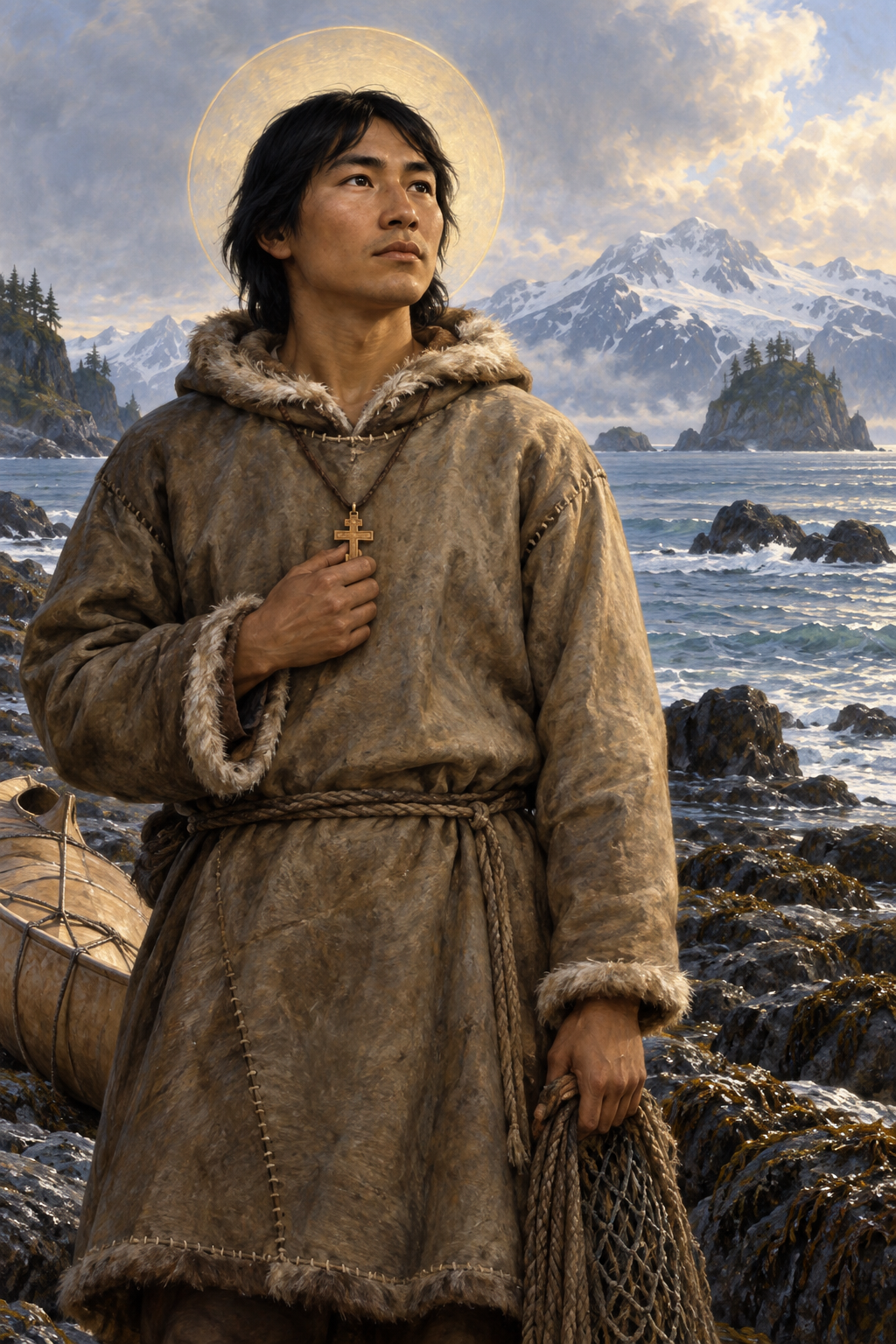
About Peter the Aleut
Peter the Aleut is remembered by the Orthodox Church in America as a young Aleut Orthodox layman from Kodiak. The does not give a birth date, death date, or family history. That absence should guide the catalog record. A slow-vetted profile can say that Peter was Aleut, Orthodox, and associated with Kodiak in the OCA source family, but it should leave life dates blank and avoid invented childhood scenes.
The OCA life places Peter in the world of the Russian-American Company and the North Pacific fur trade. It says that in 1815 a Russian ship carried fourteen Aleuts, including Peter and another man named Ivan Kyglai, toward the California coast to hunt sea otter. The profile can include this setting because it explains why an Alaskan Orthodox layman appears in a California martyrdom story. It should not use the fur-trade context to flatten Aleut people into laborers without agency or to make unsupported claims about their motives.
According to the OCA life, Spanish soldiers captured the group near San Pedro. The text says that the prisoners were taken for interrogation and that the reported pressure centered on Roman Catholic conversion. This is sensitive material. The public profile should present it as the received Orthodox account and should not turn it into broad anti-Catholic polemic or a complete political history of Spanish California. The source supports a martyrdom story; it does not by itself settle every institutional or legal question around the incident.
The OCA life presents Peter's death as a refusal to abandon Orthodox faith under coercion. It says that he would not renounce the Orthodox Church or accept another baptism. The profile can state that Orthodox sources venerate him for that refusal. It should avoid graphic descriptions of torture in the main biography, especially because the public reader needs a clear account of the saint, not a scene of violence. Graphic details, if ever used, would need a separate devotional and source-budget review.
Ivan Kyglai is important to the story because OCA's life identifies him as the witness who survived and later reported Peter's death. The final profile should name him carefully as a source-reported witness, not as a fully independent modern corroboration. This protects the chain of evidence: the catalog can tell readers that the martyrdom account came through a remembered witness without claiming more documentation than the OCA source supplies.
The same care applies to geography. The existing index row stores Kodiak, Alaska, as Peter's place of birth and California as his place of death. The OCA life associates him with Kodiak and with capture near San Pedro, but the review packet should not turn those into precise coordinates yet. Kodiak and California are acceptable broad historical labels for the current row. Exact locations should wait for a separate geographic review with source support.
Peter's record is also an example of why silence can be more accurate than completion-by-guessing. There is no secure birth year in the reviewed source family. There is no detailed family genealogy, no preserved quotation from Peter, and no broad ethnographic account that can be responsibly inferred from his title. The strongest catalog entry will be shorter on invented detail and stronger on transparent confidence: Peter is remembered as an Aleut Orthodox martyr; many surrounding facts remain unknown.
The profile should also handle names carefully. "Peter the Aleut" is the name by which he is venerated in the OCA source family. It identifies him through ethnic origin rather than family lineage, and the reviewed sources do not provide a separate Aleut name or surname. The catalog should not invent one, modernize the name into a different form, or treat the title as if it contained a complete biographical identity.
OCA sources also connect Peter with broader Orthodox memory in North America. The profile gives September 24 as his commemoration and 1980 as his glorification year. That later recognition explains why he belongs beside the Alaska mission saints in the catalog, but it should not be used to embellish the early nineteenth-century account. Recognition and historical event should remain separate layers in the biography.
This packet should not try to settle broader historical disputes with a short saint profile. It can say what the OCA source says: Peter was an Aleut Orthodox Christian from Kodiak; he was captured with companions near California; Ivan Kyglai reported his witness; Orthodox tradition venerates him as a martyr. It should not add claims about every party's motives, institutional policy, or the legal status of the captives unless separate historical sources are reviewed.
The final record should therefore present Peter as an Orthodox Aleut layman from Kodiak who is venerated as a martyr after the received account of his death in California. It should emphasize faithfulness under coercion, respect the limits of the source, and avoid graphic violence or denominational attack. It should leave patronage, exact dates, coordinates, quotations, prayers, and extended historical claims empty until separately reviewed.
The art and event choices should follow the same restraint. A quiet portrait of an Orthodox layman with a cross is more faithful to the packet than an execution scene. Featured events can name Orthodox identity, capture, refusal under coercion, witness transmission, and later glorification without making the page feel like a courtroom brief or a polemical tract.
Wondering how to weigh the stories and sources? Learn how to read a saint biography.