Biography
Peter Thomas
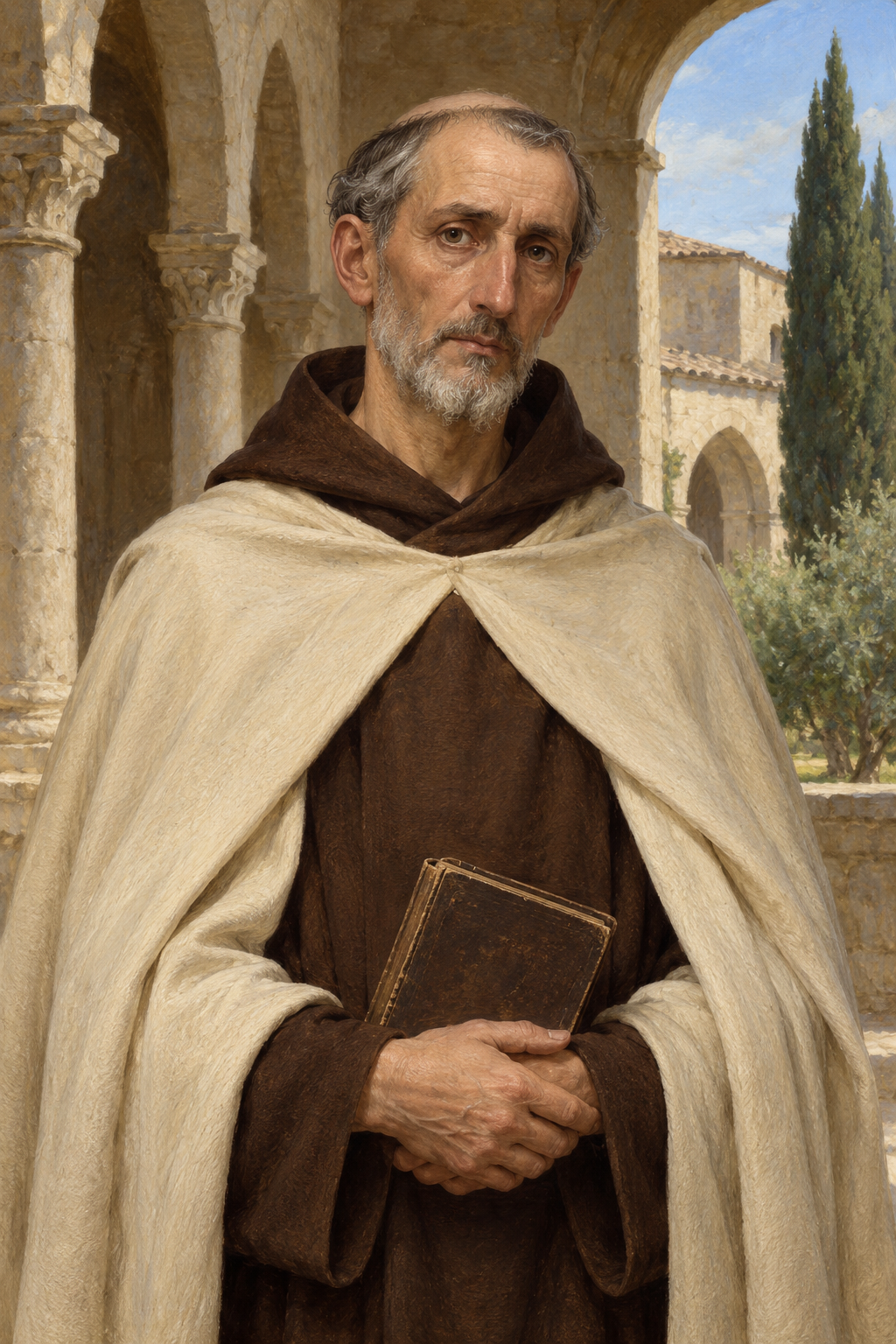
About Peter Thomas
Peter Thomas was a Carmelite friar whose work carried him from teaching in France to papal diplomacy in the eastern Mediterranean. Born about 1305 in southern Périgord, he entered the Carmelites as a young man. In 1345 the order chose him as procurator general at the papal court in Avignon. He later became a bishop and Latin patriarch of Constantinople, holding responsibilities that joined religious leadership to the political conflicts of his century.
Leopold Gluckert’s Carmelite account describes his beginnings in a poor peasant family, his ability as a teacher and his further studies in Paris. It also remembers a friar who continued a simple life of prayer while working among powerful rulers. His public responsibilities did not remove him from the religious practices through which his community understood his vocation. This portrait of personal austerity helps explain the affection with which later Carmelites remembered him.
His diplomatic work was demanding and its results were mixed. Gluckert records an effort in 1353 to reconcile Venice and Genoa, as well as negotiations involving the papacy and Naples. The disputes were not fully resolved. Peter’s later reputation as a peacemaker should therefore be understood as a description of some of his aims and activities, rather than proof that his missions consistently brought peace.
He became bishop of Patti and Lipari in 1354, moved to Corone in 1359 and received responsibilities as papal legate in the East. Further appointments followed: archbishop of Crete in 1363 and Latin patriarch of Constantinople in 1364. These offices placed him within the difficult relations between the Latin and Greek churches.
Raymond Janin’s account emphasizes the limits of his negotiations. A mission to the Serbian ruler Stefan Dušan met an unfavorable reception, and discussions at Constantinople encountered opposition from Greek clergy. Peter also became involved in an armed league supported by the papacy, Cyprus, Venice and the Hospitallers. Janin records his presence at the capture and destruction of Lampsacus and his part in defending Smyrna. His pursuit of Christian unity belonged to a world in which diplomacy and religious warfare were closely intertwined.
That connection became especially clear in 1365. Peter supported the crusading expedition led by Peter I of Cyprus, and accompanied the forces that captured Alexandria on October 9. The army subsequently withdrew, despite the king’s desire to continue. Peter Thomas wrote to Pope Urban V and Emperor Charles IV about the outcome. The expedition was not a lasting conquest, and its failure did not erase the suffering inflicted during the occupation.
Historian Jo Van Steenbergen examines the Egyptian accounts of the attack and cautions that even an eyewitness narrative requires critical reading. The account of an-Nuwayri describes inhabitants being killed or captured, property plundered and prisoners taken aboard the departing ships. These consequences form part of the history of the crusade Peter supported. Acknowledging them does not establish that he personally ordered each act of violence, but it prevents his religious aims from concealing the harm done to the city’s people.
Peter returned to Cyprus and died at the Carmelite house in Famagusta late on January 6, 1366. His reputation for holiness survived him. Richard Copsey’s review of the documentary tradition describes the later work of collecting manuscripts, earlier accounts and papal documents concerning his career. Such materials allow his life to be studied beyond a simple list of offices or a devotional account of successful missions.
The surviving record also shows how his remembrance developed. Godfrey Henschen expanded his original 1643 dossier in a revised version published in 1659, incorporating newly located material. Copsey notes that the later compilation includes twenty-seven papal bulls addressed to Peter during his lifetime. These documents are important alongside the narrative written by his friend: they preserve evidence of official responsibilities rather than relying solely on reported miracles.
His friend Philippe de Mézières wrote his life in 1366. The Frankika research catalogue identifies surviving manuscripts and explains that the Franciscan Jean Carmesson later condensed Philippe’s narrative while adding personal information. These are related accounts, not wholly independent witnesses to every episode.
Renate Blumenfeld-Kosinski studies the friendship that shaped Philippe’s account, including their meeting during an outbreak of plague and the scenes surrounding Peter’s death. Her analysis treats the language of affection as part of the biography’s presentation of holiness. The closeness between author and subject makes the account valuable, while also giving readers reason to recognize its admiring purpose.
The Carmelites honor Peter as a saint on January 8; a January 6 commemoration is also recorded. Their account distinguishes confirmation of his cult under Paul V and Urban VIII from the simple modern claim that he underwent a dated canonization ceremony. At Salles-de-Belvès, local tradition associates him with springs and fountains. Stories of healing water belong to that devotional heritage; they are not evidence that the water treats illness.
Wondering how to weigh the stories and sources? Learn how to read a saint biography.