Biography
Philander Chase
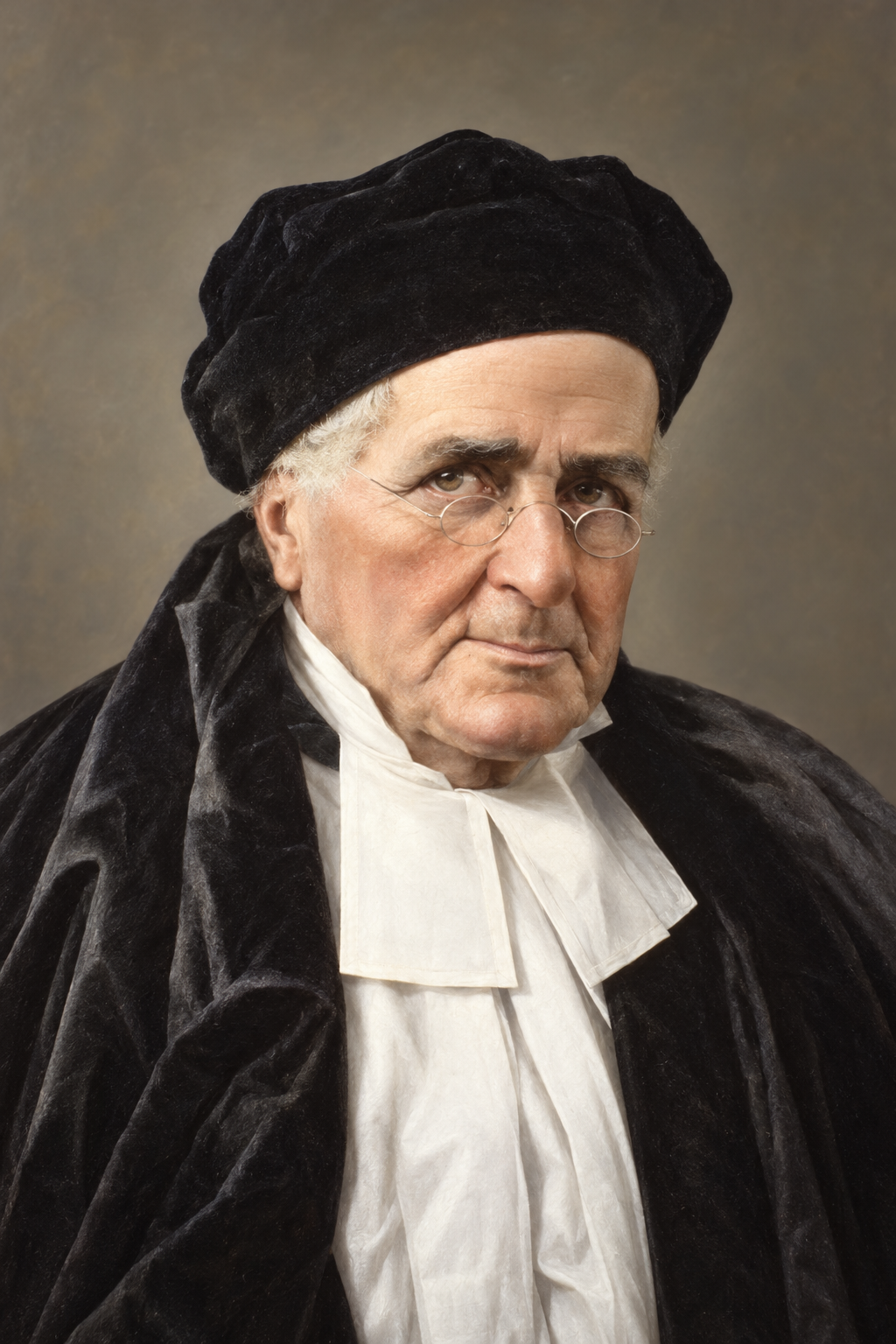
About Philander Chase
Philander Chase built churches and schools as an Episcopal minister in the expanding United States. Born in Cornish, New Hampshire, on December 14, 1775, he studied at Dartmouth and moved from his Congregational upbringing into the Episcopal Church. He was ordained deacon in 1798 and priest in 1799. His early ministry took him through New York, New Orleans, and Hartford before he moved to Ohio in 1817.
His time in New Orleans included participation in slavery. In his autobiography, Chase records purchasing a young man named Jack for five hundred dollars. Jack escaped aboard a ship bound for Liverpool after about three months. Years later, Chase learned that Jack had been recaptured and imprisoned in New Orleans. Friends asked for authorization to sell him. Chase instead directed them to emancipate Jack, while asking Jack to meet the prison fees and legal costs.
Chase’s own explanation complicates any simple account of benevolent liberation. He described the original purchase as a necessity and considered how reclaiming Jack would damage his reputation as a bishop. His later reflections also acknowledged the evils of slavery. These are Chase’s retrospective explanations, not Jack’s testimony. The sequence preserves an essential distinction: Jack first sought freedom through escape; Chase authorized emancipation only after his recapture. The account belongs alongside Chase’s educational and religious achievements.
His Hartford ministry placed him within a parish with established civic and religious connections. He began preaching there in October 1811, and the parish invited him to become its minister that December. Its records preserve the agreed salary and his formal institution the following year. When he asked to leave in 1817, he distinguished his concerns about the diocese from his relationship with the congregation. He expressed satisfaction with the parish and gratitude for individual kindnesses. His farewell sermon came in March, before the move west.
In Ohio, Chase became the first bishop of the new diocese. He wanted clergy trained close to the communities they would serve and sought money in Britain for a western institution. His family shared the practical work. His second wife, Sophia, cooked for students, cared for them when ill, and managed affairs during his absences.
Kenyon began at Worthington in 1824 with support from British donors, including Lords Gambier, Bexley, and Kenyon, Lady Rosse, and Hannah More. It developed into a grammar school, college, and seminary. The institution then moved to rural Knox County. Its earliest buildings and first graduating class made visible the educational community Chase had sought to establish. Kenyon’s first commencement took place in September 1829.
This development was part of a wider history of settlement and displacement. Kenyon’s bicentennial account acknowledges the Miami, Lenape, Wyandotte, and Shawnee peoples who traded along the Kokosing before being pushed from their ancestral homelands, often by force. Chase’s work therefore took place within an already inhabited landscape. Describing that setting only as wilderness would leave out the people whose history preceded the college.
The college also exposed limits in Chase’s leadership. Disputes arose over control, finance, and the relationship between his authority as bishop and his authority over the school. When asked to relinquish some control in 1831, he resigned both positions instead.
A brief letter to his sister Rachel Denison records his own understanding of that decision. On September 10, 1831, he reported that he had resigned his Ohio jurisdiction and, with it, his college presidency. He said that he had acted for the peace of the church and hoped for God’s blessing. He also described plans to move his family to another property. The letter gives his stated purpose, without resolving the disagreements that had led to the resignation.
Chase later became the first Episcopal bishop of Illinois and founded Jubilee College in 1839. The new institution again combined several forms of education: theological study, a college, a classical preparatory school for boys, and a school for girls. Farming formed part of its operation. The surviving sandstone building, constructed between 1839 and 1844, joined chapel, classroom, and dormitory space. Its design drew on an Anglican chapel near London. These connected spaces show how worship, study, and residential life were brought together in the institution he founded.
In his last years Chase’s health declined, but he continued preaching and teaching. His granddaughter’s biography recalls that he sometimes conducted worship while seated and taught a Sunday school near his home during his final summer. He suffered serious injuries when a carriage harness failed and he was thrown to the ground. Students carried him to bed. He died on September 20, 1852, and was buried at Jubilee. The family account remembers prayer and the reading of psalms during his final illness.
The Episcopal General Convention gave final approval to his calendar commemoration in 2006. This recognition belongs to the Episcopal tradition, rather than representing Roman Catholic canonization.
His observance falls on September 22, as reflected in the worship record of Saint Mark’s Episcopal Cathedral.
Wondering how to weigh the stories and sources? Learn how to read a saint biography.