Biography
Philip Howard
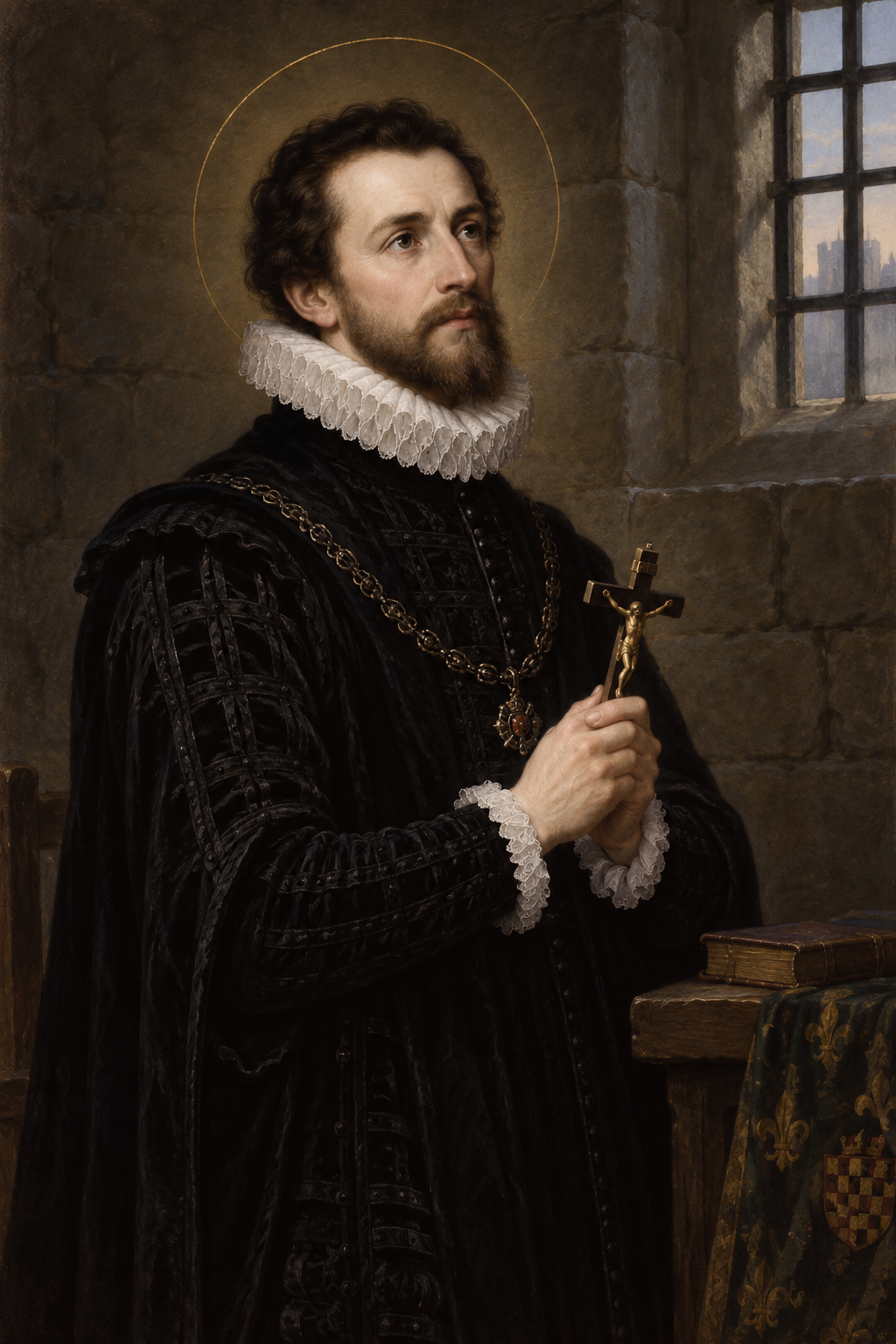
About Philip Howard
Philip Howard (1557–1595), the thirteenth Earl of Arundel, was a Catholic nobleman of Tudor England. Paul VI’s 1970 canonization letter recalls that Howard returned to the Catholic Church, attempted to escape to Europe, and died after years in prison. His story joins noble status, religious change, and the political tensions of Elizabeth I’s reign. The official account provides a concise frame; historians’ reference works supply more detail about his family, court life, trial, and imprisonment.
Howard was born at Arundel House in London on 28 June 1557. He was the son of Thomas Howard, later fourth Duke of Norfolk, and Mary FitzAlan, daughter and heiress of the twelfth Earl of Arundel. His mother died soon after his birth. Howard’s ancestry connected two prominent English families, and his maternal inheritance eventually made him Earl of Arundel. These facts come from Pollen’s biographical entry, which also gives his birth date and place.
His father conformed to the established Church, and Philip was educated partly under John Foxe, the Protestant martyrologist, before attending Cambridge. His religious formation therefore began in a household shaped by competing confessions. The surviving reference accounts do not reduce his later Catholic commitment to a single teacher or moment.
Howard married Anne Dacre in 1571; she was one of three co-heiresses of Thomas, Lord Dacre of Gilsland. The Dictionary of National Biography recounts that he initially neglected her while absorbed in court life. When his maternal grandfather died in 1580, Howard succeeded to the earldom through his mother’s line. His claim was contested, and the council restored him in blood in 1581, although not to his father’s forfeited dukedom. Inheritance changed both his standing and his responsibilities.
The Oxford Companion to British History explains that the family’s political difficulties outlasted the execution of Howard’s father, the fourth Duke of Norfolk, in 1572. The dukedom remained under attainder, while Philip acquired his maternal grandfather’s earldom in 1580. This distinction matters: Howard was a great aristocrat but did not inherit his father’s title. His son Thomas later recovered family titles under James I. The family history linked religious loyalty with court politics and the consequences of treason accusations.
Howard’s wife’s Catholic commitment influenced his religious development. Pollen dates his reception into the Catholic Church by Jesuit William Weston to 30 September 1584. The Oxford Companion also places his conversion in 1584 and associates it with Anne. Paul VI later described him as reconciled to the Catholic Church. The available accounts agree on the year and its importance, but do not allow a confident reconstruction of his private spiritual process. Afterward, the court viewed him with greater suspicion.
In 1585 Howard attempted to leave England for Europe. The diocesan account says he sailed from Littlehampton, was apprehended at sea, and was brought back to the Tower in April. Paul VI’s canonization letter confirms the attempted escape and imprisonment. The sources establish this sequence without requiring speculation about interception or motive. His departure came after conversion had altered his relationship with the royal court.
Howard first received a large fine and imprisonment at the queen’s pleasure, according to Pollen. The Oxford Companion says he was later attainted and that his son regained titles in 1604. Historic Royal Palaces identifies Beauchamp Tower as his place of confinement and notes that he remained there for ten years. Thus, his imprisonment was not a short prelude to execution but the central condition of his final decade. The sources do not support invented scenes of daily prison life.
Following the Spanish Armada, Howard was tried for treason in 1589. Pollen says the charges concerned support for Elizabeth’s excommunication and prayers for the invading forces; the Oxford Companion summarizes the case as an accusation of praying for the Armada’s success. These were charges brought against him, not facts that this biography treats as proved. Historic Royal Palaces says he was sentenced to death, but that sentence was not carried out. He remained imprisoned until his death.
Pollen reports that Anne arranged the later translation of Howard’s remains. Arundel Cathedral now identifies a shrine in its north transept as the resting place of his relics. These memorials show how the family and local church preserved his memory after his death. Their evidence concerns later commemoration and burial, rather than adding facts about his life in the Tower. Arundel Castle also remembers him among the Howard family’s saints.
Pollen lists devotional works associated with Howard, including a translation of an epistle by John Justus of Landsberg and meditations on the Four Last Things. He notes that one meditation was once attributed to Robert Southwell, so the authorship should not be overstated. The publications connect Howard’s later reputation with Catholic devotional reading, but they are not a diary of his imprisonment. Their surviving print history offers a limited glimpse of his literary interests.
Wondering how to weigh the stories and sources? Learn how to read a saint biography.