Biography
Phillips Brooks
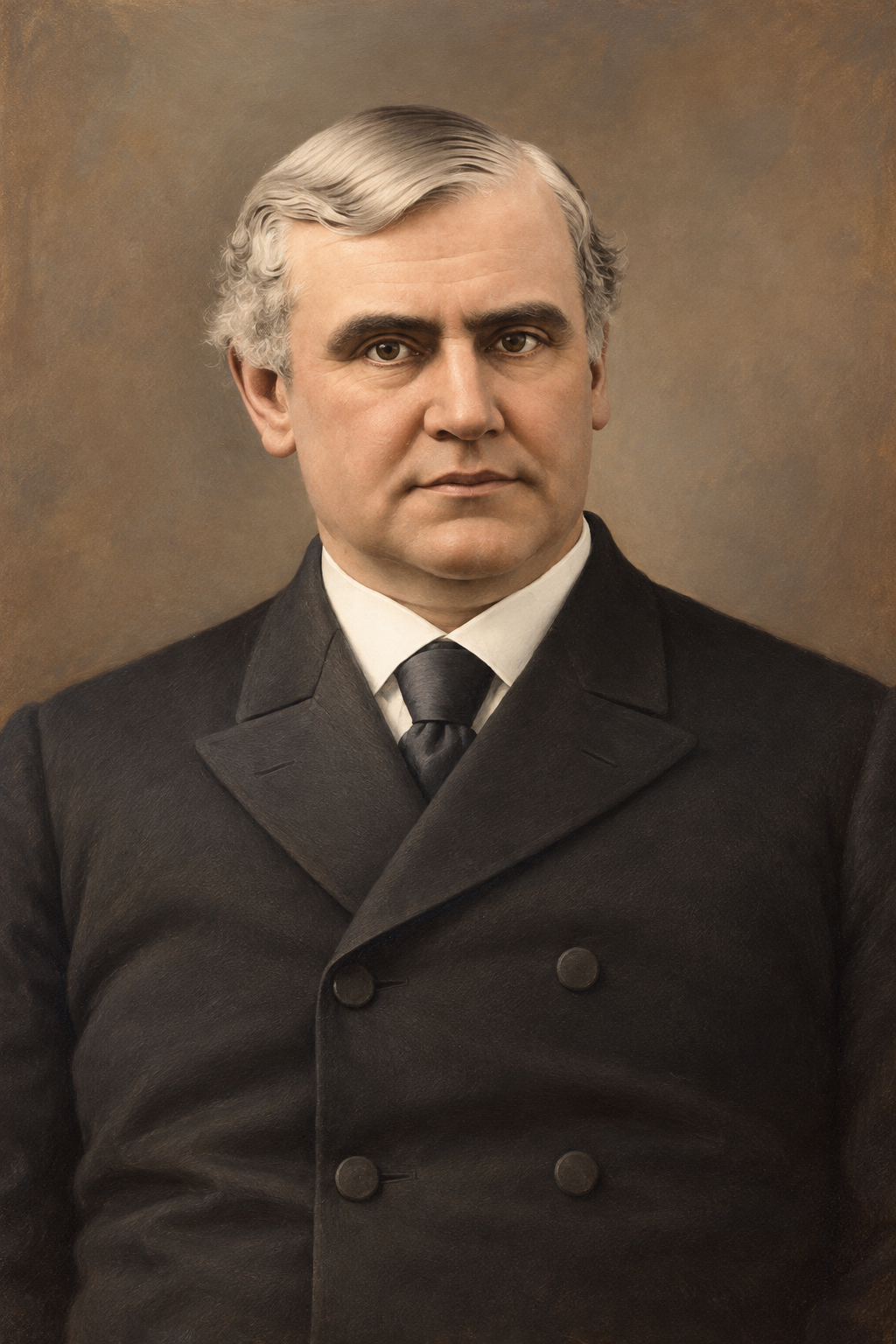
About Phillips Brooks
Phillips Brooks was an Episcopal preacher whose ministry connected Boston and Philadelphia. Born in Boston on December 13, 1835, he attended Boston Latin School and graduated from Harvard in 1855. A short attempt at teaching preceded his decision to study at Virginia Theological Seminary. In 1859 he began serving the Church of the Advent in Philadelphia; in 1862 he moved to the Church of the Holy Trinity.
At Holy Trinity, Brooks attracted large congregations to Sunday worship and weekday lectures. His preaching also brought conflict. He opposed slavery and supported the Union’s effort to defeat the seceding states, positions that some prominent parishioners rejected. The parish history records resignations in response to his sermons. His eulogy for Abraham Lincoln, delivered on April 23, 1865, circulated beyond the congregation in print. The parish’s work extended beyond its main services: members organized a night school, a mothers’ group, and an outside Bible class. Its later Phillips Brooks Memorial Chapel traced its origins to a Sunday school he established for Black people in 1867.
In the printed Lincoln sermon, Brooks began with the biblical account of David being called from shepherding to govern a people. He used that passage to interpret Lincoln’s character and public responsibilities while the president’s body lay in Philadelphia. He treated slavery as a moral system whose effects reached beyond the places where people were legally enslaved. His criticism included Northern sympathy for slaveholders and the oppression of weaker people by the powerful.
Brooks connected the assassination with the conflict between slavery and freedom, making an explicit theological and political judgment rather than offering a detached report of the crime. Near the end, he warned that punishing individual offenders would not by itself remove the underlying wrong. Racial prejudice and practices that law could not reach, he argued, could keep slavery’s spirit alive in both North and South. He called his hearers to continue the unfinished work of freedom rather than treating military victory as its completion.
His most widely remembered words began as a gift for children. After visiting Bethlehem during his travels following the Civil War, Brooks wrote a poem for Holy Trinity’s Sunday school. In 1868 the organist Lewis H. Redner set it to music, and the children’s carol became known as O Little Town of Bethlehem. The song eventually crossed denominational and national boundaries. American congregations commonly sang Redner’s setting, while English congregations also used the folk melody Forest Green.
Brooks returned to Boston in 1869 as rector of Trinity Church. He encouraged the congregation to move from Summer Street to the newly developed Back Bay. The parish had already purchased its new site and selected architect Henry Hobson Richardson when the great Boston fire destroyed the old church in 1872. The replacement church took shape between 1872 and 1877. Brooks helped determine its design and decoration, seeking a generous space for preaching and worship. Richardson’s architecture and the colorful interior painted by John La Farge and his collaborators gave that ambition a lasting physical form.
His work also continued at Harvard. The Crimson’s obituary remembered his regular appearances at college gatherings and his preaching in Appleton Chapel. It described a change in his position on voluntary chapel attendance: initially opposed, he later supported the proposal and helped win the overseers’ consent. That recollection shows a minister willing to revise his judgment about how the university should organize religious life.
Beyond his parish, Brooks served as a Harvard overseer and on the Massachusetts State Board of Education. He delivered lectures on preaching at Yale in 1877.
In his Yale lectures, Brooks explained preaching as a meeting between Christian truth and the individual person who communicates it. He argued that a sermon required both: religious information alone was insufficient, while a speaker’s cleverness or ability to entertain could not replace truth. For him, the preacher’s character, affections and moral life were part of the message’s passage to a congregation. Training therefore involved more than mastering techniques or accumulating knowledge in a theological school. He urged students to learn from the lives of other ministers without simply copying their methods.
He also considered whether the growing availability of books would make sermons unnecessary. His answer emphasized the continuing importance of one person addressing another, rather than a competition over which could supply the most polished words. He warned preachers against blaming their listeners for failure, but also against becoming careless because a patient congregation continued to attend.
He became bishop of Massachusetts in 1891, but his episcopate was brief. A later diocesan commemoration recalls that his election provoked objections to his approach to theology. The same sermon honors him as a preacher and pastor, preserving a memory that includes controversy as well as admiration.
Brooks died at his Boston home on January 23, 1893. The university newspaper’s tribute emphasized the personal care he had offered to students alongside his public achievements.
The Episcopal Church commemorates him on January 23.
Wondering how to weigh the stories and sources? Learn how to read a saint biography.