Biography
Photius of Constantinople
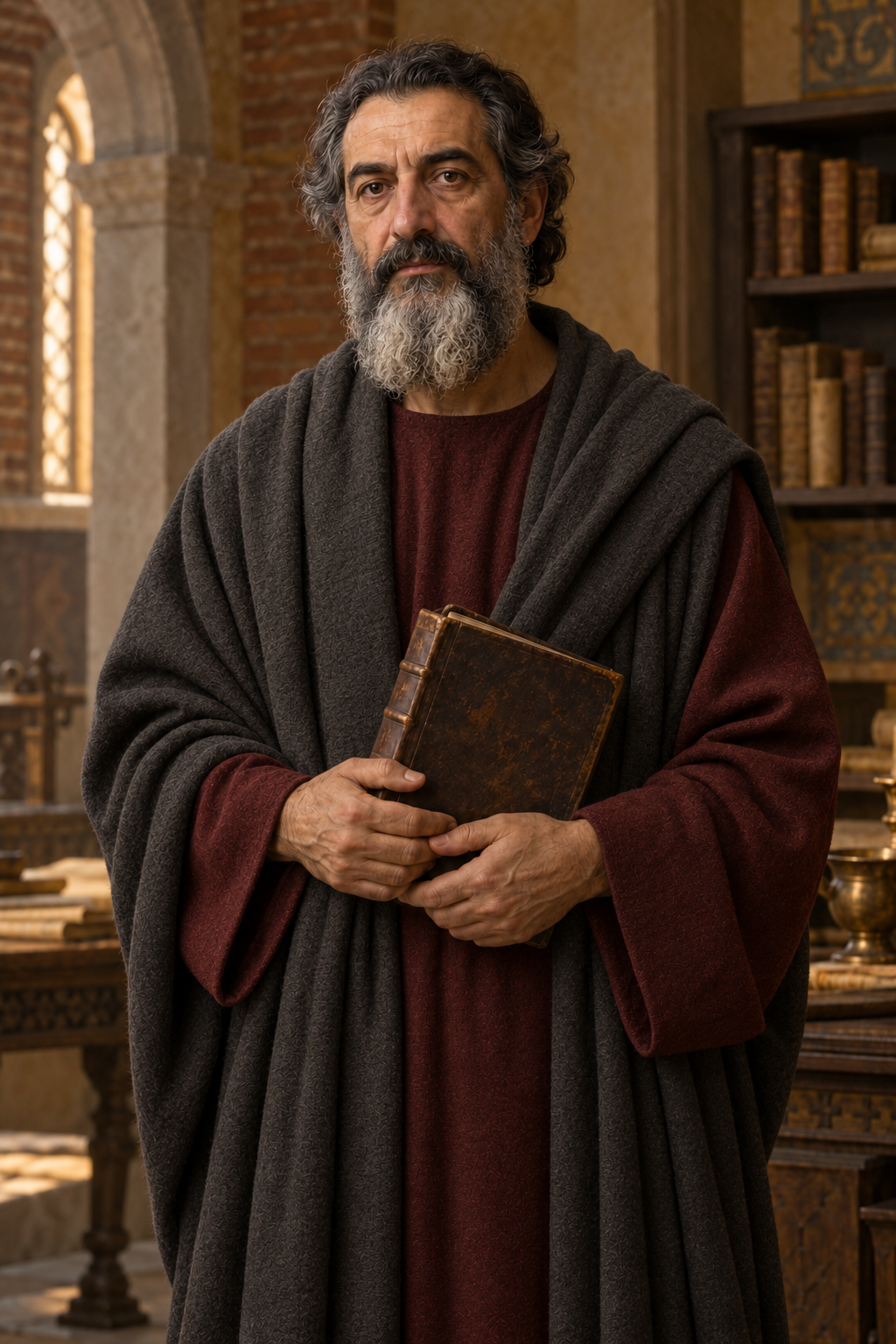
About Photius of Constantinople
Photius of Constantinople was a scholar and imperial official before becoming patriarch in 858. His two periods in office placed him at the center of disputes over church leadership, missionary territory and relations with Rome. His books also preserved a much wider world of reading: theology, philosophy, history and the sciences all belonged to his intellectual interests.
Born in Constantinople around 810, he belonged to a prominent family. His parents suffered exile during the conflict over the veneration of icons. The exact course of his education is less certain than his later learning. His career eventually brought him to the imperial chancery, where he held the position of chief secretary while continuing his studies.
Historian Warren Treadgold offers a slightly later birth estimate, around 813. He places Photius’s exile with his father in the 830s and early 840s, arguing that these years gave him time for extensive reading. This reconstruction connects the family’s religious difficulties with the learning that later made him prominent at court.
His teaching took place in a private circle rather than an established university appointment, according to the scholarly Prosopographie der mittelbyzantinischen Zeit. Students gathered in his house outside his official duties. This distinction matters because later descriptions of him as a university professor give a more formal shape to his teaching than the surviving evidence supports.
His Library began with a personal request. In its dedication, Photius tells his brother Tarasius that he has collected accounts of books read and discussed in their circle during Tarasius’s absence. He explains that he employed a secretary and arranged the summaries as they came to mind. He also warns that memory could fail when many books and long intervals were involved. The letter presents an ambitious collection through the familiar problem of sharing reading with someone who missed it.
The collection became important far beyond that family exchange because some of the works it describes no longer survive. His other writings include a lexicon, letters and the Amphilochia, a collection addressing theological, biblical and philosophical questions. Together they preserve the activity of a reader who assessed language and argument as well as collecting information.
His appointment as patriarch followed the forced departure of Ignatius. Photius was still a layman and passed rapidly through ordination before taking office. Supporters of Ignatius challenged his legitimacy. Papal representatives accepted him at a council in 861, but Pope Nicholas rejected that decision. The conflict involved rival understandings of authority as well as opposition within Constantinople itself.
Bulgaria added another dispute. Its ruler Boris sought a church organization with greater independence and approached Rome after dissatisfaction with arrangements from Constantinople. Missionary rivalry then became entangled with disagreement over the Filioque, the Western addition to the creed concerning the Holy Spirit. Photius’s council of 867 condemned Pope Nicholas, but the political balance soon changed: Basil I took power and removed Photius, restoring Ignatius.
Already in exile, Photius was condemned by the council of 869–870. He later returned to imperial favor and became a tutor to the emperor’s children. After Ignatius died, he regained the patriarchate in 877. Another council, held in 879–880 with papal representatives, rehabilitated him. The proceedings did not remove every disagreement, but they show that the confrontation had included negotiation and renewed communion, not an uninterrupted separation between East and West.
His preaching also reached beyond these disputes. Cyril Mango’s study of the surviving homilies emphasizes their concern with worship, icons and divisions within the local church; they do not mention the papacy. Two sermons arose from the attack on Constantinople by the Rus in 860. They preserve the patriarch’s public voice during a crisis in which the city’s inhabitants faced immediate danger.
Other sermons reveal how he connected belief with conduct and visible worship. In an address for the beginning of Lent, he urged repentance expressed through mercy toward poor people and forgiveness of others. In 867 he preached at the unveiling of an image of the Virgin and Child in Hagia Sophia. That sermon celebrates the restoration of sacred images, although the image he described cannot securely be identified with the mosaic visible there today.
Leo VI removed him from office in 886. His death is commonly placed around 893, but 891 also appears in church accounts, and the precise date remains uncertain. The February 6 feast should not be treated as proof of the day he died.
His Orthodox veneration continues in specific communities. In 2025 the Greek Orthodox Archdiocese of Canada identified him as patron of its Clergy Syndesmos, the clergy association, during its February 6 celebration in Toronto. This is a particular institutional patronage rather than a claim that he is patron of every priest.
His enduring literary importance rests on the survival of his reading as well as his own arguments. As Mango observes, approaching him only through the controversy with Rome obscures a preacher concerned with the life of his congregation. His surviving works allow those different responsibilities—reader, teacher and bishop—to remain visible together.
Wondering how to weigh the stories and sources? Learn how to read a saint biography.