Biography
Pierina Morosini
About Pierina Morosini
Pierina Eugenia Morosini was born on January 7, 1931, at the Stalle farm in Fiobbio, a district of Albino in the province and Diocese of Bergamo, Italy. She was baptized in Fiobbio the following day. The Dicastery for the Causes of Saints identifies her as the eldest of nine children. Her family lived by agricultural and industrial labor rather than public prominence. Pierina’s life unfolded in northern Italy during fascism, the Second World War, postwar reconstruction, and the expansion of factory employment for young women. The official cause biography supplies firm dates and places but offers only a concise account; a responsible narrative therefore stays close to what it records and does not invent childhood dialogue, motives, or domestic scenes.
In 1942 Pierina joined Catholic Action. This was not a religious order but a lay association through which Catholics received formation and participated in parish life. Its importance in her record is practical: she attended meetings, developed habits of prayer, and understood ordinary work and family responsibility as a lay vocation. John Paul II’s beatification homily later placed Pierina, Marcel Callo, and Antonia Mesina together as young laypeople formed through families, associations, and work. That interpretation belongs to the Catholic ceremony, while her membership itself is documented by the cause biography and Catholic Action’s institutional profile. The precise content of every meeting or private devotion is not recoverable from these summaries.
Pierina left formal schooling and helped support her household. On March 18, 1946, shortly after turning fifteen, she began at the Honegger cotton mill in Albino. The Dicastery says she first cleaned the department and looms, then became an apprentice, assisted other workers, and eventually operated looms. This progression gives substance to her classification as a worker and layperson. She was not secluded from modern industrial life: she learned tasks, kept a schedule, contributed wages, and worked beside other women. Accounts that present her only through her death miss years of ordinary responsibility. Her diligence was expressed in repeated labor that served her family and in assistance offered to coworkers, not in a dramatic office or public title.
In 1947 Pierina told her mother that she wanted to become a religious sister. The family needed her earnings and presence, and she remained at home. That decision should not be described as a failed vocation. The cause biography says that she made private vows of chastity, poverty, and obedience and wrote a small daily rule that she followed thereafter. Private vows did not enroll her in a religious institute or turn her into a nun. They locate her consecration within lay life, family duties, parish participation, and factory work. In the same year she joined a pilgrimage to Rome for the beatification of Maria Goretti, whose story became important in her spirituality. The influence is documented; claims of identical personalities or circumstances would go beyond the evidence.
Her surviving profile presents a disciplined pattern rather than withdrawal from other people. Prayer, Mass, spiritual direction, Catholic Action, factory shifts, and household contribution formed one life. John Paul II said at the beatification that Pierina had discovered that holiness was possible without entering a convent and that she opened herself to parish life, Catholic Action, and vocational apostolate. This is an ecclesial interpretation offered thirty years after her death, but it accurately guards an important distinction in the record: Pierina was a laywoman. Her virtues can therefore be attached to observable commitments—supporting her family, learning skilled work, helping colleagues, keeping a personal rule, and participating in an association—without pretending that historians can measure the intensity of her private feelings.
On April 4, 1957, Pierina left the factory and walked toward home. A young man attacked her on the path and struck her on the head with a stone when she resisted sexual violence. Her brother found her unconscious. She was taken to a hospital in Bergamo with a fractured skull. The Dicastery reports that she died on April 6 without ever regaining consciousness. That last fact rules out stories assigning her words of forgiveness or any other deathbed speech. The event should be stated without lurid reconstruction and without suggesting that victims who cannot resist are morally at fault. Catholic recognition calls Pierina a martyr because of the circumstances in which she defended her vowed chastity; that formal judgment is not a general measure of another victim’s dignity or courage.
The Catholic Church’s investigation concluded in beatification. On October 4, 1987, John Paul II beatified Pierina in Saint Peter’s Basilica with Marcel Callo and Antonia Mesina. The homily called all three laypeople, young, and martyrs, emphasizing the settings of family, association, home, and factory. These words document the church’s public recognition and the meaning assigned to it; they do not supply new eyewitness evidence for 1957. The Dicastery lists Pierina’s liturgical memorial as May 6. That date must remain distinct from April 6, the documented day of her death. This packet therefore corrects the legacy feast field to May 6 and records the observance under the Holy See’s cause profile rather than assuming identical rank in every Roman Catholic jurisdiction.
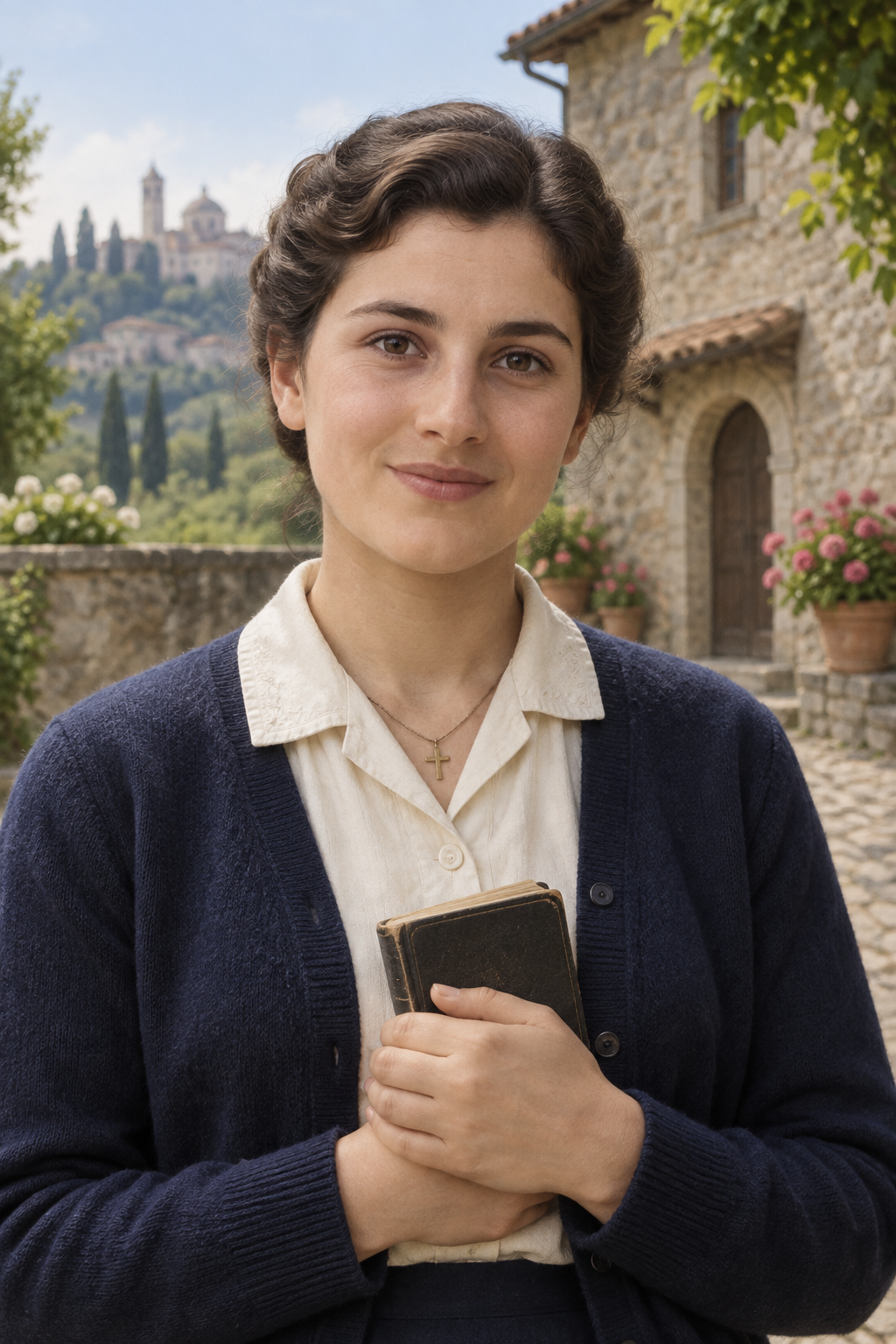
Pierina Morosini remains significant because her short life joins ordinary lay responsibility with deliberate religious commitment. Her record includes no office, published book, or founded institution. It includes a teenager who entered factory work, contributed to a large household, helped fellow workers, remained active in her parish association, and shaped a private rule around the life available to her. Her violent death is part of that history but should not consume it. The source record also requires restraint: no spoken final forgiveness, no invented route coordinates, no unsupported prayer, and no claim that devotional artwork reproduces her appearance. A careful account remembers her agency, work, relationships, and Catholic recognition while speaking about the attack in a way that does not burden other survivors with comparison.
Wondering how to weigh the stories and sources? Learn how to read a saint biography.