Biography
Pietro I Orseolo
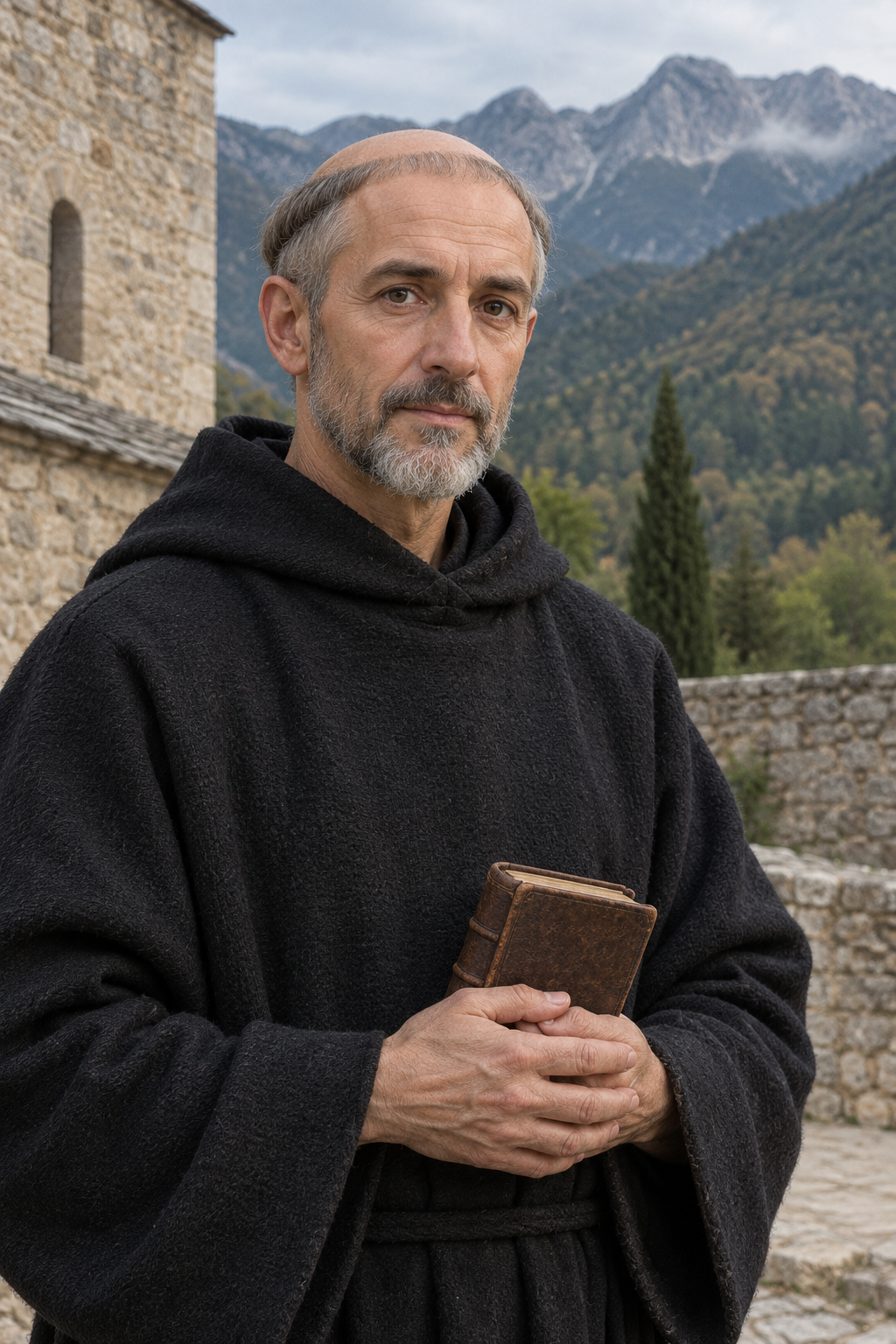
About Pietro I Orseolo
Pietro I Orseolo was doge of Venice from 976 until 978, when he left political office for the monastery of Saint-Michel-de-Cuxa in the Pyrenees. His life joined public responsibility, violent factional conflict and a lasting commitment to monastic prayer. Historian Marco Pozza places his probable birth in the late 920s. He was married to Felicia, and their son Pietro later became doge; a daughter married Giovanni Morosini.
His earliest documented public activity belongs to 960, when he signed a prohibition on the slave trade. In 971 his name appears on another restriction, this time on supplying arms and timber to Muslim powers. His election as doge followed the revolt in 976 that killed Pietro IV Candiano and damaged the ducal palace and Saint Mark’s church. He negotiated a settlement with Candiano’s widow, but the hostility of the opposing faction continued.
The chronicles offer sharply different explanations of his position. As Giorgio Cracco shows, John the Deacon presents a pious ruler distinguished by justice and generosity. Peter Damian’s life of Romuald instead accuses Orseolo of complicity in the attack on his predecessor and interprets his withdrawal as repentance. Neither a spotless political portrait nor a confident assertion of guilt does justice to this disagreement. The accusation belongs in his story, but it remains an accusation within competing accounts.
Cracco also argues that Orseolo’s religious interests preceded his departure from office. He places him among Venetian aristocrats drawn toward a life beyond wealth and political power, including Giovanni Morosini and Giovanni Gradenigo. Abbot Guarino of Cuxa, Romuald and the hermit Marino helped shape this circle. Such connections make the move to a monastery more than an isolated, sudden change of mind, while leaving room for the political pressures surrounding it.
His government also left a record of practical assistance. The New Catholic Encyclopedia describes the care he gave to widows, orphans and pilgrims, along with hospital building and reconstruction after the revolt. It records his use of personal resources for the damaged palace and Saint Mark’s. His public role was brief, but rebuilding and relief were substantial parts of the way later writers remembered it.
In 978 he departed secretly for Cuxa. There he joined a Benedictine community rather than beginning a new religious order. The New Catholic Encyclopedia describes him taking humble tasks and practicing severe penance. These are features of his monastic remembrance; they do not provide an exact daily timetable or erase the disputes surrounding his earlier political life.
Cuxa was itself an important religious center. Art historian Marcel Durliat describes a community following the Benedictine Rule and remaining independent of Cluny while sharing its spiritual outlook. Its connections reached both the papacy and the Catalan counts. A large church had been consecrated in 974, shortly before Orseolo arrived. The later cloister and other Romanesque additions belong to subsequent generations, so the surviving complex should not all be imagined as the setting he knew.
The connections with Venice did not simply disappear. Cracco follows Morosini’s return from Cuxa in 982 and the foundation of San Giorgio Maggiore. He sees that monastery as one lasting consequence of the circle’s religious choices, bringing a contemplative community back into Venetian life.
He died at Cuxa on January 10, in 987 or 988. Pozza preserves the uncertainty over the year. Clement XII recognized him as a saint in 1731, and his feast is kept on January 10.
His memory remained attached to the countryside around the abbey. The regional heritage inventory records the remains of a chapel dedicated to him near Cuxa, traditionally associated with his hermitage. It describes a rough stone said to have been his resting place and a later commemorative stele. These are witnesses to local remembrance; the tradition about the stone is not independent proof of where he slept.
Relics attributed to him likewise require care. In the published abstract of his study, Richard Donat describes examining two reliquaries, one at Cuxa and one in the treasury of Saint-Pierre at Prades, against historical and anthropobiological evidence. The abstract establishes that these attributed remains have been studied; it does not by itself establish the identity of every bone.
In Rome, Bartolomeo Pincellotti’s eighteenth-century statue at Palazzo Venezia presents Orseolo as a figure of spiritual renunciation. The museum describes his upward gaze and the ducal cap held in his hand, joining his former office with his departure from it. The sculpture formed part of a program celebrating Venetian history and prestige. It is a later interpretation of the saint, rather than a portrait made during his lifetime.
The Venetian Church names him among its co-patrons. A Venetian confraternity publication also recalls his historical patronage of the doges. In Mestre, the parish bearing his name explicitly honors him as its patron. These distinct associations preserve both the public and local dimensions of his remembrance.
Wondering how to weigh the stories and sources? Learn how to read a saint biography.