Biography
Pirmin
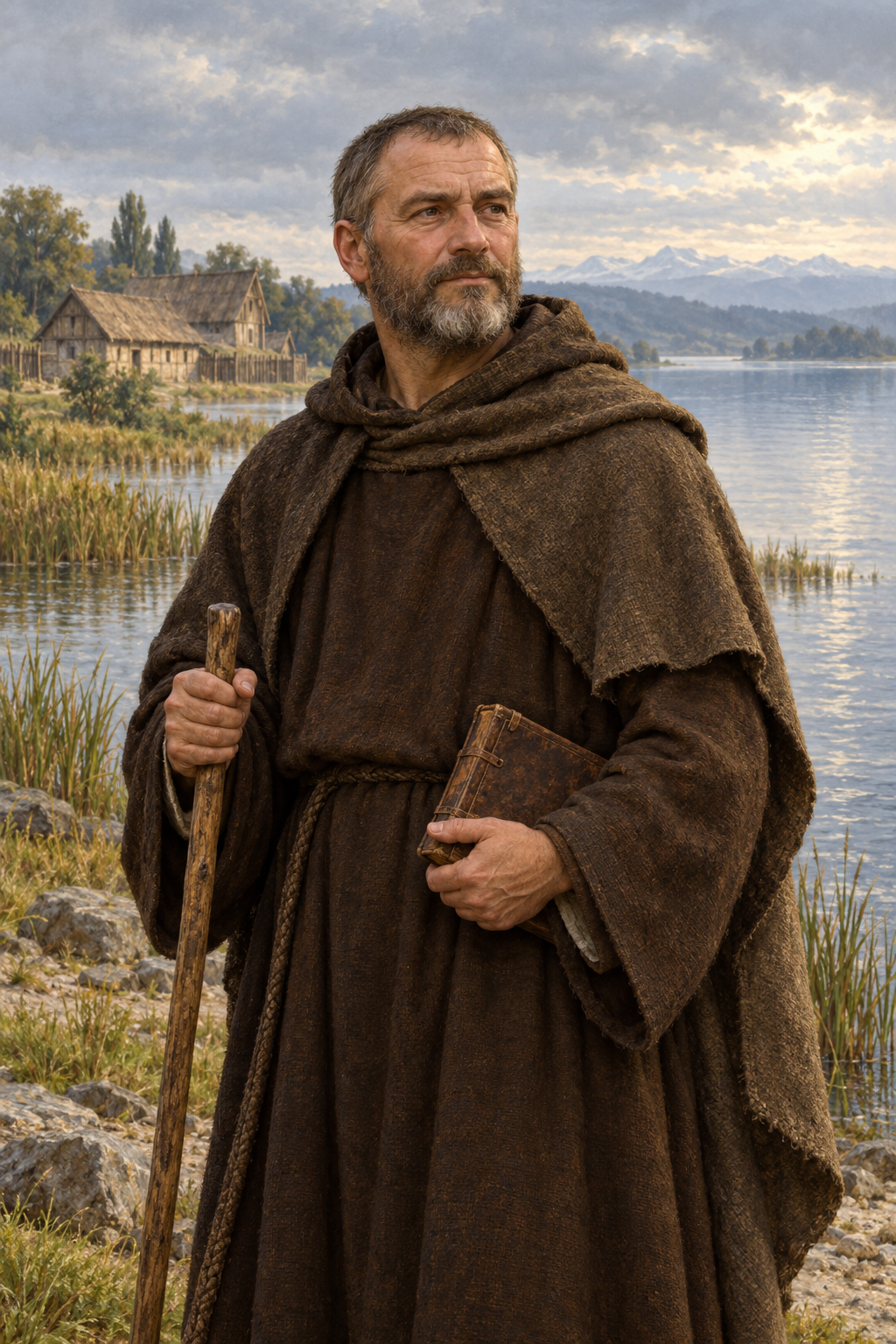
About Pirmin
Pirmin was an eighth-century missionary bishop and monastic founder in the Upper Rhine region, especially associated with Reichenau, Murbach and Hornbach. His origins remain uncertain. Historian Arnold Angenendt considers northern Gaul, possibly Meaux, a likely starting point. His religious work developed alongside the expansion of Carolingian power, which both supported and complicated his foundations.
In 724, Charles Martel placed him under protection for the foundation at Reichenau. Three years later, conflict between Charles and the Alemannic leadership forced Pirmin away. Angenendt connects his expulsion with Theudebald’s hostility toward Charles. Pirmin went on to establish Murbach with the assistance of Count Eberhard. There, monastic independence included freedom from the diocesan bishop’s control and the possibility of a bishop within the community.
Pirmin’s communities followed a mixed rule drawing on Benedict and Columbanus. Angenendt distinguishes this shared observance from a centralized order governed by a superior abbot. Hornbach was another foundation, supported by Count Warnharius.
The ideal of religious life away from one’s homeland, known as peregrinatio, helps explain this movement between places. Werner Vogler’s account in the Historical Dictionary of Switzerland places it at the heart of Pirmin’s religious activity. Vogler also cautions against assigning every later monastic connection to Pirmin personally: work at Gengenbach, Schuttern and Weissenburg cannot be demonstrated, nor can a meeting with Boniface. Pfäfers and Niederaltaich should not be listed as his own foundations simply because later tradition claimed them.
His death is usually placed in the middle of the 750s at Hornbach. The Swiss dictionary gives November 2 or 3, probably 755, whereas other reference accounts use 753 or about 754. The uncertainty is real, and November 3 is the day of his liturgical remembrance rather than a securely established modern death certificate.
The surviving account of his life also requires careful reading. The Bavarian Academy’s catalogue dates the earliest Vita to after 850, written at Hornbach, possibly in connection with a transfer of his remains. Its detailed attention to Reichenau and Hornbach shows the interests of the communities preserving his memory. It was written roughly a century after his death, so it cannot be treated as an eyewitness diary.
A small instructional work called the Scarapsus has often been presented as his own teaching manual. Angenendt notes that only one of its six manuscripts attributes it to him.
Vogler likewise warns that the Vita and attributed Scarapsus cannot provide straightforward evidence for the details of Pirmin’s activity.
The island tradition tells how snakes, toads and other creatures fled Reichenau when Pirmin arrived. The local tourism account preserves this story as a legend. Such imagery expresses the saint’s power in the devotional imagination; it does not establish that the island was empty before him or that an animal infestation was historically removed by a miracle.
Archaeology has sharpened that distinction. In its account of the 2024 Reichenau exhibition, Heidelberg University describes Matthias Untermann’s reassessment of the early buildings as evidence for settlement before the monastery. The community later became a major center of learning and manuscript production. The celebrated ninth-century Saint Gall monastery plan and the much later illuminated books belong to that continuing history, rather than to Pirmin’s personal handiwork. His foundation’s influence outlasted his own short residence on the island.
His cult spread beyond the places where he worked. The New Catholic Encyclopedia records veneration by the early ninth century and his inclusion in Rabanus Maurus’s martyrology. It also records patronage of the Palatinate, Alsace and Innsbruck, with invocation against rheumatism, rats, snakes and plague. These are documented devotional associations, not claims that prayer replaces treatment or prevents disease.
Innsbruck’s history gives that devotion a particular setting. According to Felix Vetter’s study, the city chose Pirmin as a patron during the plague of 1611. In 1906 he and Peter Canisius were also named patrons of catechetical teaching in the city’s elementary schools. The same study follows the relics through wartime damage in 1943 and 1944 and their solemn return to the Jesuit church in 1954. The story records both the vulnerability of a shrine and the persistence of the people who cared for it.
Vetter also describes an unsuccessful attempt to move the relics away after the Jesuits were suppressed in 1773. Local opposition kept the principal shrine in Innsbruck, although a relic was later sent to Saint Blasien.
The diocesan account of Innsbruck’s Saint Pirmin church explicitly names him as its patron and records the placement of a relic in its altar in 2022. Alongside the wider city devotion, this local dedication shows how his memory continues in an ordinary worshipping community.
The Herder dictionary also records his patronage of Reichenau and invocation for eye disease, snakebite, poisoning and intestinal worms. Its list belongs to the history of devotion. It does not establish that Pirmin practiced medicine, and those associations should not be turned into invented episodes of healing during his lifetime.
Wondering how to weigh the stories and sources? Learn how to read a saint biography.