Biography
Pope Boniface IV
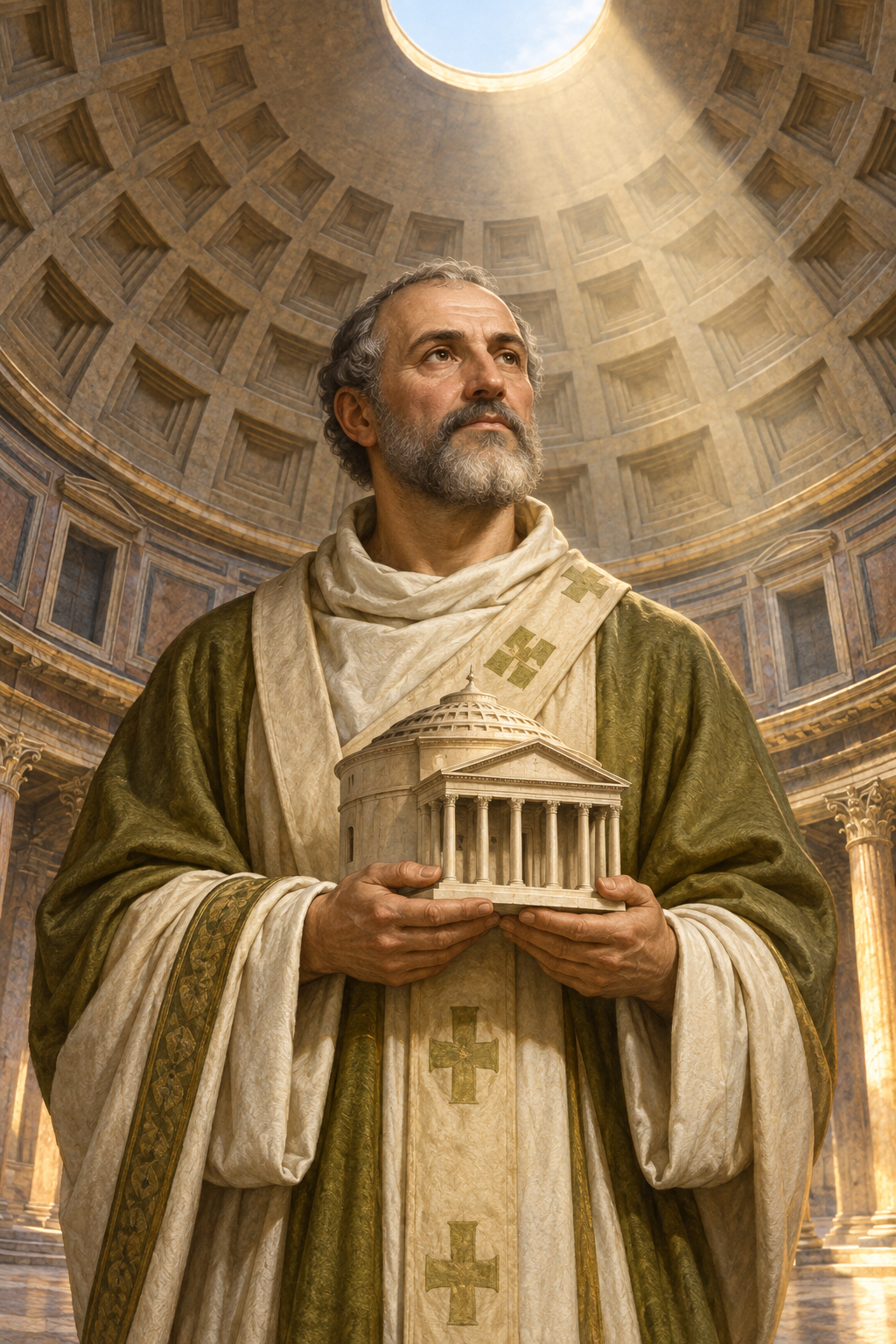
About Pope Boniface IV
Boniface IV came from the Marsican territory of central Italy, according to the Holy See's papal list. It does not give a birth year or identify a town. Before he was pope, he served the Roman church under Gregory the Great. Treccani describes his work as a dispensator, a role connected with managing church resources, and the Catholic Encyclopedia also remembers him as a deacon. These reports reveal administrative experience, but they do not supply a full picture of his early life. After the death of Boniface III, the Roman see remained vacant for more than nine months. The Holy See dates Boniface IV's pontificate from August 25, 608, to May 8, 615. He inherited a church whose relationships with imperial officials, Italian neighbors, and new communities abroad required attention.His most visible act concerned a Roman building already ancient in his lifetime. The emperor Phocas granted the Pantheon to Boniface, and the pope had it prepared for Christian worship. In 609 he dedicated it to Mary and all the martyrs, under the name Santa Maria ad Martyres. The Italian Ministry of Culture records the transfer and dedication, while Treccani dates the ceremony to May 13. Boniface did not build the Pantheon or erase its earlier Roman history; he changed its use and placed it in the worshiping life of the city. The surviving building makes that choice unusually concrete. Its dedication day is a date in the history of the church and monument, not the same event as the later observance of Boniface himself.Boniface's responsibilities reached beyond Rome. Treccani describes difficulties caused by the Three Chapters controversy among churches in northeastern Italy and his dealings in a region where Lombard and imperial interests overlapped. A letter from Columban addressed the pope sharply about that dispute. The record should not turn these disagreements into a simple tale in which one bishop settled every faction. In 610, Mellitus of London came to Rome and attended a gathering concerned with monastic life; he returned with messages for the church in England. The Catholic Encyclopedia cautions that some texts later attributed to this synod and related letters are doubtful. Boniface's contact with England is real, but a careful biography avoids quoting disputed documents as certain papal decrees.The years of his pontificate brought famine, disease and flooding to parts of Italy. Treccani cites his epitaph's memory of almsgiving and aid to affected people. These accounts should be treated as evidence of a pastoral priority, without an invented daily itinerary or precise tally of those helped. The same reference presents his dealings with Lombard neighbors as a policy of conciliation amid wider political change. This was not a peaceful age simply because war sometimes paused: religious conflict and imperial pressures remained. Boniface's work combined worship, administration, correspondence and practical care. Those strands are more securely documented than the later devotional details sometimes attached to his name.The Holy See gives May 8, 615, as the end of Boniface's pontificate, and Vatican News lists his saint's day on May 8. Treccani also dates his burial at St. Peter's to that day. Older references preserve a different May 25 martyrology notice, a sign that calendar history needs to be kept distinct from his best-supported death date. The inherited May 13 catalog value points instead to the dedication of Santa Maria ad Martyres. His saint record therefore uses May 8 for his observance and treats the Pantheon dedication as an event of his ministry. The portrait's model building and imagined dome represent that history, not a preserved likeness or proof he held a miniature monument. The church within the Pantheon remains the strongest visible reminder of his pontificate.
Wondering how to weigh the stories and sources? Learn how to read a saint biography.