Biography
Pope Eugene I
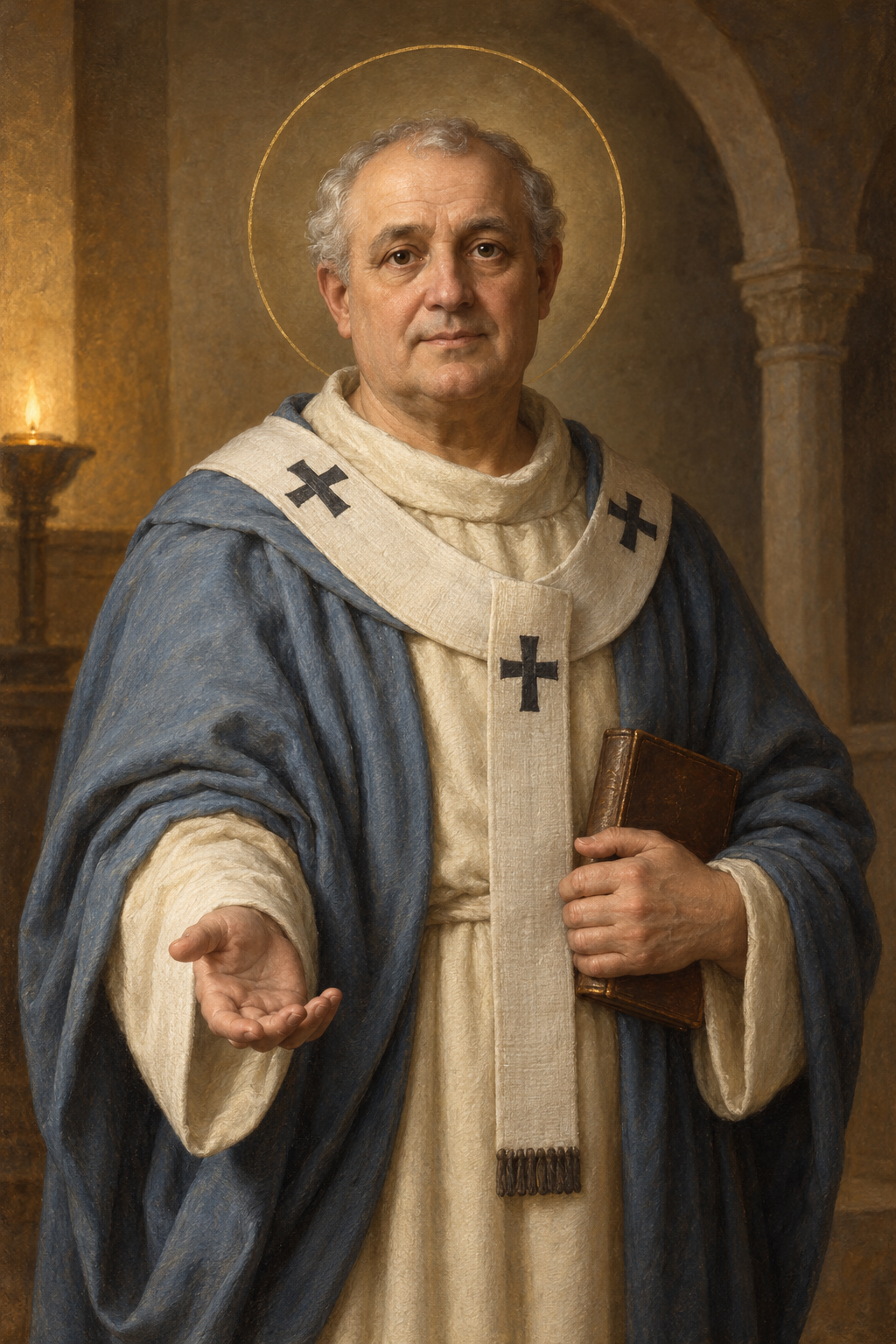
About Pope Eugene I
Eugene I became bishop of Rome on 10 August 654 and served until his death on 2 June 657. He was a Roman whose brief pontificate began while his predecessor, Martin I, was still alive in exile.
His family lived in Rome’s first ecclesiastical region, associated with the Aventine. His father was named Rufinianus, and Eugene had belonged to the clergy from childhood. The surviving account gives no birth date and little detail about his earlier ministry. He entered the historical record as the Church in Rome faced a severe conflict with the imperial government.
During Martin’s absence, the archpriest, archdeacon and chief notary had carried responsibility for the Roman church’s administration.
The emperor Constans II had ordered Martin’s removal. After imperial troops took him from Rome, the clergy were instructed to choose another bishop. Eugene’s consecration followed more than a year later. John Healy’s study of the episode stresses how little direct evidence survives about the election itself. The emperor approved it, but the surviving material does not explain all the decisions made by Eugene or the Roman clergy.
The underlying religious dispute concerned Christ’s will and activity. Constans’s decree, the Typos, tried to silence discussion of whether these should be described as one or two. Martin’s Lateran council in 649 had condemned the decree and the doctrine of one will. Eugene therefore inherited a situation in which an attempt at agreement with Constantinople could also appear to surrender what Rome had already defended.
Martin’s position made the succession especially difficult. From exile he complained that help had not reached him from Rome, yet he prayed for the Roman people and their new pastor. Healy distinguishes this acceptance from proof of a formal resignation or advance permission for the election. He also finds no evidence that Eugene personally caused the failure to supply Martin with necessities. The relationship cannot be reduced to a simple story of betrayal.
Eugene’s representatives appeared in Constantinople seeking renewed communion with the patriarch Peter. Pauline Allen and Bronwen Neil examine this mission in the documents surrounding Maximus the Confessor’s trial. Those documents suggest that the envoys were approaching an agreement, but they do not settle how fully their actions represented the pope’s instructions. The mission belongs to a wider effort to heal a division whose theological and political consequences had become inseparable.
An account preserved in the Liber Pontificalis describes the decisive protest in Rome. Peter’s statement of faith was judged unclear about Christ’s will and activity. The clergy and people reacted so strongly that Eugene could not celebrate Mass at Santa Maria Maggiore until he promised to reject it. The attempted reconciliation therefore met opposition within his own church, and he abandoned acceptance of the patriarch’s letter.
The contents and sequence of these negotiations require care. Sansterre concludes that no one can say with certainty whether Eugene’s representatives exceeded their mandate or what agreement they reached. A later exchange involving Maximus and monks in Cagliari has often been linked to Eugene’s rejection of Peter’s letter. Its revised dating places it in 658, under Eugene’s successor Vitalian, so it cannot establish what caused the earlier Roman protest.
By September 656, Eugene had fallen out of favor with the imperial party. Allen and Neil describe officials threatening to dispose of the pope and those who supported his position in Rome. The threat reveals the pressure surrounding his decision, although it does not prove that an operation to arrest him was carried out.
Other encounters preserve a quieter side of his ministry. The young English pilgrim Wilfrid came to Rome to learn its ecclesiastical and monastic practice. Archdeacon Boniface introduced him to the pope, who prayed over him and blessed him. The visit connected Eugene’s short Roman ministry with a church far from the imperial negotiations. The papal record also credits him with consecrating twenty-one bishops.
At the request of the Frankish king Clovis II, Eugene also granted a privilege to the monastery of Saint-Maurice at Agaune. Sansterre notes that the surviving document was reworked in later centuries, while retaining elements of the original. Its later transmission complicates the evidence for this act.
The contemporary papal biography remembers his material care for others. It says that he supplied the customary clergy stipend and gave alms to those in need. Even on the day of his death, he directed that the full allowances be distributed to the poor, clergy and household. Its praise of his gentleness stands beside this concrete description of provision.
Eugene was buried at Saint Peter’s and is commemorated on 2 June. His memory continues in places that have explicitly chosen his name. Saint Eugene’s parish in Santa Rosa, California, says it was named after Pope Eugene I and became the cathedral of the new diocese in 1962. This local dedication keeps his name before its congregation.
Wondering how to weigh the stories and sources? Learn how to read a saint biography.