Biography
Pope Eusebius
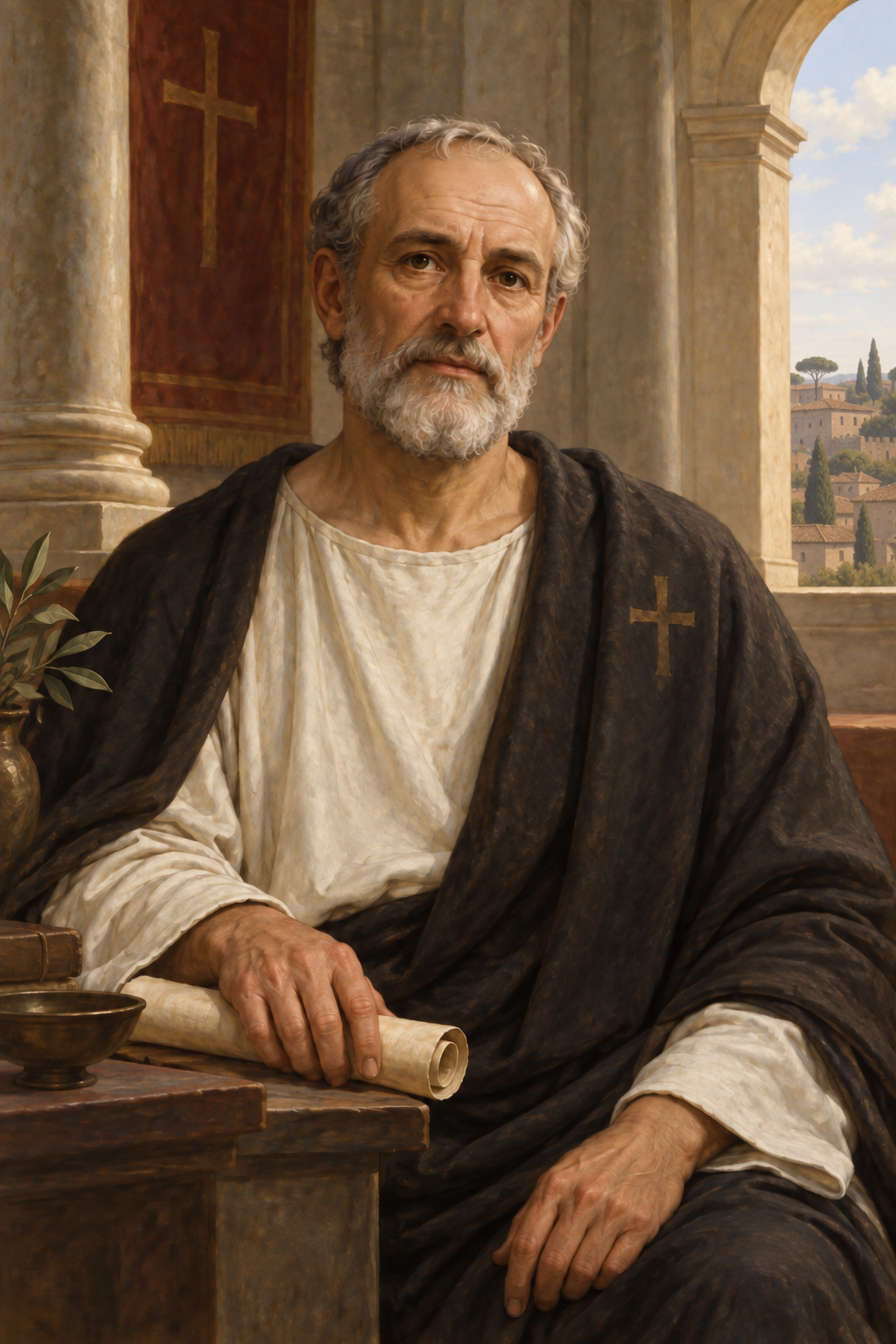
About Pope Eusebius
Eusebius was bishop of Rome for only a short time near the end of the great persecution of Christians in the Roman Empire. The Holy See lists him as the thirty-first pope and dates his term to 309. A modern critical history, however, finds the year uncertain: scholars have placed the same brief episcopate in 308, 309, or 310. The evidence is firmer for the conflict that marked his leadership than for his birth or the exact length of his office. The Holy See's list gives Greece as his birthplace, but the critical account treats the late story of Greek origin as uncertain. No exact birth year or birthplace should be presented as established.Roman Christians faced a painful question after some believers had renounced their faith under pressure during persecution. These people were known as the lapsi, or those who had fallen away. They sought a way back into the church, but members of the community disagreed over what repentance and readmission required. Eusebius inherited a dispute that had already divided Christians during the episcopate of his predecessor Marcellus. The conflict concerned real people, not merely a theoretical rule: some wanted reconciliation after danger had passed, while others feared that immediate readmission without penitence would neglect the gravity of what had happened. The surviving evidence does not preserve the views of every person caught in that division.The most important witness to Eusebius's part in the dispute is a later epitaph composed by Pope Damasus for his tomb. It names a cleric called Heraclius as the opposing leader and portrays Eusebius teaching penitence to those seeking return. Damasus also describes the Roman community as split and disturbed by violence. The inscription was written decades after the events, and its language honors Eusebius; it should be read as an early memorial, not as a transcript of every debate. Fragments of the original and a later copy are associated with Eusebius's crypt in the Catacombs of Saint Callixtus. The inscription gives a rare view of the church's internal struggle at a moment of change.The disagreement became serious enough for the emperor Maxentius to intervene. Damasus says that both Eusebius and Heraclius were sent away. Eusebius went to Sicily and died there in exile. Later historical reconstruction places his death at Syracuse, but the epitaph itself supplies only the Sicilian setting. An account of his exile therefore needs to distinguish the place attested in the early witness from a more specific later conclusion. He was not described as having been executed. Damasus honored him as a martyr because of his suffering and exile, while a critical review notes that other ancient calendars did not all use that title. The different labels record a history of veneration, not proof of a violent death.The dates in the early records are difficult to reconcile. The Liberian Catalogue gives April 18 and August 17 for the beginning and end of Eusebius's episcopate, but its stated length does not match that interval. Di Berardino also notes that the year depends on disputed reconstructions of the papal succession. The Holy See's modern list uses 309; that is a legitimate conventional date but does not remove the historical uncertainty. An ancient September 26 commemoration cannot safely be converted into a precise death date. The date of a memorial and the date of a person's death may follow different histories, especially when a body was later returned for burial. Keeping the death year blank is more accurate than choosing among the competing chronologies without enough evidence.Eusebius's body was brought back to Rome and placed in a separate crypt at the cemetery of Callixtus on the Appian Way. The catacomb's custodians describe its marble-lined burial space and the later monument bearing Damasus's poem. The setting matters because the surviving inscription connects a specific remembered bishop with the conflict described in literary accounts. The crypt is evidence of continued Roman devotion to Eusebius after a death away from his church. It does not settle every chronological question about his episcopate or prove the details of later stories. The physical place and the text together give more dependable evidence than decrees attributed to him in much later collections, which critical scholarship judges spurious.His calendar history also changed. An older Roman martyrology names Pope Eusebius on September 26, in line with early calendar evidence discussed by Di Berardino. Vatican News now lists him among the saints of August 17. The two dates should be described by their sources and periods, not silently merged into a single supposed death anniversary. Nor should August 17 be used to erase evidence that earlier Roman devotion kept September 26. The later shift in observance is a calendar decision; it cannot resolve the historical question of when he died. His profile therefore uses the current Roman Catholic date while preserving the older one as a cited part of his reception.Eusebius is remembered for insisting that return to communion after apostasy involved repentance, while still allowing a path to reconciliation. The Damasan epitaph makes that stance the center of his brief life in office. It also preserves the consequence: division, imperial exile, and death far from Rome. His memory remained attached to the crypt where his body was later placed, and later Catholic calendars continued to name him. The record leaves his family, birthplace, precise episcopal year, and death date uncertain. Its strongest testimony is the early witness to a leader trying to guide a divided community through a grave pastoral question.
Wondering how to weigh the stories and sources? Learn how to read a saint biography.