Biography
Pope Hormisdas
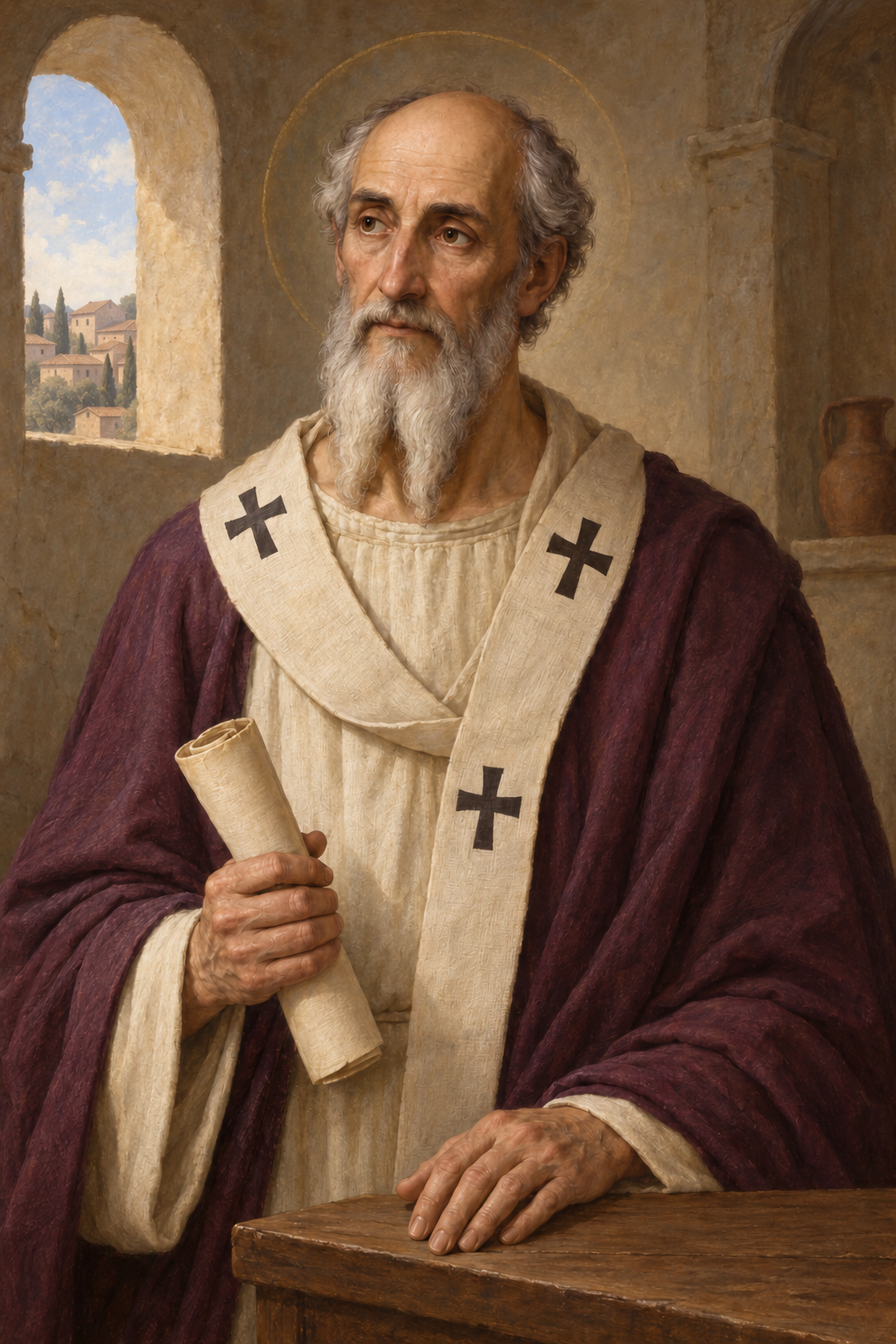
About Pope Hormisdas
Hormisdas was bishop of Rome from 20 July 514 until 6 August 523. His pontificate is remembered especially for the restoration of communion with Constantinople after a division that had lasted for more than thirty years.
Born at Frosinone, he had been married and was the father of Silverius, who later became pope. Silverius composed his father’s epitaph, remembering both his Roman ministry and his efforts toward reconciliation. Hormisdas served as a deacon under Pope Symmachus. In 501 he read to a Roman synod a disputed document about papal elections and church property. His role placed him within the difficult arguments over ecclesiastical authority that preceded his own pontificate.
One early task was to receive adherents of the rival Laurentian party who had not yet returned to communion. A more enduring division separated Rome from Constantinople. The dispute involved the Council of Chalcedon and the standing of Acacius, a former patriarch whose name Rome required to be condemned. Hormisdas inherited this conflict; it had begun in 484, long before his election.
Emperor Anastasius reopened negotiations while facing a revolt led by Vitalian. Hormisdas sent envoys in 515 and again in 517, but neither mission achieved reconciliation. His representatives carried detailed instructions and a profession of faith for Eastern bishops to sign. The imperial change in 518 transformed the situation: the new emperor Justin supported Chalcedon and sought renewed communion with Rome.
The correspondence reveals a deliberate combination of peace-making and firm conditions. In his reply to Anastasius, Hormisdas welcomed the opening of communication and prayed for the church’s unity. Yet he asked to know the proposed council’s business before giving a fuller answer. The surviving profession of faith required adherence to Chalcedon and Pope Leo’s teaching, condemnation of named opponents, and communion with the apostolic see. It also demanded that those excluded from that communion should no longer be commemorated during worship.
Political interests accompanied the religious negotiations. In the published abstract of his study, Marco Cristini argues that King Theoderic influenced the embassies partly in hope of securing imperial recognition for his intended heir, Eutharic. The king’s involvement places the search for church unity within the relations between Gothic Italy and the Eastern empire.
A new papal delegation reached Constantinople in 519, and Patriarch John accepted the profession of faith. The settlement of 28 March restored communion between the two sees. It did not remove every disagreement. John prefaced his acceptance with language joining the older and newer Rome, while provincial resistance continued. Sardella emphasizes that the legates remained in the East for more than a year as they dealt with churches that had not accepted Rome’s terms.
The difficulty was particularly visible at Thessalonica, where Bishop Dorotheus resisted the profession. Violence against members of the papal mission intensified the dispute. Although Hormisdas sought his removal, Dorotheus eventually retained his see. The older historian James Barmby also notes the objections of Eastern communities unwilling to condemn deceased bishops whom they honoured. Reconciliation had therefore to be worked out among particular churches and their memories, as well as announced by rulers and patriarchs.
A further controversy involved Scythian monks who proposed a formula about one of the Trinity suffering in the flesh. Hormisdas resisted adding their expression to the established definitions. Barmby explains that the concern involved how Christ’s divine and human natures were spoken of together. The dispute did not settle permanently against the monks’ wording: later teaching accepted the qualification that God suffered in the flesh.
His letters to Spain addressed the ordinary formation and accountability of church leaders. He opposed payments for ordination and insisted that candidates should be tested through service rather than advanced abruptly. He also called for regular provincial councils. Where circumstances prevented the customary two meetings a year, the bishops were at least to assemble once. In appointing Sallustius his representative in Baetica and Lusitania, he preserved the established privileges of metropolitan bishops and required reports of decisions made.
He commissioned Dionysius Exiguus to bring Greek synodal canons into a Greek and Latin collection. Such work connected the church’s Eastern and Western traditions.
Hormisdas died at Rome and was buried at Saint Peter’s. His Catholic commemoration is listed on 6 August by Vatican News. Frosinone honours him jointly with Silverius as a patron of the city. This relationship remains part of local worship: the diocese’s 2026 calendar announces a cathedral Mass and procession for their shared solemnity on 20 June.
In 2015 the diocese organized visits of the patrons’ relics to parishes across Frosinone. The reliquary, made for the preceding anniversary of Hormisdas’s election, reproduced a “Tower of Peace” associated with his profession of faith. The report also connected the anniversary with cathedral restoration and support for a local meal service for poor people. His remembrance joined the memory of an ancient reconciliation with the practical life of his home city.
Wondering how to weigh the stories and sources? Learn how to read a saint biography.