Biography
Pope Leo II
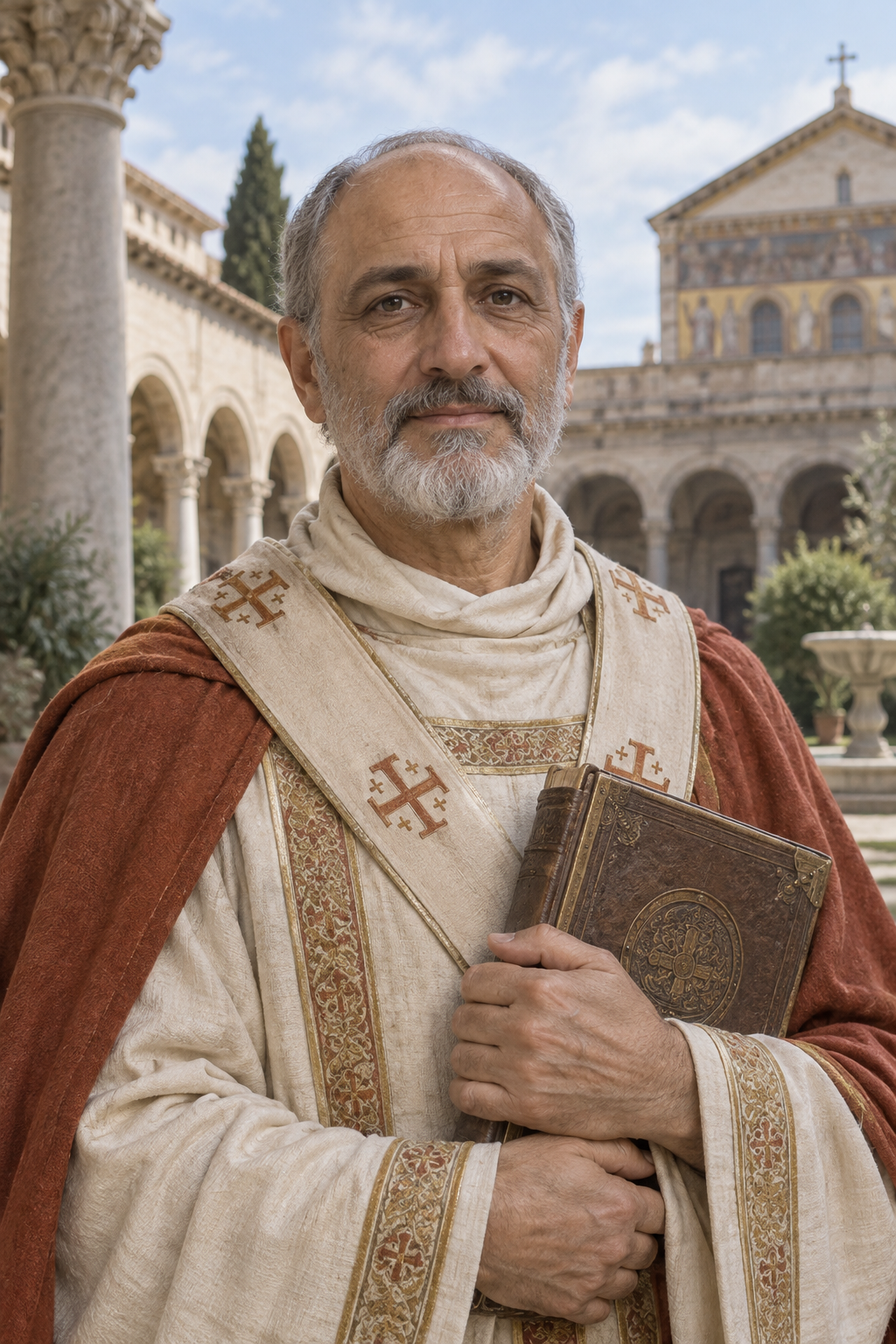
About Pope Leo II
Leo II faced doctrinal conflict. His birth year is unknown. Elected after Agatho's death, he was consecrated on August 17, 682, and served for less than a year before his death in 683.
Election did not immediately allow him to begin his episcopal ministry. News had to travel between Rome and the imperial court at Constantinople, and imperial authorization preceded his consecration. Susi's reconstruction places the election in January 681, leaving a prolonged interval before the August 682 consecration. The delay placed his first decisions within a Church whose relations with the imperial court required prolonged negotiation. In Susi's interpretation, the imperial court used the vacancy to strengthen its position while the council completed its work. Leo inherited that tension: agreeing on doctrine did not remove competing understandings of the authority of emperor and pope.
The main question awaiting him was the reception of the Third Council of Constantinople. Emperor Constantine IV sent him the council's proceedings and entrusted opponents of its decisions to his judgment. In the emperor's letter, Christian division was a wound that required the cooperation of bishops and ruler. Constantine also asked Leo to appoint a representative at the imperial court.
Leo confirmed the council's teaching of Christ's divine and human wills. His confirmation included the condemnation of Honorius, an earlier pope. Writing to the Spanish bishops, he faulted Honorius for failing to suppress error. He also sought acceptance of the council beyond Rome, sending its decisions to Spain and addressing King Ervig as well as church leaders.
The teaching Leo accepted concerned the completeness of Christ's humanity, not two rival personalities within him. The council insisted that he was fully human as well as divine, and that a real human nature included the capacity to will and to act. It rejected the claim that acknowledging his divinity required denying that human capacity. For the bishops, the two wills belonged to one Christ, without division or confusion. Their explanation made salvation inseparable from his genuinely human life and actions. The bishops addressed this explanation to the emperor, answering the objection that a human capacity for choice would place Christ in conflict with God. They described his human willing as obedient to the divine will, rather than something abolished by it.
On January 6, 683, he reconciled Anastasius and Leontius after they accepted the Church's profession of faith.
Leo also completed an agreement concerning the archbishop of Ravenna. Agnellus, writing in the ninth century, describes negotiations begun under Agatho and concluded by Leo after his predecessor's death. Agnellus says Archbishop Theodore had secretly asked Agatho to invite him to Rome; the later historian's account is not a contemporary record of Theodore's motives. Ravenna would elect its own candidate, but the new archbishop would receive consecration at Rome. His required stay there was limited to eight days, and he would subsequently send a representative for the annual feast of the apostles rather than being required to return personally. In this account, Leo confirmed written terms with his clergy: the restoration of Roman authority involved practical concessions, not simply a demand that Ravenna submit without conditions.
His responsibilities within Rome included places of worship. The papal biography credits him with Saint Paul's church near Bibiana. This was a separate foundation from Saint Bibiana itself. Whether the work created an entirely new structure or adapted an older building is not established. Another church, San Giorgio in Velabro, became associated with his name through a later addition to the papal biography; that attribution should not be treated as equally secure.
The Spanish reception of the council continued after Leo's death. Benedict II, his successor, renewed the request through the notary Peter. King Ervig arranged for provincial consideration when a general Spanish gathering could not be assembled, and representatives of the other metropolitan churches attended at Toledo. The Fourteenth Council of Toledo, meeting in November 684, recalled receiving the proceedings and his request for their acceptance. Its account explains that the documents had arrived after another general council had closed, while bad weather made an immediate new gathering impracticable. Provincial assemblies first examined them; the Toledo meeting then compared the teaching with earlier councils. Leo's correspondence therefore began a process that depended on other bishops reading, discussing and accepting what he had sent, rather than a single act of publication in Rome.
He ordained clergy on June 27, 683, died afterward, and was buried on July 3. His exact day of death remains uncertain.
A glimpse of the world in which he worked survives at Santa Sabina in Rome. Fabrizio Bisconti interprets a recovered fresco there as a remembrance of the return of the papal delegates from the council, carrying books. The painting is not a secure portrait of Leo: Bisconti does not identify him among its figures. It instead preserves a visual memory of the Roman Church receiving the decisions whose acceptance became his principal task.
Wondering how to weigh the stories and sources? Learn how to read a saint biography.
Explore similar vocations
Prayers for Pope Leo II
Pope Leo II: petition
O Eternal Shepherd, watch over the peace of Thy flock.