Biography
Pope Paschal I
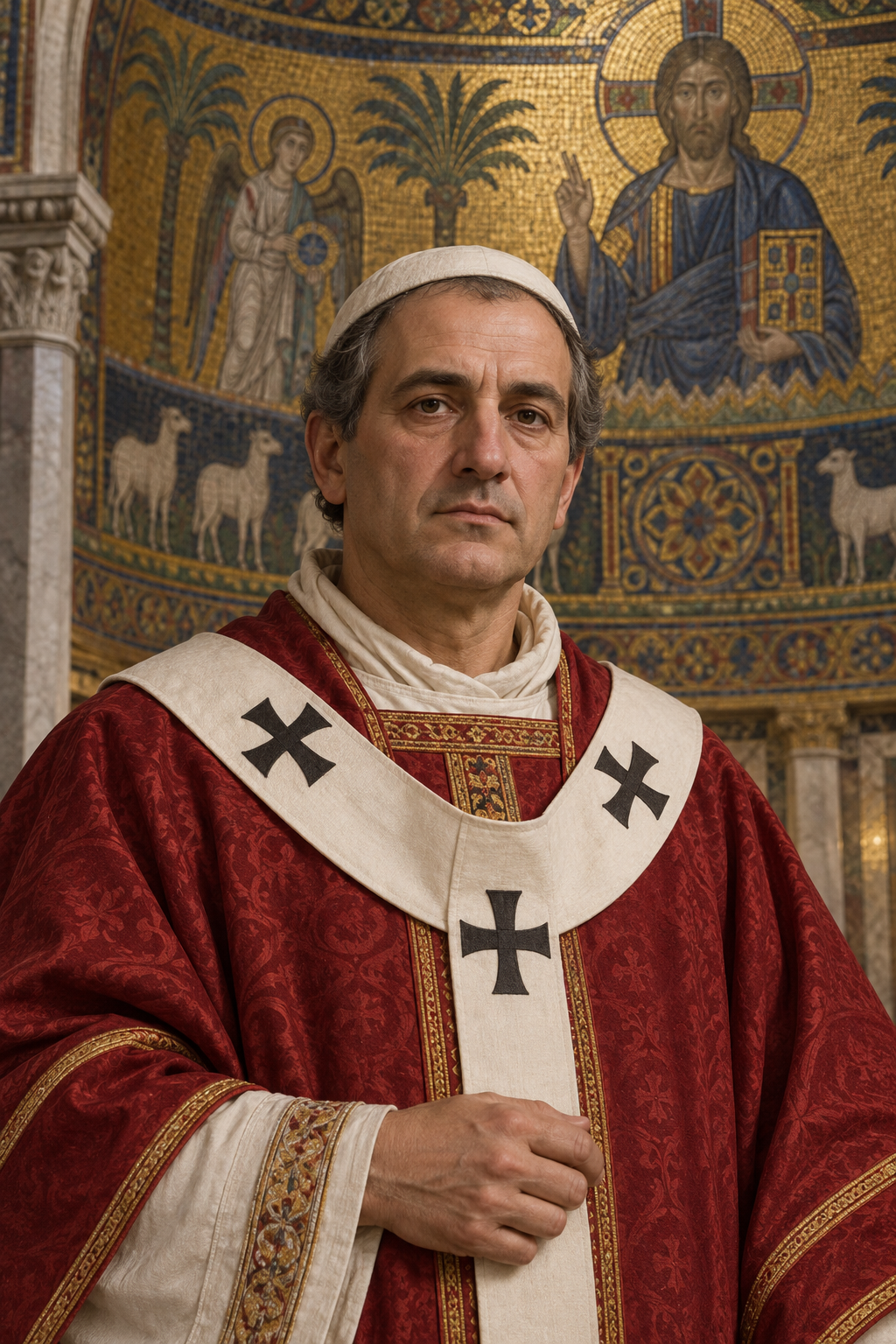
About Pope Paschal I
Paschal's life before his election is known chiefly through the Liber Pontificalis, a collection of papal biographies written from a Roman church perspective. A modern Treccani study identifies his parents as Bonosus and Theodora and places his birth in the later eighth century, perhaps in Rome. It traces his formation at the Lateran and his service first as a subdeacon and then as a priest. Under Pope Leo III he became rector of the monastery of Saint Stephen near Saint Peter's, whose monks supported the basilica's daily worship. The account praises his personal generosity to people in need. That praise belongs to a biographical source interested in commending him, while his office and work in the monastery provide a firmer outline of the career that preceded his election.He succeeded Stephen IV in January 817. The Holy See records January 25 as the beginning of his pontificate, while Treccani thinks the election was probably the following day, another reason not to make the exact day central to his story. He quickly sent envoys to Louis the Pious, the Frankish emperor, to report the election and maintain the relationship between Rome and the Carolingian court. The resulting agreement reaffirmed papal claims to territories and addressed support for future papal elections. These were political negotiations as well as church affairs. Paschal was responsible for a Roman community that depended on rulers beyond the city for defense, yet also sought room to govern its own institutions.A separate challenge came from Constantinople, where imperial opposition to the veneration of sacred images had revived. Treccani describes an eastern embassy that reached Rome soon after Paschal's election. A Greek response attributed to him argued for the use of images with citations from earlier eastern Christian writers. Only part of this exchange survives, and the exact composition of the embassy is uncertain. The evidence nevertheless makes his position clearer than a later legend could: he opposed the iconoclastic policy and maintained contact with eastern Christians who defended images. Monks displaced by conflict in the East may also have helped shape the Roman church projects that followed, though the degree of their role cannot be fixed from the surviving record.Paschal's church building gave visible form to that religious and political setting. The Liber Pontificalis, compared with surviving monuments by Treccani, links him to a chapel of Saints Processus and Martinian near Saint Peter's and to the rebuilding of Santa Prassede, Santa Maria in Dominica, and Santa Cecilia. The mosaics at Santa Prassede and Santa Maria in Dominica emphasized Christ, Mary, and the saints in a city where the proper use of images was under debate. These churches were not simply decorations of a papal reputation. They became places of worship, monastic service, and collective memory. Their surviving fabric and inscriptions allow some parts of the ninth-century building program to be studied even when written accounts are incomplete.The rebuilding also changed the location of devotion to martyrs. Paschal arranged the transfer of many relics from suburban cemeteries and catacombs to churches inside Rome. An inscription still associated with Santa Prassede states that the remains of 2,300 martyrs were moved there by his order. The figure records what the church publicly claimed; it is not an independently counted inventory of every body. Treccani regards the large-scale movement as a distinctive feature of his pontificate. At Santa Cecilia, the later papal biography includes a dream in which the martyr revealed her burial place. The translation of relics is part of the historical program, while the dream remains a hagiographic explanation rather than a verified occurrence.After about 820 the sources describe fewer major Roman building projects and more dealings with the Franks. In 823 Paschal crowned Louis's son Lothar in Rome. The relationship then became strained over an abbey's rights and over rivalry within the city. Two Roman officials connected with the imperial side, Theodore and Leo, were imprisoned, blinded, and killed. Frankish investigators suspected that Paschal had ordered the violence. Treccani reports that he denied responsibility under oath before a synod but defended the men who carried out the killings. The surviving accounts do not justify treating the accusation as a proven verdict, nor do they allow the deaths to be passed over as a minor dispute. They reveal how dangerous Roman church politics could become.Paschal died in 824. Treccani judges February 11 probable and reports that hostility in Rome affected the circumstances of his burial. The Holy See leaves the end of his pontificate within a wider February-to-May range, so this catalog stores only the year. Vatican News records his Catholic commemoration on February 11; a feast date is not proof of the day of death. His surviving churches make his artistic and devotional program unusually tangible for an early medieval pope. At the same time, the unresolved political violence of his final years belongs in the account. Both strands help explain the influence and limits of Roman papal authority under the Carolingians.
Wondering how to weigh the stories and sources? Learn how to read a saint biography.