Biography
Pope Pius V
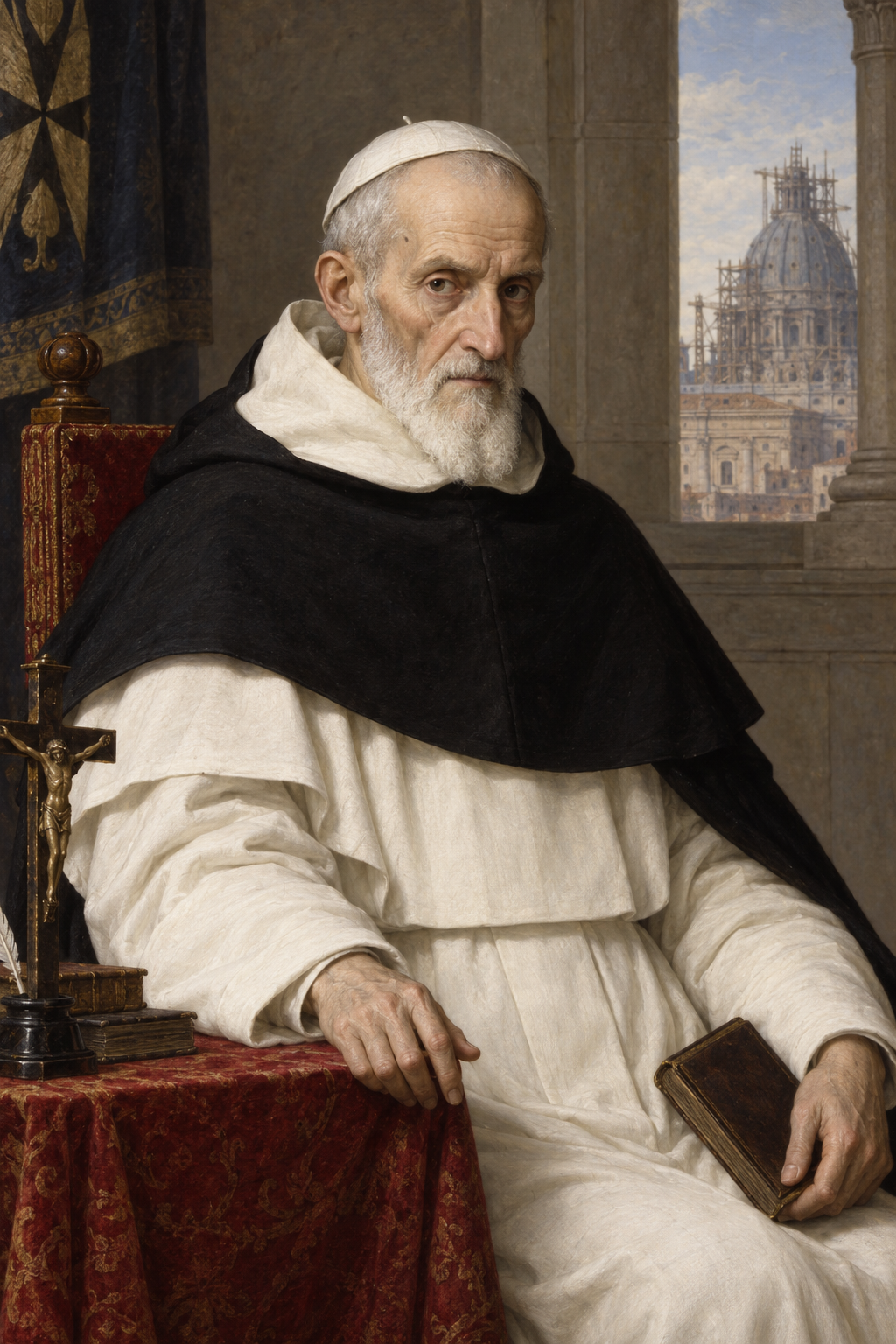
About Pope Pius V
Antonio Ghislieri was born in 1504 at Bosco Marengo, near Alessandria in northern Italy. Two official Vatican institutions give different January days for his birth: Vatican City State says January 17, while the Dicastery for the Causes of Saints says January 27. This profile therefore records the year without choosing a day that the reviewed sources do not reconcile. Treccani describes a family of modest means and says that he entered the Dominican convent at Voghera at fourteen, taking the religious name Michele. He continued his studies at Bologna and was ordained a priest in 1528. These are the foundations of his public career; details of his private childhood are not established by the sources used here.He taught and worked in Dominican communities before taking offices in the Roman Inquisition. Treccani names his service as a commissioner of that institution, then his appointment as bishop of Sutri and Nepi in 1556, cardinal in 1557, and chief inquisitor in 1558. His rise was tied to the Catholic response to the Reformation and to debates within the church about how to enforce doctrine and reform conduct. The inquisitorial posts were not merely scholarly titles: they belonged to an institution that investigated and punished religious dissent. A responsible account of Pius cannot describe his theological convictions and later reforming work while leaving that coercive authority out of view.After Pius IV died, Ghislieri was elected bishop of Rome in January 1566 and took the name Pius V. He became pope shortly after the Council of Trent had completed its work, so decisions made at the council still had to be applied across dioceses and religious communities. Treccani says he opposed nepotism, reshaped the papal court, pressed for clerical discipline, and insisted that bishops reside in their dioceses. He appointed visitors to examine clergy and required regular synods as a way to spread the council's decisions. These measures were administrative as well as spiritual: they changed who supervised local ministers and how church teaching and conduct were checked. They also reflected his austere expectations of others, which contemporary Catholics did not all experience in the same way.Pius also sponsored common texts for Catholic teaching and worship. The Roman Catechism was published in 1566, the revised Breviary in 1568, and the Roman Missal in 1570. Treccani places these editions within his effort to apply Trent and to make instruction and public prayer more consistent. The texts were the work of many scholars, editors, and church officials; describing them as papal acts identifies his sponsorship rather than solitary authorship. He commissioned work on the Latin Bible and named Thomas Aquinas a Doctor of the Church in 1567. He also established the Congregation of the Index of Forbidden Books in 1571. That institution is another reminder that reform of teaching included the restriction of texts and ideas judged unacceptable by his government.The Dicastery for the Causes of Saints also describes his attention to people facing hardship in Rome. Its biography says he supported hospitals and other relief institutions and organized food distribution and health measures during the famine of 1566. This evidence gives a more grounded view of his pastoral priorities than general praise for charity. It does not establish how many people were served or whether every plan worked as intended. His pontificate therefore joined care for the city's poor to strict regulation of church life, showing different parts of one administration rather than a single uncomplicated reputation.Outside Rome, Pius sought alliances among Catholic rulers. Treccani says he excommunicated Elizabeth I of England while trying to favor the Catholic Mary Stuart, a decision with serious consequences for Catholics living under Elizabeth's government. The same reference reports that his plan for a wider league against religious opponents within Europe did not succeed. These policies cannot be understood only as private devotion: they were acts of a religious ruler engaging in the power struggles of the sixteenth century. His commitment to Catholic unity was clear, but the means he chose could sharpen conflict and expose people far from Rome to political risk.In the Mediterranean he succeeded in bringing states into the Holy League against Ottoman naval expansion. Its fleet defeated Ottoman forces at Lepanto on October 7, 1571. The sailors and commanders fought the battle; Pius helped assemble the alliance but did not lead the ships. The Dicastery for the Causes of Saints recounts how he urged prayer of the rosary before the battle and later associated the victory with Marian devotion. Those prayers and the resulting feast are part of Catholic memory of the event. Treccani adds that the alliance largely failed to endure after the victory, so Lepanto should not be described as the permanent settlement of a wider conflict.Pius died in Rome on May 1, 1572, after a six-year pontificate. The Dicastery records his beatification by Clement X in 1672 and canonization by Clement XI on May 22, 1712. Its current liturgical entry commemorates him on April 30; an older reference such as Treccani retains May 5, illustrating how calendar placement can change without changing a person's death date. His life remains significant for the enduring Catholic books and institutions associated with his application of Trent. The record also preserves his inquisitorial and political actions, so readers can understand both the reforms for which the church honors him and the historical costs of his methods.
Wondering how to weigh the stories and sources? Learn how to read a saint biography.