Biography
Pope Simplicius
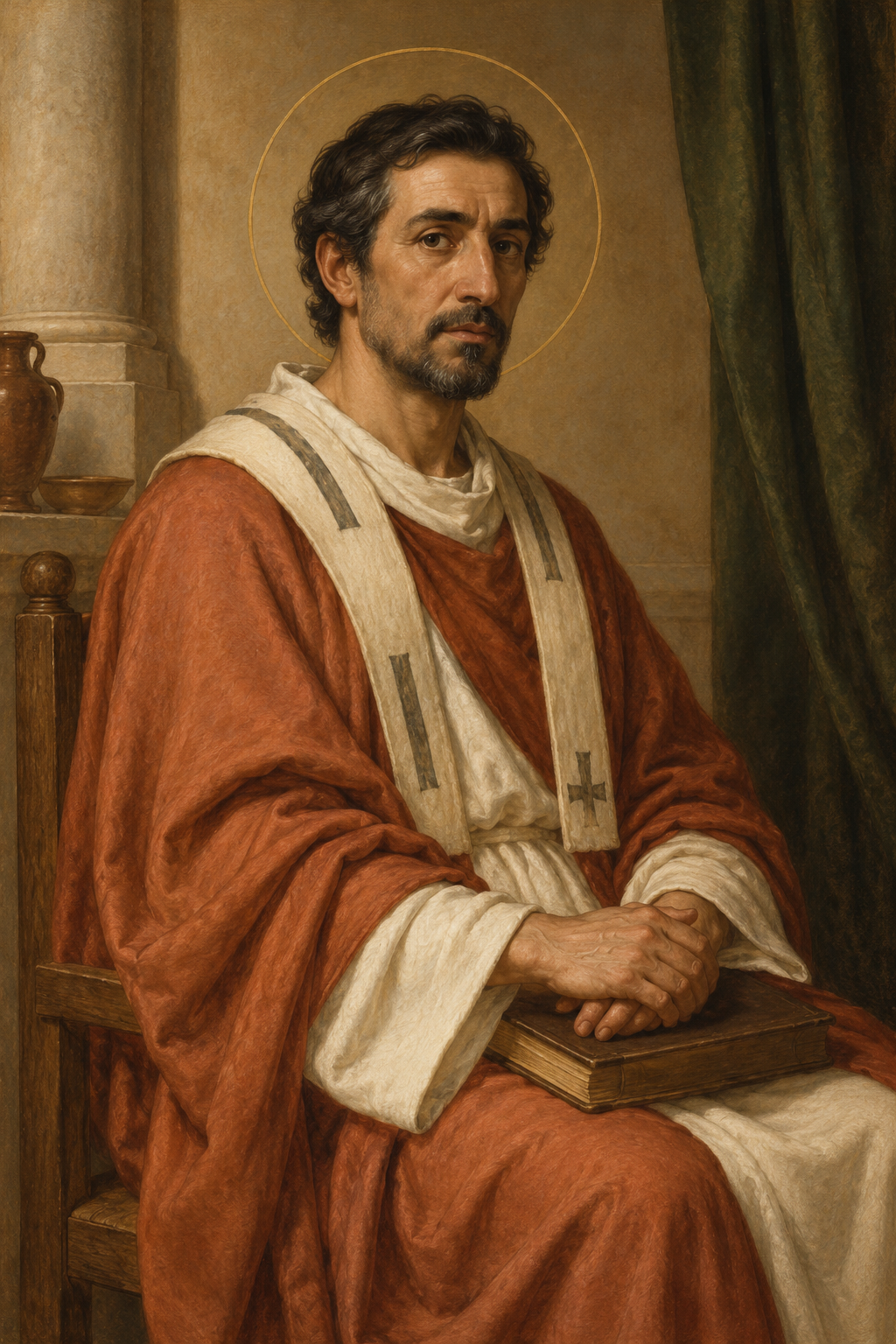
About Pope Simplicius
Simplicius was born at Tivoli and became bishop of Rome on 3 March 468. His pontificate lasted fifteen years, until 10 March 483. He governed the Roman church through the end of the Western Roman Empire and a widening disagreement with Constantinople about faith and ecclesiastical authority.
The deposition of Romulus Augustulus in 476 ended the succession of Western emperors. Odoacer became ruler of Italy, retaining much of the existing administration. Although he was an Arian Christian, the change did not bring an immediate collapse in the Roman church’s ordinary life. Simplicius continued to exercise his ministry within a political order whose highest authority in Italy was now a king rather than an emperor.
His letters show the practical responsibilities that continued amid these changes. One rebukes John of Ravenna for forcing Gregory to accept episcopal ordination. Simplicius allowed Gregory to govern the church of Modena, but warned John against repeating such coercion. The letter also addressed Gregory’s material support, arranging income from property while preserving Ravenna’s ownership. Correction of the irregular act included attention to the circumstances in which the new bishop would have to live.
Another letter concerns Gaudentius, accused of unlawful ordinations and of keeping income that should have served others. Simplicius removed his authority to ordain and ordered restitution. Only one quarter of the church’s revenue was to remain at his disposal; the other portions supported clergy, buildings, pilgrims and poor people. The financial directions make clear that episcopal resources carried obligations beyond the bishop’s own household.
In Spain, he appointed Zeno of Seville to act with the authority of the Roman see. His brief letter praises Zeno’s ministry and commissions him to protect apostolic teaching and the established decisions of the Fathers. This was a different use of correspondence: entrusting a distant bishop with responsibility for maintaining order.
The Eastern disputes proved harder to resolve. Basiliscus displaced Emperor Zeno and issued an edict rejecting the Council of Chalcedon. Simplicius wrote to defend the council’s teaching, encouraged the clergy and monks who opposed the reversal, and appealed to the emperor. His concern was both doctrinal and institutional: decisions that Rome regarded as settled were being overturned through a combination of imperial power and disputed episcopal appointments.
Zeno’s return to power brought temporary encouragement. Simplicius welcomed his profession of faith and sought the restoration of the bishop whom he recognized at Alexandria. Yet the succession there remained contested. Peter Mongus gathered support, while John Talaia’s election drew accusations from the emperor. Simplicius resisted recognition of Mongus, but his ability to direct events from Rome was limited by conflicting reports and the decisions of Eastern leaders.
Communication with Acacius of Constantinople became increasingly strained. Pennacchio notes that news sometimes reached Simplicius through monks before official information arrived from the patriarch. The two sees also differed over the grounds of their authority. Rome emphasized its apostolic inheritance, while Constantinople’s standing rested partly on its place as the imperial capital. These tensions helped prepare the division that became known as the Acacian schism.
His work in Rome included churches and the organization of worship. Santo Stefano Rotondo on the Caelian hill preserves the memory of his fifth-century foundation. Its church guide describes the original design as concentric rings combined with a Greek cross. Later rebuilding removed the outer ring. The present building therefore retains an unusual ancient form while also bearing the changes made by many later generations.
Another foundation reused a great aristocratic hall. Peter Harrington’s study examines the conversion of the hall of Junius Bassus into a church of Saint Andrew, associated with the Gothic Catholic donor Valila and Simplicius. The building retained older decoration while receiving Christian additions. Harrington treats the donation cautiously: its relationship to Rome’s community churches was complicated, and the donor’s intentions cannot simply be equated with the pope’s institutional plans.
Simplicius also arranged weekly service by priests from different Roman regions at Saint Peter’s, Saint Paul’s and Saint Lawrence’s. Harrington places this within a broader papal effort to meet pastoral and liturgical needs at the major basilicas. Such arrangements joined the care of buildings with the provision of baptism and penance for the people who came to them.
Near the end of his life, Simplicius was also concerned about the election that would follow his death. Harrington discusses the later report that he requested consultation with the secular authorities to avoid disorder. The arrangement became controversial under a later pope, revealing the difficulty of separating ecclesiastical and political responsibilities.
Simplicius died before the dispute with Constantinople reached its later crisis. He was buried at Saint Peter’s. His Catholic commemoration is now kept on 10 March, the date listed by the Diocese of Tivoli among its local saints. His correspondence and Roman foundations preserve a ministry concerned with doctrine, accountable leadership and the continuing life of Christian communities during political change.
Wondering how to weigh the stories and sources? Learn how to read a saint biography.