Biography
Pope Zosimus
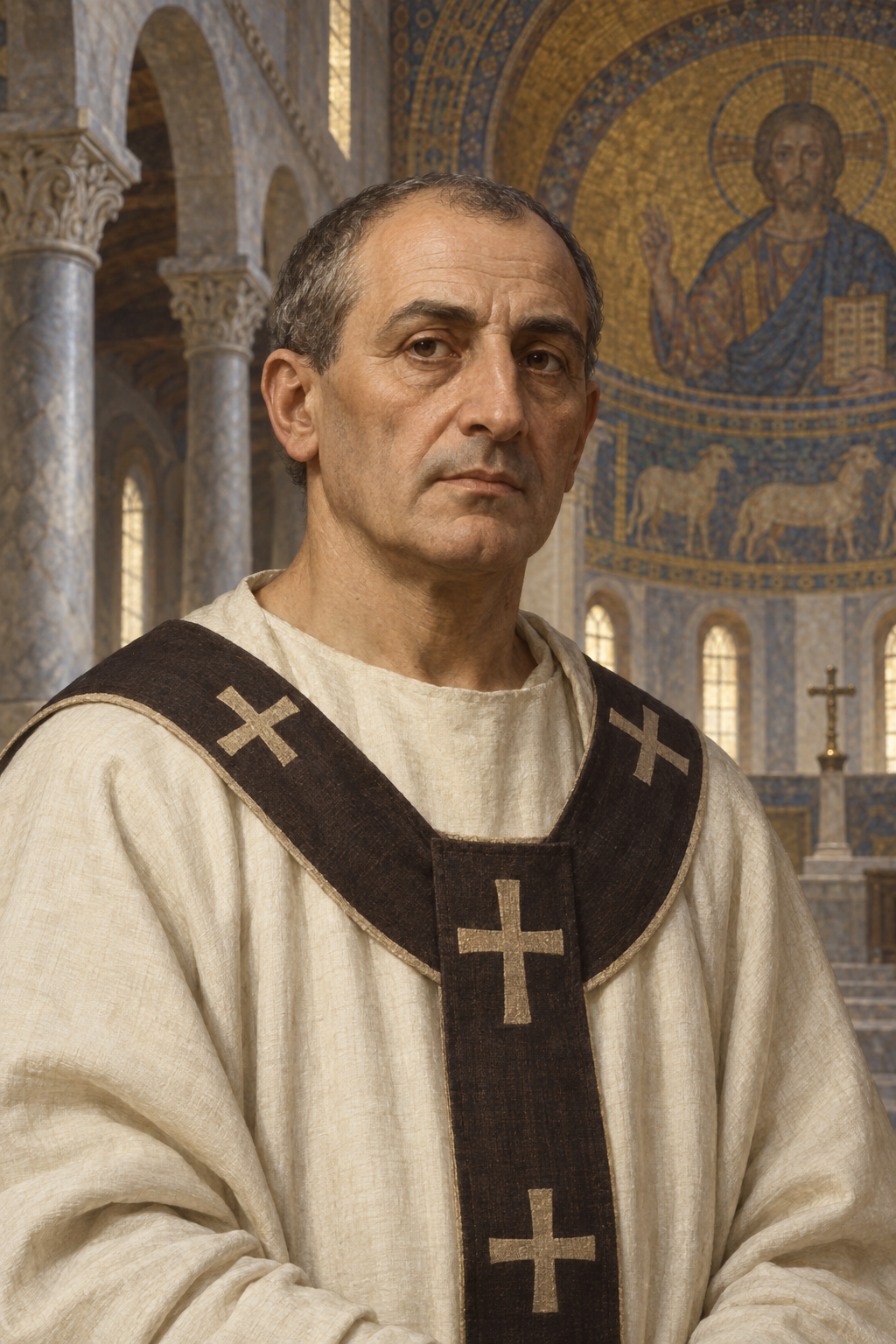
About Pope Zosimus
The Liber Pontificalis tradition, as summarized by the Catholic Encyclopedia, calls Zosimus a Greek and gives his father’s name as Abram, while cautioning that family details in early papal biographies are not always exact. Nothing reliable is known about his life before election. After Pope Innocent I died in March 417, Zosimus was elected and consecrated bishop of Rome that month. His early letters show that questions of church jurisdiction quickly became part of his work: he gave Patroclus of Arles expanded metropolitan authority in Gaul, provoking objections from bishops in Vienne, Narbonne, and Marseille. The quarrel continued beyond Zosimus’s lifetime and was not finally settled until Leo I.The best-known episode of the pontificate began when Caelestius came to Rome to defend himself against charges raised in Africa. Augustine, writing as an opponent in the controversy, preserves the sequence in detail: Caelestius appeared before the Roman clergy, declined to condemn disputed propositions about Adam and infant sin, yet professed general agreement with earlier teaching and offered a confession of faith. Augustine says Zosimus judged the African action premature and invited further evidence to be presented at Rome. This account is valuable because it preserves arguments and procedure close to the events, but its polemical purpose matters: Augustine explains the episode in a work written to refute Pelagian teaching, not as a neutral transcript of the Roman meeting.Pelagius then sent a confession and a treatise on free will. Augustine says the Roman clergy read them at another meeting and that Zosimus initially wrote to African bishops in defense of Pelagius and in criticism of his accusers. African bishops answered with additional arguments and documents. Augustine quotes Zosimus as saying that he had not yet decided the case and would not do so without consulting them. This is why the surviving record is better described as a developing investigation than as a single instant decision. The evidence shows real hesitation and a willingness to hear the case; it does not justify reducing the sequence to a simple endorsement of the teaching later condemned.The next stage came in 418, after an African council renewed its condemnation and Emperor Honorius acted against Pelagian leaders. The Oxford Handbook’s account places the imperial decree on April 30 and the African synod on May 1, with Zosimus endorsing those judgments later that summer. His circular letter, known as the Tractoria, condemned Pelagius and Caelestius and required bishops to subscribe. Augustine later described the change in emphasis as an interval of leniency followed by a repeated sentence, not as a reversal of the Church’s doctrinal position. That interpretation comes from an engaged participant, but the timeline is corroborated by the scholarly chronology and by the existence of Zosimus’s surviving correspondence.Zosimus’s work was not confined to the Pelagian question. The Presbyters Project catalogues a letter to Aurelius of Carthage and other African bishops in which the pope discusses the file of evidence on Caelestius sent to Rome by the subdeacon Marcellinus. It also summarizes Zosimus’s defense of the authority of the Roman see and his reply to African objections. This record gives a useful window on how material moved between Rome and North Africa: officials transmitted dossiers, bishops exchanged synodal letters, and a pope responded to reports rather than deciding from an isolated summary. The catalog entry is modern scholarship about a historical letter; it does not make every disputed jurisdictional assertion in the correspondence an uncontested fact.A separate dispute concerned Apiarius, a priest in Africa who appealed to Rome after his local bishop excommunicated him. The Catholic Encyclopedia says Zosimus accepted the appeal and sent legates to investigate, but based his action on a canon he believed belonged to Nicaea that was actually from Sardica. Roman manuscript collections had transmitted those canons in a sequence that could obscure the distinction, while African copies did not include the Sardican provision among the Nicene canons. The resulting conflict over clerical appeals persisted after Zosimus died. This episode reveals the practical problems of communication and manuscript transmission behind church jurisdiction; it should not be presented as a settled expansion of authority accepted by all parties.Zosimus’s death ended the immediate Roman phase of these disputes, but it did not resolve the questions of jurisdiction or clerical appeals. The Catholic Encyclopedia notes that the African bishops continued to resist the Roman claim concerning Apiarius, who was eventually restored to his position by an African council. It also says Zosimus’s letters to Gaul were later cited in arguments about the authority of Arles. These afterlives show that his letters remained part of subsequent legal debate. They do not establish that every claim he advanced was accepted across the church, and the profile distinguishes the existence of correspondence from later interpretations of its authority.The Tractoria was sent beyond Rome as a circular, asking bishops to subscribe to the condemnation. The Catholic Encyclopedia notes that some western bishops delayed or refused, and that Julian of Eclanum continued to resist the settlement. The controversy therefore remained active after the papal letter: local bishops received and interpreted the directive, while dissident writers argued against it. This context helps explain why Augustine continued to defend the African position in later works. The surviving account shows Zosimus’s formal act and the contested reception, without implying that one letter immediately ended debate across the empire.
Wondering how to weigh the stories and sources? Learn how to read a saint biography.