Biography
Procopius of Sázava
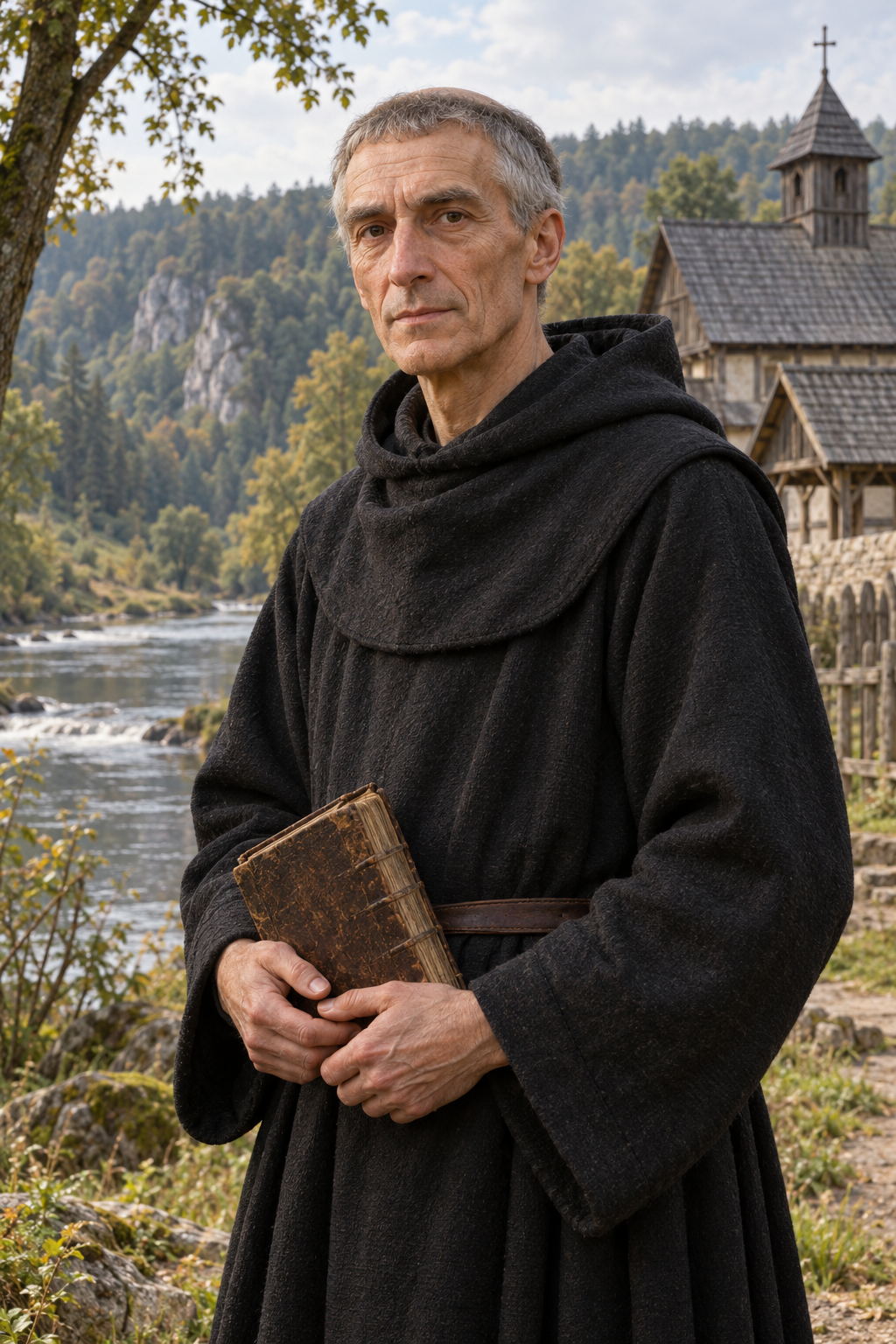
About Procopius of Sázava
Procopius of Sázava was a priest, hermit and abbot whose monastery became an important home of Slavonic Christian worship in medieval Bohemia. Pavel Spunar’s reference account places his birth around 970, although the precise year is unknown. It describes a priest who withdrew into the forests near Sázava and gathered followers around him. With ducal support, this community became a monastery following the Benedictine rule. Spunar emphasizes that the origins of its first monks remain uncertain: the sources do not establish exactly how the tradition of Slavonic worship reached them.
Later accounts place his birthplace at Chotouň and describe him as married, with a son named Jimram. The National Heritage Institute distinguishes these traditions from secure contemporary documentation. It also questions the familiar claim that he studied at a school on Prague’s Vyšehrad, since that institution belongs to a later period. His formation may instead have taken place under an individual priest. These gaps matter: the surviving narratives preserve a remembered vocation, but do not supply a complete record of his childhood or education.
Historian Petr Sommer reads the early Life of Procopius as a source shaped by the example of Benedict. Its author presents the abbot as a father to his monks, a shepherd to local people and someone who worked with his hands. Sommer also cautions that a reference to property echoes Matthew’s Gospel. It cannot simply be read as a detailed statement about what Procopius personally owned. The narrative combines individual memories with language chosen to make him recognizable as a holy monk.
Sommer finds social history within the miracle stories as well. One tells of a man prevented by a river from joining the Rogation processions until a boat came to him through the saint’s intercession. The miraculous arrival is a familiar hagiographic motif. The procession nevertheless provides evidence for how the monastery’s authors understood its pastoral relationship with the surrounding population. The story may reflect practice in Procopius’s lifetime or in the period when the account was written.
The monastery’s institutional history continued after his death. The National Heritage Institute records the expulsion of the Slavonic community in 1055, its return in 1061 and a second expulsion in 1096. Latin Benedictines from Břevnov then occupied the monastery. They continued its religious life and Procopius’s cult, while a local chronicler recorded the house’s history in Latin. The change of community and language did not bring remembrance of its first abbot to an end.
Procopius died at Sázava on March 25, 1053. His later image drew heavily on stories of power over evil. A familiar legend describes him harnessing a devil to a plow and cutting a furrow between Chotouň and Sázava. The Czech bishops’ account explicitly presents this as a tradition. It explains the plowing devil and other attributes found in devotional art; it does not establish that the landscape was formed by a supernatural event.
His recognition as a saint is traditionally associated with July 4, 1204, but the role of the papacy remains disputed. In his conference abstract, historian Petr Kubín points out that the canonization narrative survives in a later addition to the saint’s Life and that no corresponding papal acts remain. He also identifies procedural and historical problems in the story. Yet he does not dismiss the early cult: July 4 appears as Procopius’s feast in calendars beginning with the thirteenth-century Codex Gigas. The evidence supports public veneration more securely than every detail of the later canonization account. Sommer considers a purely local recognition less likely, while acknowledging that the question cannot be settled unequivocally. The disagreement concerns the route to recognition, not whether a medieval cult existed.
Procopius became a patron of Bohemia and of people whose livelihoods depended on the land. An Archdiocese of Prague notice identifies miners, farmers, winegrowers and hermits among those associated with his patronage. Its account of the Sázava pilgrimage also shows the continuing place of the church dedicated to him in local worship.
At Žďár nad Sázavou, the regional museum identifies him as the patron of the parish church and describes surviving Baroque paintings. Its account also records his invocation for protection from evil spirits. The imagery changed over time: he could appear as a simple monk or as an abbot in ceremonial vestments, sometimes holding a chained devil. These varied images belong to the history of devotion. They express what later communities sought from his protection rather than providing an authenticated likeness.
His remembrance extends beyond the Catholic Church. On March 9, 2017, the Russian Orthodox Holy Synod included Procopius in its calendar among early Western saints. Its decision listed his commemoration on September 16, corresponding to September 29 in the civil calendar then in use. The recorded decision concerns inclusion in that church’s calendar; it should not be mistaken for the beginning of all Orthodox veneration.
Wondering how to weigh the stories and sources? Learn how to read a saint biography.