Biography
Protase Hong Jae-yeong
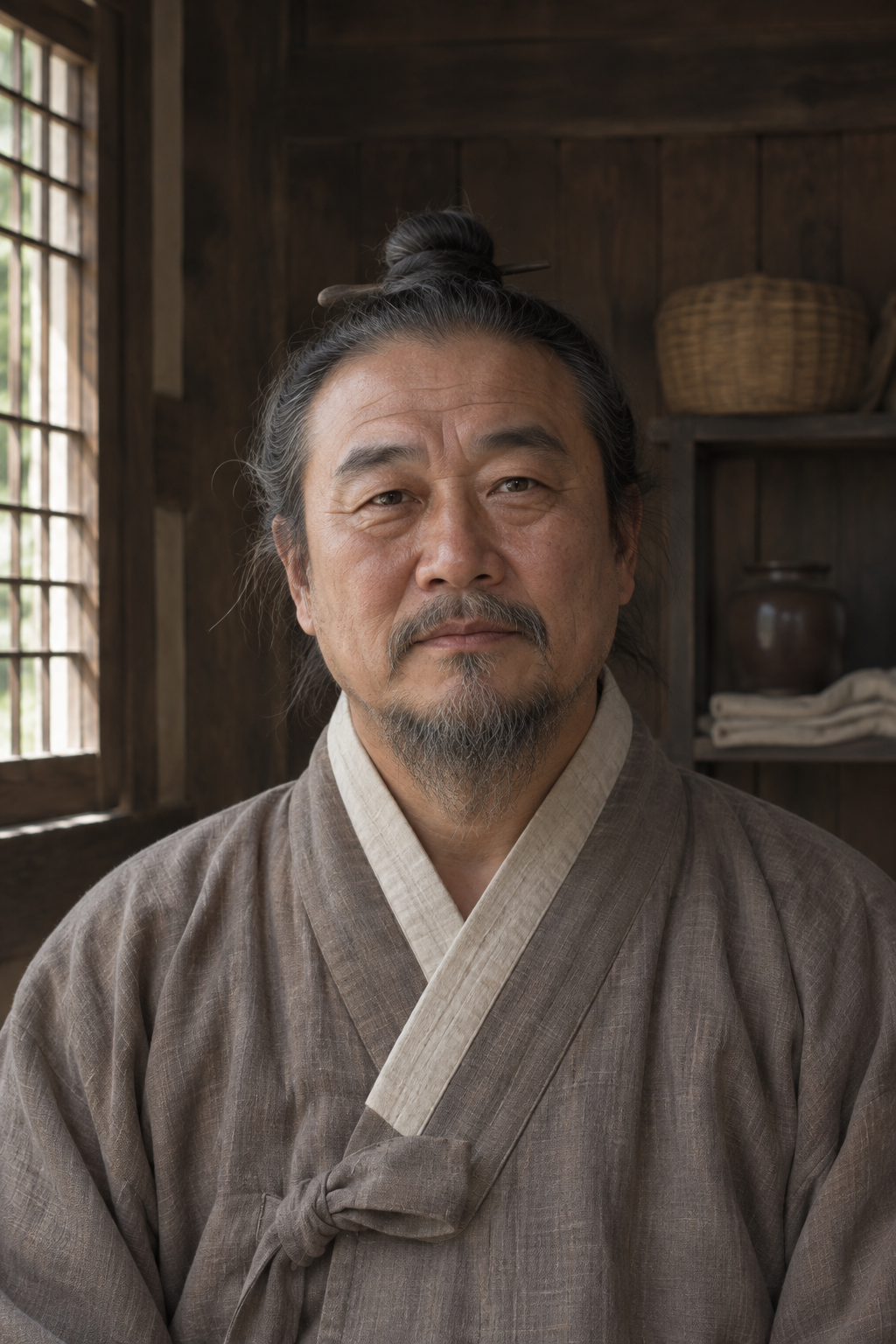
About Protase Hong Jae-yeong
Protase Hong Jae-yeong taught his children in exile. He belonged to the Pungsan Hong clan, a family of officials connected with Yesan. The Korean Catholic Encyclopedia places his birth in Chungju in 1780 and his upbringing in Seoul. His nephews Hong Byeong-ju and Hong Yeong-ju were also executed for their Catholic faith in 1840.
Two generations of his family had served the king as censors. His grandfather was Hong Yang-han. His father, Luke Hong Nak-min, served in the royal censorate. Protase received his earliest Christian instruction from Luke. As he grew older, he began to meet with other believers on his own account and took part in a community devoted to studying Catholic teaching.
Protase’s wife was the youngest of the three daughters of Augustine’s older brother Jeong Yak-hyeon. Her sister had married Hwang Sa-yeong. The two men therefore knew one another as brothers-in-law, a connection within the family as well as within the Church.
In 1801 the authorities arrested both father and son. Luke died professing his faith. Protase promised to give up Catholicism and was sentenced to exile in Gwangju, in Jeolla Province. An answer he gave under questioning continued to trouble another family years later. He had mentioned the dead son of Yi Ik-un. The father subsequently petitioned the king, maintaining that his son had had no connection with Catholicism.
Yi’s petition survives in the record of Sunjo’s reign. The man whose name had been mentioned was his adopted son, a nephew who had died as a young adult. Opponents had alleged that his name turned up repeatedly in statements by Catholic prisoners. Yi answered that it had appeared only once, in Protase’s testimony, and that the conversation described there gave no grounds for treating his son as a Catholic. Even years after Protase’s departure, his words in custody were being contested in the capital. Yi defended his son by recounting a conversation in which the young man warned Protase that studying Catholicism could bring arrest and death. The petition also concerned a student circular attacking Yi and his son. Yi alleged that opponents had attached the names of two absent students to it without their consent.
For a time in Gwangju, Protase ceased to practise his religion. When he took it up again he gave much of his time to prayer and to teaching his children. Catholic accounts remember his fasts and the help he gave to people in need. The pattern of his days in exile reversed the choice he had made at his trial. In Gwangju his own children could receive the kind of instruction his father had given him in Seoul. The same account recalls the severity of his earlier religious observance: he fasted three times a week and sometimes prayed kneeling so long that he had difficulty walking.
In 1832 a general amnesty offered Protase a chance to leave Gwangju. The local official repeatedly asked him to change his beliefs before returning home. Protase refused and stayed in exile.
His son Thomas Hong Bong-ju was born there and learned his religion from both parents. Thomas married Barbara Sim, a woman from Incheon. By 1839 the household included a married couple and child. Barbara helped provide the refugees with food and a place to sleep. The son’s official biography also records a difficulty within the household. Thomas neglected his religious duties, and Protase cut his hair to keep him from going out. The measure did not change his conduct.
When persecution returned, his household sheltered four women who had nowhere else to go. The diocesan account describes him providing for them in his own home.
Oh Se-taek’s account describes the public response when officers from Jeonju came to the house. About three hundred residents reportedly gathered, protesting the arrest of someone they regarded as righteous. Protase was taken first to the Gwangju office and then to Jeonju, where the questioning and punishment continued.
During the interrogations Protase refused both to renounce his faith and to identify other Christians. The governor ordered him held after pronouncing sentence. Even after the ruling came back from the royal court, the governor called him out once more and tried to change his answer. The bishops’ account remembers that he held to it.
On January 4, 1840, he was beheaded in Jeonju. Three fellow Catholics went with him to their deaths, James Oh Jong-nye, Magdalene Yi and Barbara Choe. Barbara Choe, one of the women who had sought shelter in his house, was a different person from his daughter-in-law Barbara Sim, who had already died in prison.
Thomas survived the 1839 persecution and eventually returned to Yesan. He had renounced his faith in custody and later sought to practise it again. A later assignment took him to Shanghai to help Bishop Berneux enter Korea. He helped the French missionaries and was beheaded in Seoul in 1866.
Wondering how to weigh the stories and sources? Learn how to read a saint biography.