Biography
Rabanus Maurus
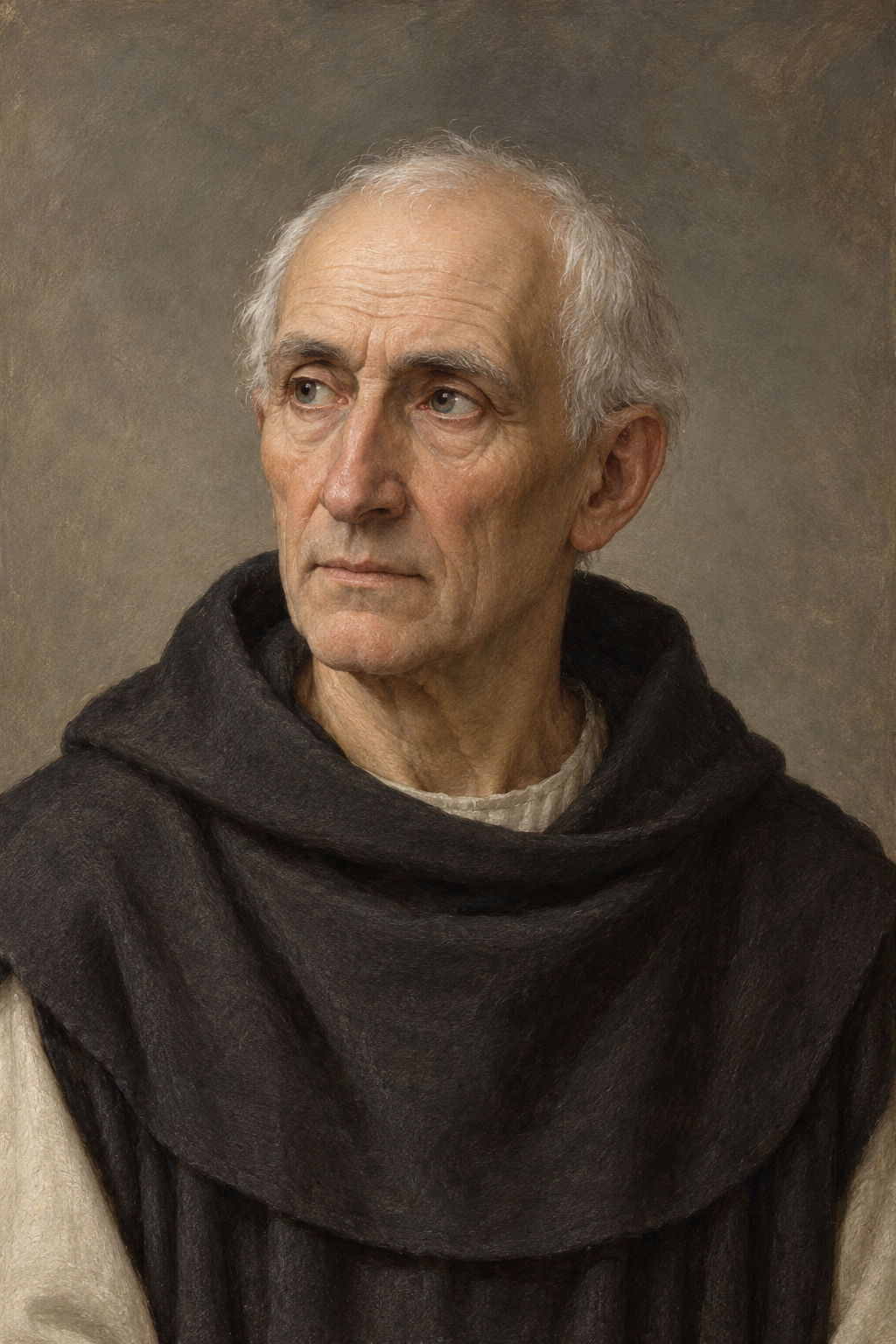
About Rabanus Maurus
Rabanus Maurus grew up in the world of Carolingian monasteries and became a teacher, abbot and bishop. Born around 780, he entered Fulda as a child entrusted to the community. After becoming a deacon in 801, he studied with Alcuin at Tours. Alcuin gave him the name Maurus, recalling a disciple of Benedict. Back at Fulda, Rabanus taught in the monastic school. He became a priest in 814 and abbot in 822.
His early teaching years were troubled. The historian Franz Brunhölzl describes the difficulties imposed by Abbot Ratgar, whose ambitious building program disrupted the community. Ratgar was removed in 817, and his successor Eigil provided a more favorable setting for study. When Rabanus later became abbot, he had responsibility for the monastery’s property and rights as well as its religious life. He supported its scribes, school and library. The collection included ancient secular literature alongside Christian writings, and the school attracted students from beyond Fulda.
His learning did not place him outside the conflicts of his age. Mainz’s diocesan account describes his close connections with Carolingian rulers and his involvement in their disputes. After twenty years as abbot, he withdrew from office in 842. The interval gave him time for scholarly work, but it did not end his public responsibilities. In 847 he became archbishop of Mainz. His work there included building projects and assemblies of bishops, alongside the social responsibilities of a large church province.
The episcopate also involved difficult theological disputes. Rabanus presided at the 848 synod that condemned the teaching on predestination of Gottschalk, formerly a child oblate at Fulda. He also participated in the Eucharistic controversy involving Paschasius Radbertus and Ratramnus. His reputation thus belongs to the conflicts of Carolingian Christianity as well as its schools.
The diocesan account also remembers a different kind of responsibility: feeding poor people at Winkel on the Rhine during a severe famine. Rabanus died on February 4, 856, and was buried at Saint Alban’s in Mainz. The church that held his grave no longer survives.
His surviving work ranges across biblical commentary, clergy training, grammar, chronology and encyclopedic learning. Much of it gathers and reorganizes earlier Christian scholarship. Brunhölzl distinguishes this method from plagiarism: compilation belonged to the scholarly practice of the period. His biblical commentaries circulated widely and remained influential into the early modern era. The later title “teacher of Germany” expresses his reputation, but Brunhölzl cautions against treating it as a precise contemporary office or an unlimited claim about his influence.
Rabanus understood scholarship as a service to people who needed help reading Scripture. In his 2009 audience, Benedict XVI draws attention to the practical purpose of the commentaries: they brought explanations from earlier Christian writers within reach of readers who did not possess many books. Rabanus regularly identified the authorities on whom he relied. His guides for clergy connected biblical interpretation with the meaning of worship, while his penitential writings addressed the handling of sin and penance according to the assumptions of his own period. These were works for use in church life, not simply exercises in collecting information.
His work on the Holy Cross reveals another side of this learning. John J. Contreni’s review of its critical edition describes a text that Rabanus continued revising over decades. He first submitted a copy to his fellow monk Hatto around 810. Later copies went to influential recipients, including bishops and rulers. The book’s history therefore joins personal collaboration, repeated revision and the cultivation of relationships. Its complicated combination of poetry and images was part of a living scholarly project, rather than a single finished exercise preserved unchanged.
The book also survived the transition to print. Bridwell Library’s account of its 1503 edition explains how black letters arranged in a grid carry one poem, while selected red letters form another within a picture. Readers must attend to both the words and their placement. The printed page preserves the visual character of the medieval work, including representations of Christ, the evangelists’ symbols and Rabanus kneeling before the cross. This survival offers a concrete example of the continuing interest in his combination of writing and religious imagery.
The scholarly catalogue Geschichtsquellen records more than eighty manuscripts of the cross poems and identifies an especially important Fulda copy now in the Vatican Library. Its corrections are attributed to Rabanus himself. The material record therefore preserves evidence of his work as a revising author, as well as later readers’ decisions to copy and keep it. The catalogue also records medieval copies preserved in Paris and Vienna, extending the evidence beyond the community at Fulda.
Benedict XVI notes that several dioceses venerate Rabanus as a saint or blessed. He also presents Rabanus’s authorship of the hymn Veni Creator Spiritus as likely, rather than certain. That distinction should remain part of his literary remembrance.
At Petersberg, the Catholic parish includes a church dedicated to Rabanus Maurus.
Wondering how to weigh the stories and sources? Learn how to read a saint biography.