Biography
Rafael Arnáiz Barón
About Rafael Arnáiz Barón
Rafael Arnaiz Baron was born on April 9, 1911, at Burgos in Spain. The Dicastery for the Causes of Saints describes him as the eldest child in a Christian family and places his vocation within ordinary family life, education, illness, and contemplative desire.
Rafael was educated in Jesuit schools. An early illness interrupted his schooling, and after recovery he was consecrated to Our Lady of the Pillar. The page should state this as a devotional fact from the official profile, without making illness the only key to his life.
His childhood and youth were not a simple withdrawal from ordinary life. He belonged to a family, studied seriously, enjoyed artistic work, and developed friendships. Those ordinary human details keep the profile from making him seem like a disembodied spiritual symbol.
His family later moved to Oviedo. Rafael showed artistic gifts and an interest in architecture, and in 1930 he began architectural studies in Madrid. This background matters because his later writings often show a mind attentive to beauty, form, and interior clarity.
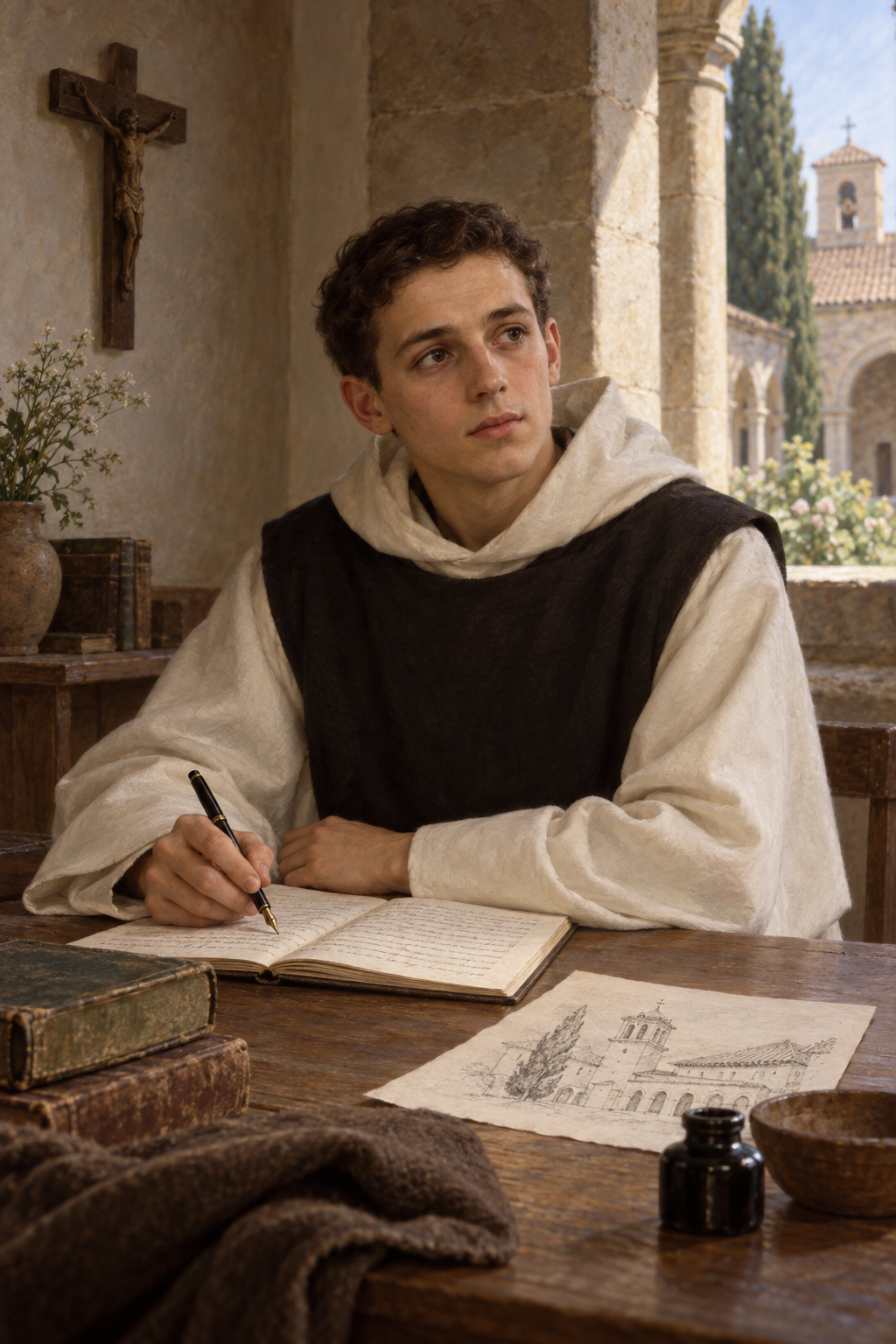
Architecture also gives the artwork and prose a concrete attribute that is not medical. A small sketch, notebook, or plan can point to his studies and the way his imagination moved from visible structures toward the ordered silence of monastic life.
Through relatives he came to know the Trappist monastery of San Isidro de Duenas. The official biographies describe this encounter as decisive for his vocation. The monastery offered silence, prayer, and a life ordered toward God, not an escape from the world.
The final page should describe San Isidro de Duenas as the place where Rafael's desire became concrete. It should avoid romanticizing the monastery as a beautiful backdrop only. For him, the cloister meant obedience, community, renunciation, prayer, and repeated surrender.
On January 16, 1934, Rafael entered San Isidro de Duenas. The final page should make clear that he entered the Trappist monastery and desired the monastic life, while also preserving the important canonical nuance that illness prevented him from becoming a professed monk.
Diabetes soon forced him to leave the monastery. He returned more than once, but the same illness continued to interrupt ordinary formation. Because of his health and the rules governing profession, he lived as an oblate rather than as a professed Trappist.
The repeated departures could be misunderstood as instability unless they are explained. The sources show a young man who kept returning when allowed, not one who treated the vocation lightly. His fidelity was measured by returning, not by the uninterrupted path he wanted.
That distinction is not a technical footnote. It is central to the shape of his sanctity. Rafael's life became a repeated offering of desire, interruption, obedience, and return. He loved the monastic vocation even when he could not possess it in the way he first hoped.
The Vatican biography emphasizes his letters and spiritual writings. They show not a romanticized illness, but a young Christian learning to seek God in limits, dependency, and hidden fidelity. The public profile should avoid medical spectacle and focus on contemplative trust.
Those writings can be referenced without long quotation. They are useful because they let the page speak about Rafael's interior life from evidence, while still respecting quotation limits and avoiding a collage of pious excerpts.
Spain's wider turmoil formed the background of his final years, but this packet does not make political history the center of his page. The reviewed sources support a contemplative profile grounded in the monastery, his family, illness, and writings.
Rafael died in the monastery infirmary on April 26, 1938, at the age of twenty-seven. The reviewed sources support San Isidro de Duenas as the death context, but this deferred packet leaves the database death-place field empty until final normalization verifies exact wording.
The shortness of his life should be named without sentimentality. He did not leave a large institution, missionary geography, or public office. He left the witness of desire purified by limits and made legible through letters, prayer, patient return, and ordinary obedience.
His body was first buried in the monastery cemetery and later translated to the abbey church. The page can mention this briefly if the final packet needs shrine context, but it should not let posthumous devotion displace the short and hidden life itself.
Rafael was canonized on October 11, 2009. His witness is the holiness of a young lay oblate whose interrupted vocation became a school of surrender. The final profile should avoid overclaiming monastic profession and should keep his youth, writing, architectural sensibility, and contemplative longing together.
Artwork should show a young Spanish Trappist oblate in a white Cistercian habit with dark scapular, writing in a monastery cell or cloister with a notebook, pen, and small architectural sketch. Avoid medical imagery, rendered text, logos, halos, modern props, and exact-likeness claims.
Wondering how to weigh the stories and sources? Learn how to read a saint biography.