Biography
Rafqa Pietra Choboq Ar-Rayès
About Rafqa Pietra Choboq Ar-Rayès
Rafqa Pietra Choboq Ar-Rayes was born on June 29, 1832, at Himlaya in Lebanon. The Holy See biography says she was baptized on July 7 with the name Boutroussieh.
Her mother died when Rafqa was seven. The public page should name this loss but not make grief the only lens for her life. Her vocation developed through family, work, catechesis, education, and the Maronite religious world around her.
This matters because Rafqa is sometimes remembered almost entirely through the language of suffering. The slow-vetted page should begin with a fuller human life: a Lebanese child, a baptized Christian, a daughter formed by family and loss, and a woman who entered active religious service before monastic hiddenness.
Rafqa first entered religious life through the Mariamette congregation after going to Our Lady of Deliverance in Bikfaya. She received the habit on March 19, 1861, and made first vows a year later.
The Mariamette years were not a mere prelude. They included teaching, service, study, and mobility within the Church's needs. The final profile should let that period stand on its own before moving to the Lebanese Maronite Order.
During this period she served at the Jesuit-run seminary in Ghazir and studied Arabic, calligraphy, and mathematics during free time. Those details keep the profile from reducing her to later suffering. She was also a learner, teacher, and capable servant of the Church.
Arabic, calligraphy, and mathematics also give concrete texture to her formation. They help readers see Rafqa as intellectually and practically engaged, not only as a passive recipient of events around her.
In 1860 she taught catechism at Deir el-Kamar. The official biography includes the testimony that she saved a child during violence there. The final page may name this carefully as part of the official tradition, without turning danger into spectacle.
At Maad she helped establish a girls' school. This educational work belongs in the center of the biography because it shows her practical charity before the years of illness for which she is often remembered.
The school also provides a careful way to speak about women's formation in her Lebanese setting. Avoid broad claims about social reform unless a stronger source is added; the reviewed sources support the concrete fact of helping establish a girls' school.
After the crisis of the Mariamette congregation, Rafqa entered the Lebanese Maronite Order. She received the habit on July 12, 1871, and professed vows on August 25, 1872.
The transfer should be described as a concrete ecclesial step, not as a vague change of scenery. Rafqa moved from one form of religious service into a Maronite monastic life of prayer, obedience, and community.
That movement from active teaching to monastic life can frame the biography without forcing a contrast. In both settings, Rafqa sought God through the form of obedience available to her: catechesis, school service, common life, prayer, and patient endurance.
In 1897 she moved to the monastery of Saint Joseph al-Daher in Jrabta. The existing catalog death place already preserves this Jrabta context. The public page should use it to locate her final years without overloading the At a glance field.
Her later life included severe suffering. The sources contain devotional and hagiographic material about illness and spiritual offering, but the page should avoid medical spectacle. It can say that she endured illness in prayer and hidden fidelity, while leaving graphic detail aside.
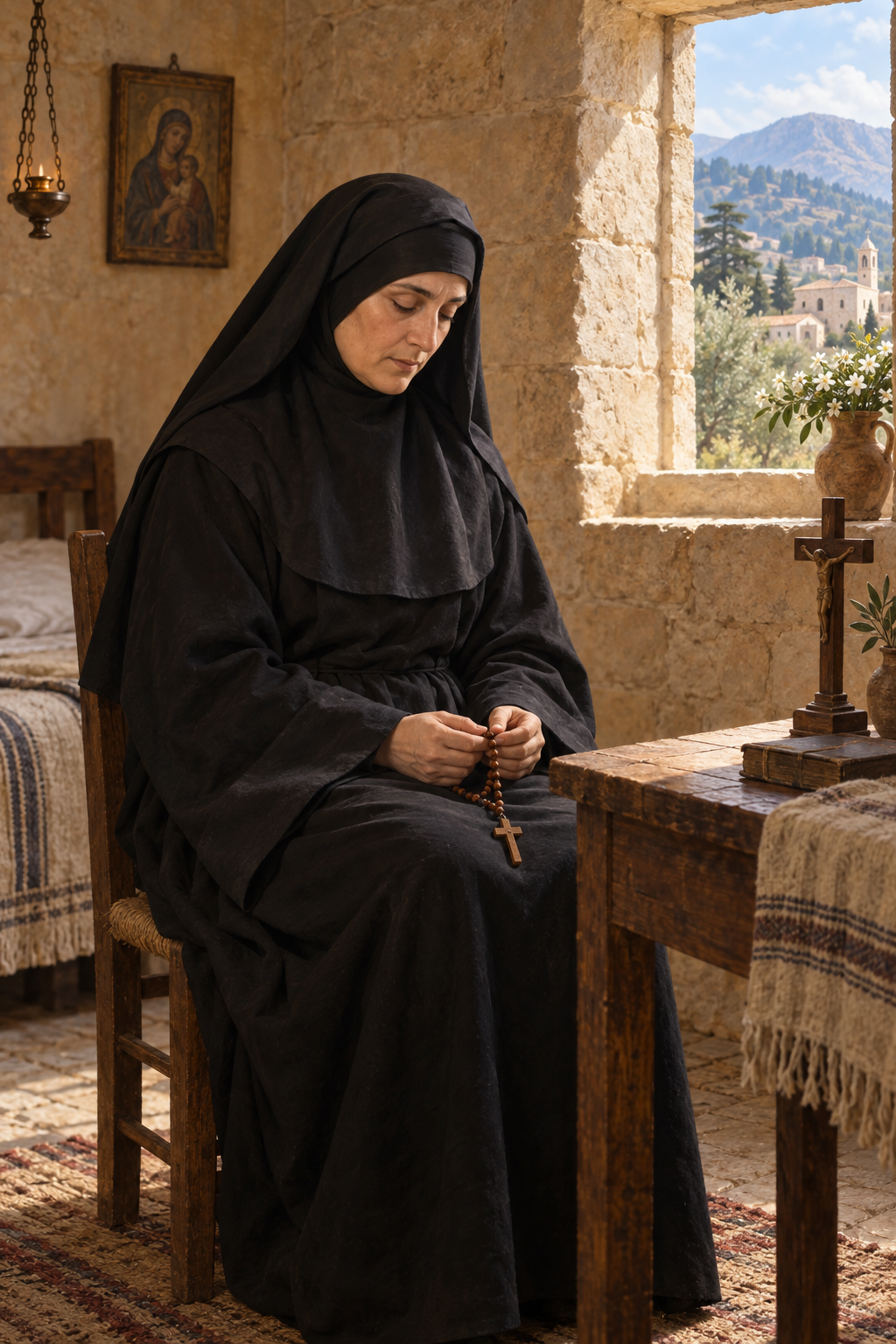
The artwork follows the same rule. It should show prayer beads, cross, stone room, and mountain light rather than symptoms or distress. Dignity should be the visual language of the final years.
Reports of visions or miraculous elements should be attributed carefully as official hagiographic testimony or tradition, not narrated as independently verifiable events. This protects the page's historical tone while respecting the devotional source family.
Rafqa died at Saint Joseph al-Daher monastery in Jrabta on March 23, 1914. The Dicastery profile records her beatification by John Paul II in 1985 and canonization by him on June 10, 2001, with March 23 as her memorial.
The death place already appears in the catalog, so the importer should preserve it exactly. Any later refinement should be only a verified normalization, not an unsourced alteration.
That preservation keeps the draft conservative: it enriches the narrative while leaving the reviewed index field intact for final acceptance.
It also keeps place evidence visible for reviewers.
Her witness is best framed through patient prayer, education, Maronite monastic fidelity, and suffering received without spectacle. The final profile should show a woman who taught, served, learned, and prayed, not only a figure defined by pain.
Artwork should show a Lebanese Maronite nun in a black habit and veil in a simple Jrabta monastery interior, with cross, prayer beads, stone walls, and Lebanese mountain light. Avoid medicalized imagery, rendered text, logos, halos, modern props, and exact-likeness claims.
Wondering how to weigh the stories and sources? Learn how to read a saint biography.