Biography
Relindis of Maaseik
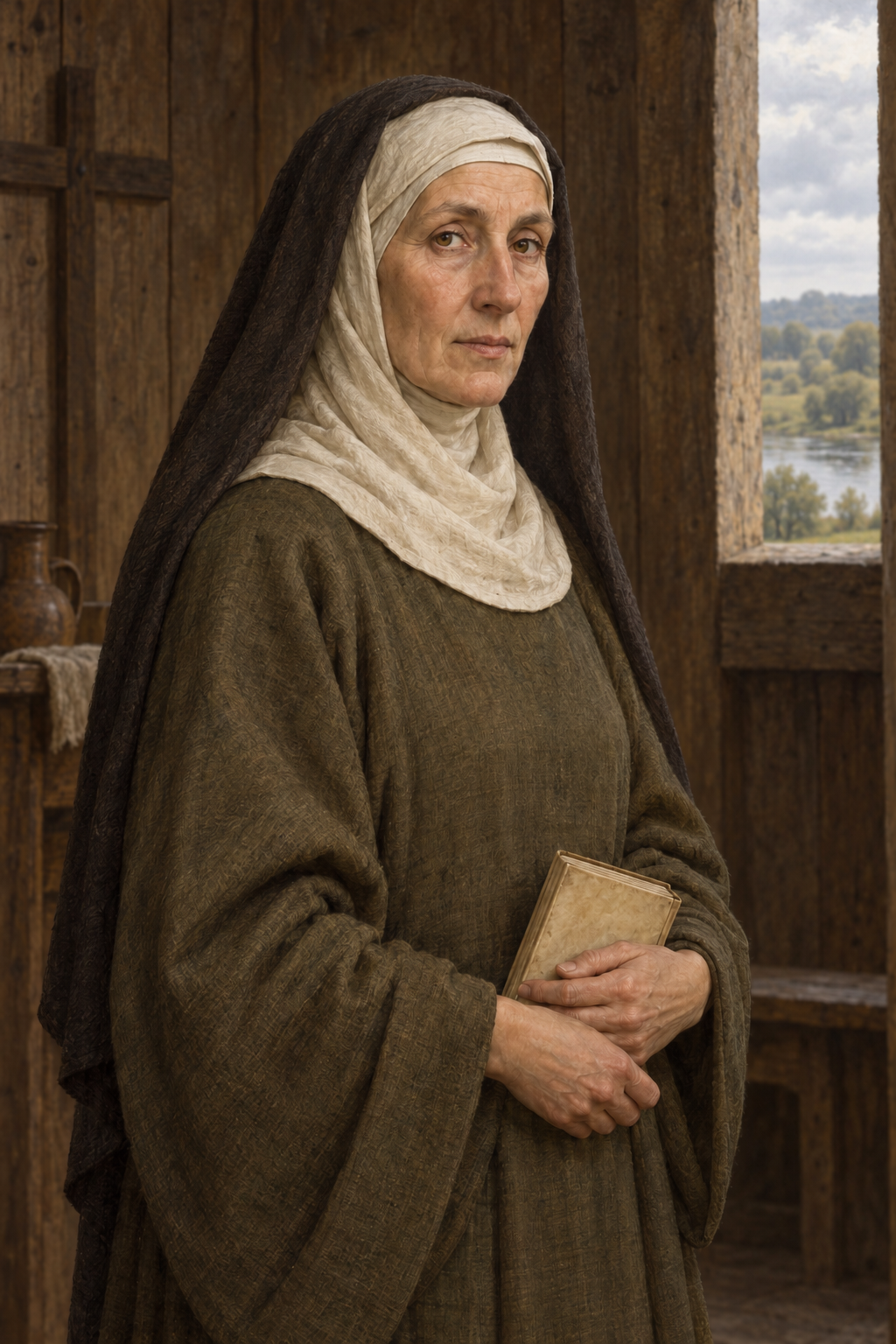
About Relindis of Maaseik
Relindis is remembered with her sister Harlindis among the founding abbesses of Aldeneik, near Maaseik in the Meuse region. Their joint Life calls her Renula, a form of the name that also appears in modern scholarship. The sisters’ story belongs to the history of women’s religious communities in the eighth century, although the surviving account was written long after their lives. Their relics and objects associated with them became the focus of a lasting local devotion.
The Life presents the sisters as daughters of Adalhard and Grinuara. Their parents supported their wish for a religious life and established a retreat where the family could live together. Alain Dierkens distinguishes this small household foundation from the monastery it later became. In the story, the sisters inherited the property after their parents died, and their consecration as abbesses marked a further stage in the formation of the community. The account thus remembers the house through family support, inherited land and the religious commitment of the two women.
Education and skilled work occupy a prominent place in the tradition. The sisters are depicted learning to read, sing psalms, write and paint, as well as to weave and do needlework. Their later community combined prayer with teaching, reading, writing and manual labor. The Life associated surviving books and richly worked cloths with their hands. It also described their own participation in building the house of prayer. These details give their remembered holiness a practical setting, among the work and learning of a religious household. After Harlindis died, the story depicts Relindis grieving and burying her sister before continuing her own life of prayer and spiritual struggle.
Relindis succeeded Harlindis as abbess according to the tradition retained by Nominis, the French bishops’ saints service. That notice associates the succession with Saint Boniface and remembers her skill in embroidery and painting.
The chronology remains uncertain. Dierkens considered a foundation in the first half of the eighth century plausible, but warned against turning the Life’s references to Willibrord and Boniface into a precise timetable. He regarded the connection with Boniface more cautiously than the connection with Willibrord. The narrative’s emphasis on Benedictine order also requires care: the account of the community’s rule may reflect the conditions and concerns of a later writer.
Relindis was remembered as surviving her sister and living to an advanced age, but no securely established year of death emerges from the tradition. Van Strydonck and Reyniers note that specific years proposed for both sisters lack historical proof. Their account also follows the subsequent history of the cult: Abbess Ava replaced the decaying wooden church with a stone building, and Bishop Franco of Liège solemnly transferred the relics into it. In 1571 the chapter brought the treasury and relics to Saint Catherine’s Church in Maaseik amid the insecurity of the religious conflicts.
The material objects preserved at Maaseik have their own histories. The Flemish heritage inventory identifies the Codex Eyckensis as an eighth-century Gospel book, traditionally attributed to the sisters but probably originating at Echternach. It also lists seventeenth-century wooden relic containers with silver fittings and textiles of differing origins. Some of the cloth was probably Anglo-Saxon. These distinctions matter because the treasury brings together objects remembered in connection with Relindis without establishing that each object was made or used by her. The inventory traces the treasury’s preservation through confiscation in the French period, when the sacristan recovered it from storage and brought it to safety. A comparison with an earlier inventory found the collection largely intact.
In 2016 specialists opened the relic containers for scientific examination. Their contents proved more complex than a pair of intact burials: they included remains from at least six people, with bones of different periods and both burned and unburned material. The burned group was older than the chronology commonly assigned to the sisters in the Life. The researchers stressed that radiocarbon dating establishes the age of the material rather than the date of the fire that damaged it. Their study leaves the identity and sequence of the oldest remains unresolved.
Archaeology has likewise complicated the familiar picture of the monastery’s beginnings. In her study of the church at Aldeneik, Anja Neskens compares the historical tradition with excavation carried out in 2008. She reports a lack of finds directly attributable to the wooden Merovingian church. The later examination of the relics nevertheless raises the possibility of an earlier, seventh-century phase. The evidence therefore does not supply a simple archaeological confirmation of the foundation dates repeated in local accounts.
Relindis also remains part of local religious memory beyond Aldeneik. The City of Sint-Truiden’s heritage account identifies her and Harlindis as the two patron saints of Ordingen parish. It connects their names with local streets, recalling a former Kerkstraat renamed Relindisstraat. The sisters’ names remain joined in that local patronage.
Wondering how to weigh the stories and sources? Learn how to read a saint biography.