Biography
Richard Gwyn
About Richard Gwyn
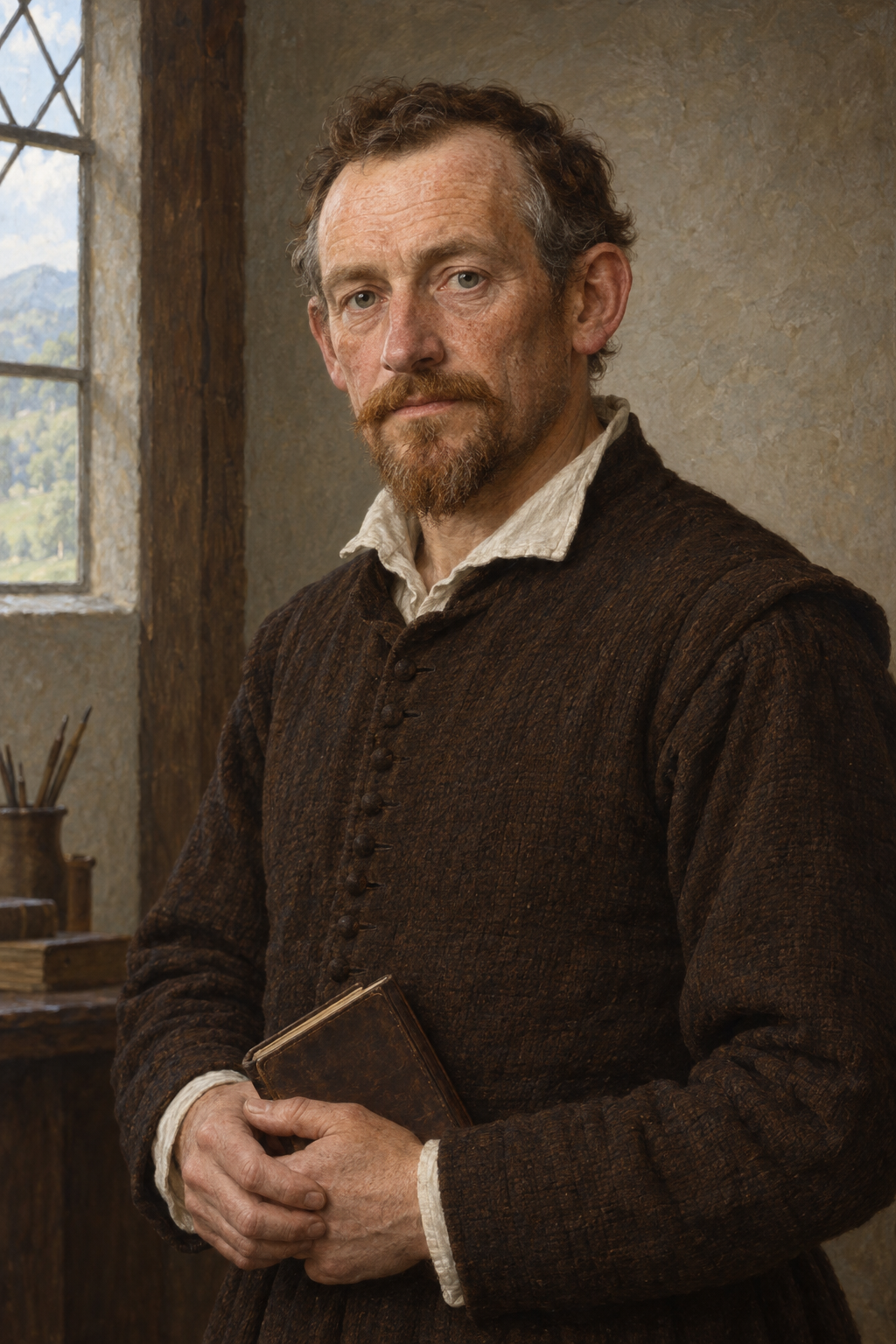
Richard Gwyn was born at Llanidloes in Montgomeryshire around 1537. Known in English as Richard White, he became a schoolmaster in the Wrexham district. His work took him to several places, including Overton, where the Dictionary of Welsh Biography places his conversion to Catholicism. He is remembered both as a teacher and as a writer in Welsh.
Accounts commonly associate his education with Oxford and Saint John’s College, Cambridge. The older Dictionary of National Biography questioned the identification of the Cambridge student, suggesting that records for different men named Richard Gwyn or Richard White might have been confused. The uncertainty concerns the details of his university career rather than the schoolmaster’s later activity in Wales.
His religious commitment made it difficult to remain in one place. Jones’s account describes him moving to evade the authorities, being captured at Wrexham in 1579 and escaping. A second arrest followed in July 1580. The next four years were spent in prison. His teaching career and family life had become bound up with the consequences of refusing to conform in religion.
Gwyn was married to Catherine and had six children, three of whom survived him. Burton’s historical account describes repeated pressure to secure his conformity: release was offered if he would conform, and he was forcibly carried to Protestant worship. The imprisonment involved appearances at different assizes without gaining his freedom. In 1583 he was taken before the Council of the Marches and subjected to torture before being returned to Wrexham.
Alexandra Walsham’s modern study follows the same years through the surviving martyr narratives. It describes imprisonment in shackles, efforts to make him attend Protestant services, questioning and torture. He and two other men were indicted on a charge of proselytizing. The questions put to him included whether he recognized Elizabeth as his lawful sovereign. The conflict therefore involved both religious allegiance and the authorities’ interpretation of loyalty to the Crown.
The final proceedings took place at Wrexham in October 1584. Thomas’s account names Sir George Bromley and Simon Thelwall among the judges. It records that the jury was shut in the church overnight before returning a guilty verdict, and that Thelwall pronounced sentence in Bromley’s absence. The sentence was the severe punishment attached to treason: hanging, drawing and quartering. This was a formal criminal conviction, remembered by the Catholic community as martyrdom for his faith.
Burton records a final offer of life if Gwyn would acknowledge the queen as supreme head of the Church. Catherine continued to console and encourage him. He was executed at Wrexham in October 1584. Burton and Walsham give 15 October; Jones’s Welsh biography gives 17 October. The difference also appears in the older discussion of the contemporary accounts.
Gwyn’s Welsh writing forms another part of his legacy. Jones identifies five poems that Gwyn called carols, strongly attacking Protestantism and defending Catholicism. They place him within the religious controversy of his time as a writer as well as a teacher. His literary identity is therefore part of the surviving record alongside the accounts of his imprisonment and death.
The stories of his death circulated in both English and Latin. Walsham distinguishes an English manuscript Life, formerly preserved at Holywell, from the account incorporated into the Latin Concertatio. Their differences suggest independent composition, although they may have drawn on a common source now lost. That transmission helps explain why the record preserves vivid details alongside disagreements. The accounts were subsequently brought together in David Aneurin Thomas’s edition of the Welsh Catholic martyr documents.
Paul VI canonized him with the Forty Martyrs of England and Wales on 25 October 1970. The Diocese of Wrexham marked the fiftieth anniversary with a cathedral Mass in 2020, remembering Richard Gwyn among the six Welsh martyrs in the group. Bishop Peter Brignall also used Gwyn’s feast to recall the work of Catholic teachers and parish catechists in passing faith to another generation. His memory remained connected with teaching, the work by which he had supported his life in Wales.
The Latin Mass Society adopted him as a patron in 2008, together with Margaret Clitherow. Its own account deliberately chose a Welsh layman and an English laywoman who had died in connection with passing on faith and protecting priests. Gwyn’s relic is preserved at Saint Mary’s Cathedral in Wrexham. The society’s register uses the Welsh form Rhisiart Gwyn for him, while also explaining the English name Richard White.
He was also explicitly chosen as patron of the combined Catholic communities of Chirk, Llangollen and Ruabon. Their parish history remembers him as a local poet and schoolmaster. The Ruabon community later entered a sharing agreement with the Anglican congregation, inaugurated with the participation of both bishops in 1980. This later chapter belongs to the community that honors him, preserving his memory in a setting of cooperation between Christians.
Wondering how to weigh the stories and sources? Learn how to read a saint biography.