Biography
Richard of Chichester
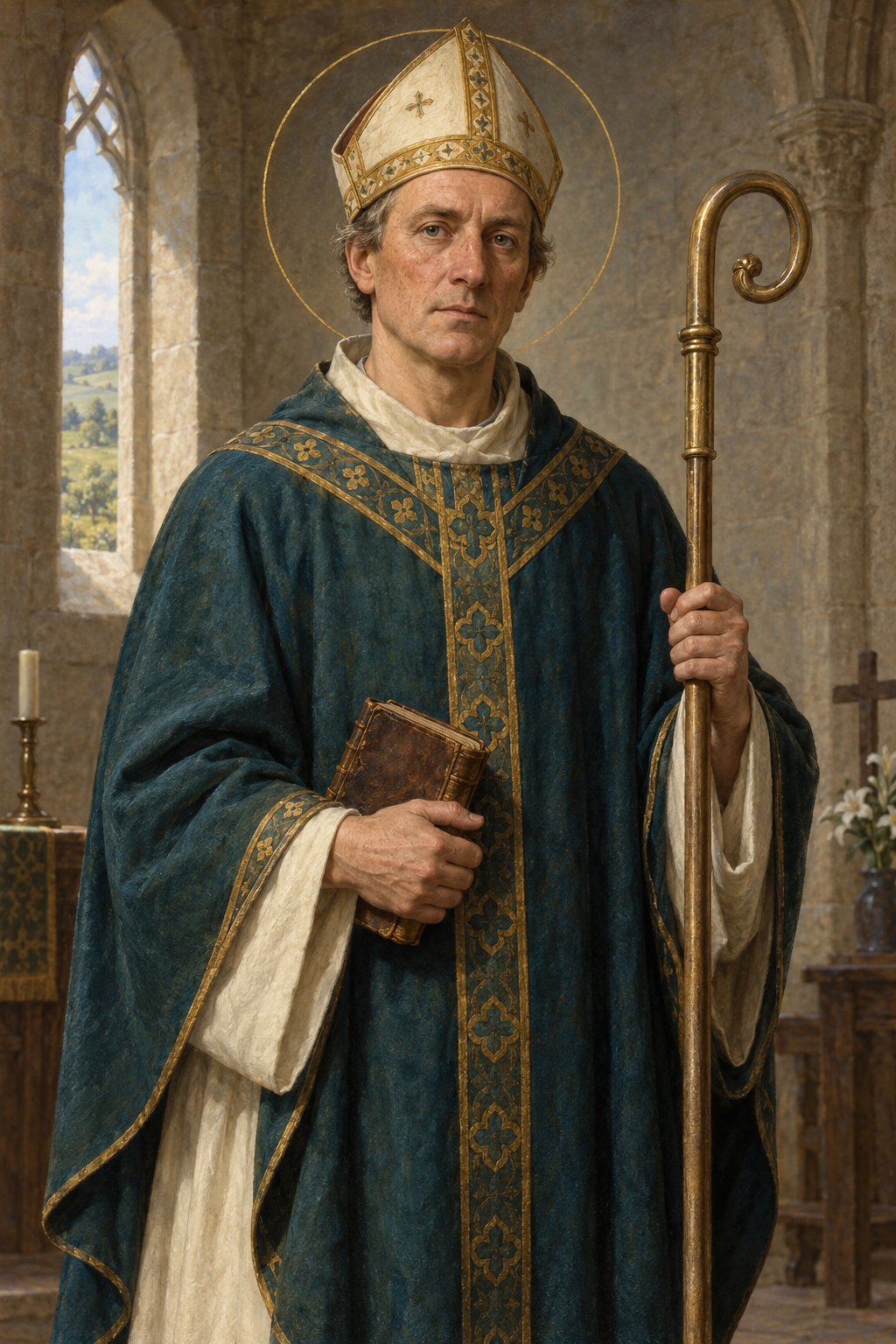
About Richard of Chichester
Richard of Chichester was born at Droitwich in Worcestershire about 1197. His later name remembered that birthplace. He became a scholar and church administrator before serving as a bishop whose appointment brought him into a prolonged dispute with Henry III.
The Dominican Ralph Bocking, who knew Richard, describes a young man drawn toward learning rather than the inheritance offered by his elder brother. Richard studied the liberal arts and canon law and became chancellor of Oxford. Bocking then presents his service to Archbishop Edmund as a close partnership: Richard managed the business of the archbishop’s court while Edmund’s example shaped his religious life. He stayed with Edmund through opposition and exile. After the archbishop’s death, Richard studied theology among the Dominicans at Orléans, received priestly ordination and established an oratory honoring Edmund.
His return to England led again to service as an archbishop’s chancellor, now under Boniface of Savoy. In 1244 the choice of Robert Passelewe as bishop of Chichester was overturned, and Richard was elected instead. The king favored Passelewe and withheld the property and income belonging to the bishopric. Richard appealed to Innocent IV, who consecrated him at Lyons in March 1245.
Bocking’s account makes the consequences tangible. Simon of Tarring, a priest with limited resources of his own, gave the displaced bishop a home. Richard accepted modest support and continued traveling through his diocese, visiting religious houses, preaching and administering the sacraments. His position gave him an office to exercise but, for a time, none of its usual material security.
The dispute finally eased when the bishopric’s temporal resources were delivered to Richard in July 1246. The historian David Jones connects the following years with sustained attention to pastoral administration. Richard issued the earliest surviving series of Chichester diocesan statutes, while his charters show an interest in the practical responsibilities of a bishop.
Bocking also remembered Richard keeping a notebook and recording useful remarks in his own hand after hearing them discussed at table.
His surviving will gives another view of those responsibilities. He left forty pounds toward the fabric of Chichester Cathedral and specified burial near Edmund’s altar. Religious communities were to receive books as well as money: the Franciscans at Chichester his annotated Psalter, the friars at Lewes a volume containing Luke and John, and the Dominicans at Arundel a book of Sentences. These were particular volumes assigned to particular communities, rather than an undifferentiated gift of a library.
The same document remembers members of his household and directs that their bequests should rank with his debts. He asked his executors to recover the revenues withheld by the king. After the named obligations were met, any remaining property was to assist poor religious people, hospitals, widows, orphans and wards, and the repair of roads and bridges. Provision for his dependents, the settlement of debts and wider charitable purposes all belonged within his final arrangements.
Richard also took an active part in promoting crusading. Ian Bass’s study of the English bishops traces his appointment as a collector for the Holy Land subsidy in 1250 and the widening of that mandate. In November 1252 a royal order authorized him to preach the crusade and to deal with vows; another order sought the archbishops’ assistance for his preaching and collections. Bass notes how briefly the hagiographers describe the coastal preaching journey, naming Chichester, Canterbury and Dover rather than providing a complete itinerary.
His will included fifty marks for Robert Chaundos to go to the Holy Land in his place if willing, with another person to be substituted otherwise.
Bass cautions that whether Chaundos actually went is unknown. The provision records Richard’s intention, rather than proof that this proposed journey took place.
Richard became ill at Dover and died there on 3 April 1253. His body was taken back to Chichester Cathedral for burial.
Devotion developed before formal canonization. Jones records the appointment of a chaplain at Richard’s grave in 1254 and the opening of an investigation in 1256. Urban IV canonized him in 1262. Miracle reports, offerings and bequests helped sustain a cult that Jones describes as principally local and southern English. The surviving miracle narratives also show people seeking his intercession beyond Sussex. They preserve evidence of devotion and reported healings, rather than establishing every extraordinary event as independently verified history.
In 1276 his remains were moved to a more prominent shrine in the cathedral, with Edward I among those attending. The shrine was destroyed in 1538 during the Reformation. Depictions of Richard returned in later centuries, and an altar was restored at the site in 1930. Chichester Cathedral now identifies him as Sussex’s patron and marks his translated feast on 16 June, also celebrated locally as Sussex Day.
A Catholic school in Manchester explicitly names Richard as its patron and also records the traditional patronage of coachmen. These remain distinct, specifically stated associations.
Wondering how to weigh the stories and sources? Learn how to read a saint biography.