Biography
Richard Pampuri
About Richard Pampuri
Richard Pampuri was born Erminio Filippo Pampuri at Trivolzio in the province of Pavia in 1897. The existing catalog gives August 2, while the Vatican biography gives August 12 and says he was baptized the next day.
This deferred draft preserves the database date and flags the conflict for the final packet rather than silently changing a structured field. The conflict is small in scope but important for a slow-vetted record because the At a glance fields should match reviewed evidence.
Pampuri's mother died when he was three, and his father died in 1907. He was raised for a time by a maternal aunt at Torrino. The page should mention these losses soberly, without making orphanhood the only explanation of his vocation.
Those family losses do, however, help explain why the page should keep his human formation concrete. He did not enter medicine or religious life as an abstract symbol of service. He came through childhood vulnerability, study, war-time medical duty, and ordinary rural practice.
He studied medicine at the University of Pavia. During the First World War he served in the fighting zone, including service in the Medical Corps. The sources allow this military context, but the profile should keep medical service rather than military identity at the center.
The war years should be handled with restraint. They show experience of urgent care under pressure, but they should not become a dramatic battlefield story. The sources support medical service, not a military portrait.
Pampuri graduated in medicine and surgery on July 6, 1921. He then practiced at Morimondo, where he became known for care of poor rural patients. The public page should use this period to show ordinary professional charity before his religious profession.
Morimondo is important because it locates his holiness in repeatable, local duties. A rural physician had to make visits, diagnose, treat, reassure, and keep returning. This is quieter than a miracle story, but it is central to his witness.
His medical work was not a secular prelude to holiness. It was already a place where faith, competence, and service met. Patients in rural poverty needed a doctor's skill as much as kind intention, so the page should honor his professional seriousness.
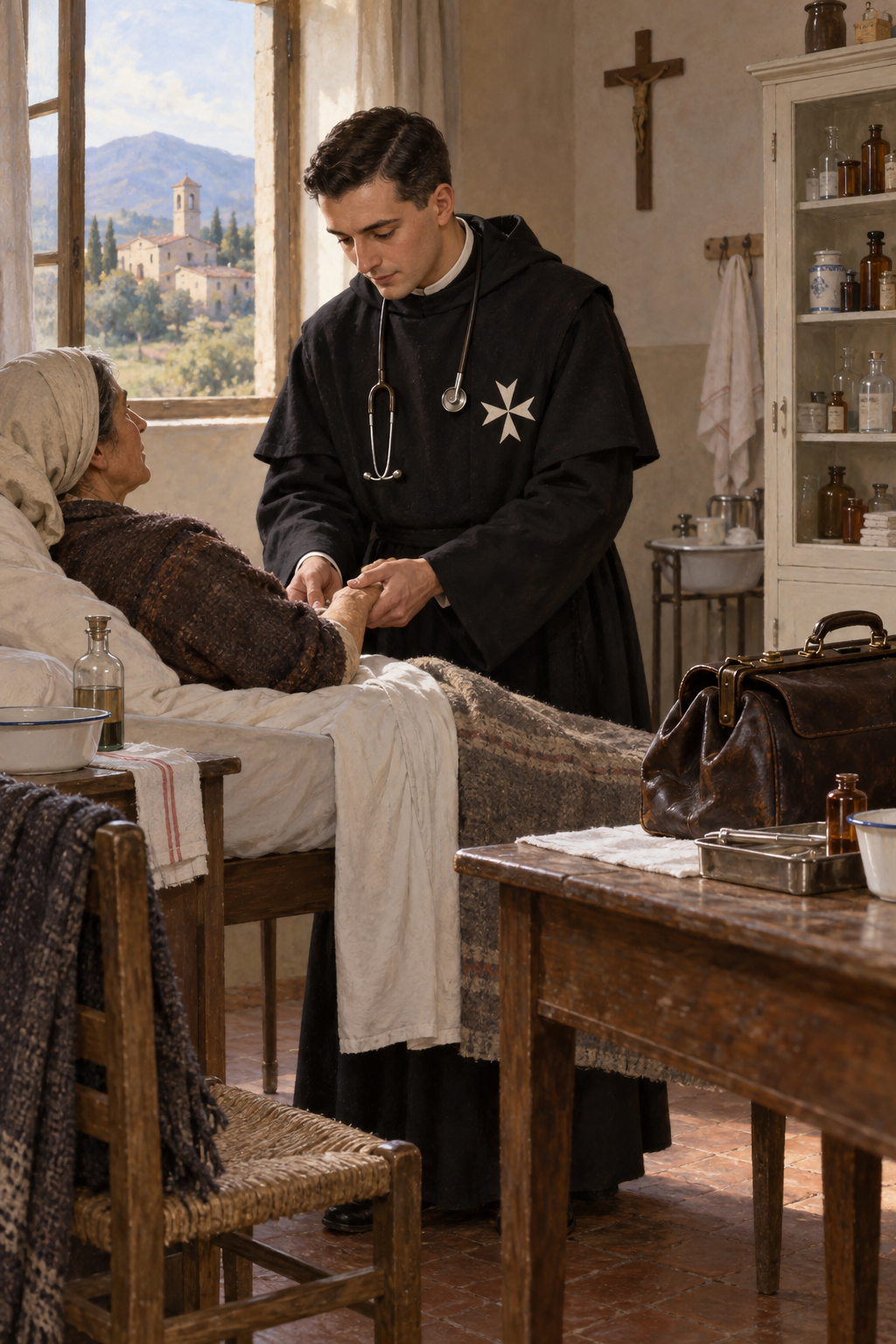
The final profile should therefore avoid vague praise that could apply to any kind person. Pampuri's charity had instruments: study, clinical judgment, a medical bag, rural travel, hospital service, and the patience required by sick and poor patients.
In 1927 Pampuri entered the Hospitaller Order of Saint John of God in Milan. The move should be presented as a deepening of his medical vocation, not a rejection of it. The Hospitaller charism gave religious form to care for the sick.
Because the catalog class currently says "Monk / Nun," this draft should use prose to clarify that the reviewed sources identify him as a Hospitaller religious brother. A later normalization step can decide whether companion classes need refinement.
He professed vows on October 24, 1928. In the Order's Brescia hospital he directed the dental clinic. This detail should stay concrete: clinic, patients, health, and religious obedience, rather than vague language about compassion.
The dental clinic should not be treated as a lesser medical assignment. It shows that sanctity can live in specialized, sometimes overlooked forms of care. The page can keep this practical detail without importing unsourced clinical claims.
His own health weakened, and he died in Milan on May 1, 1930. The Dicastery profile records his beatification by John Paul II in 1981 and canonization on November 1, 1989, with May 1 as the memorial.
His life was short, but not unfinished in the sense of wasted. The public page can show a coherent movement from family loss to medical service, from rural practice to religious profession, and from professional skill to vowed hospitality.
The final page should present Richard Pampuri as physician, religious brother, and servant of poor patients. It should avoid modern medical imagery, graphic illness, or inflated claims about his clinical practice beyond the reviewed sources.
It should also preserve the birth-date conflict transparently. If the final packet corrects the structured date, it should do so with explicit evidence and tests, not as an incidental biography edit.
For devotional tone, the page should be warm but practical. Pampuri's witness is not that medicine magically became easy or that patients became symbols. It is that professional duty, vowed hospitality, and Christian charity could meet in a clinic, at a bedside, and in the small acts by which a sick person is treated as a neighbor.
That is modest, concrete, durable Christian holiness.
Artwork should show a young Italian doctor-brother in a simple Hospitaller habit in a modest period clinic, with medical bag, cabinet, bed, and rural setting as attributes. Avoid modern equipment, gore, rendered text, logos, halos, military pose, and exact-likeness claims.
Wondering how to weigh the stories and sources? Learn how to read a saint biography.