Biography
Rita of Cascia
About Rita of Cascia
Rita of Cascia was a late-medieval woman from Roccaporena, a village within the territory of Cascia in Umbria. No surviving document fixes her birth date, although modern scholarship places it probably in the last decades of the fourteenth century. The familiar year 1381 belongs to tradition, so this profile retains it only as an approximate date rather than a civil record. Official Catholic accounts call her Margherita Lotti, but the reliable early evidence says little about her family.
Responsible biography begins with that shortage of records rather than with the much fuller story familiar from later devotion. The earliest evidence includes a painted wooden casket with a verse inscription, the Codex miraculorum begun in 1457, and fifteenth-century images connected with her local cult. The casket imagery places Rita beside scenes of Christ's death and Mary Magdalene, while JHS monograms connect her memorial to currents of fifteenth-century devotion circulating at Cascia. Agostino Cavallucci wrote the first full surviving life in 1610. Its stories reflect Counter-Reformation ideals and hagiographic patterns. Historical context can clarify Rita's world, but it cannot transform a late devotional narrative into contemporary testimony.
In the received account, Rita married Paolo Mancini, became the mother of two sons, and was widowed when her husband was killed amid a family feud. The same tradition says that she forgave his killers, resisted retaliation, and lost both sons before they could continue the conflict. These details are not treated here as contemporary documentation, yet they became central to the Church's interpretation of Rita as a woman of peace. John Paul II emphasized that her acceptance of suffering was not passive resignation but a form of love joined to forgiveness. That distinction matters when recounting a marriage and feud whose particulars cannot now be independently reconstructed.
After widowhood, Rita entered the women's community of Santa Maria Maddalena in Cascia and spent the rest of her life there. A witness in the 1626 process remembered that the house had carried that name before it became associated with Blessed Rita. Catholic tradition now identifies her as an Augustinian nun, and papal teaching connects her spirituality with Saint Augustine. Modern scholarship cautions that the community may still have been under diocesan rather than Augustinian governance during Rita's lifetime. Rita left no known writings, so her interior life must be approached through early memorials and the later testimony of her community rather than through words of her own.
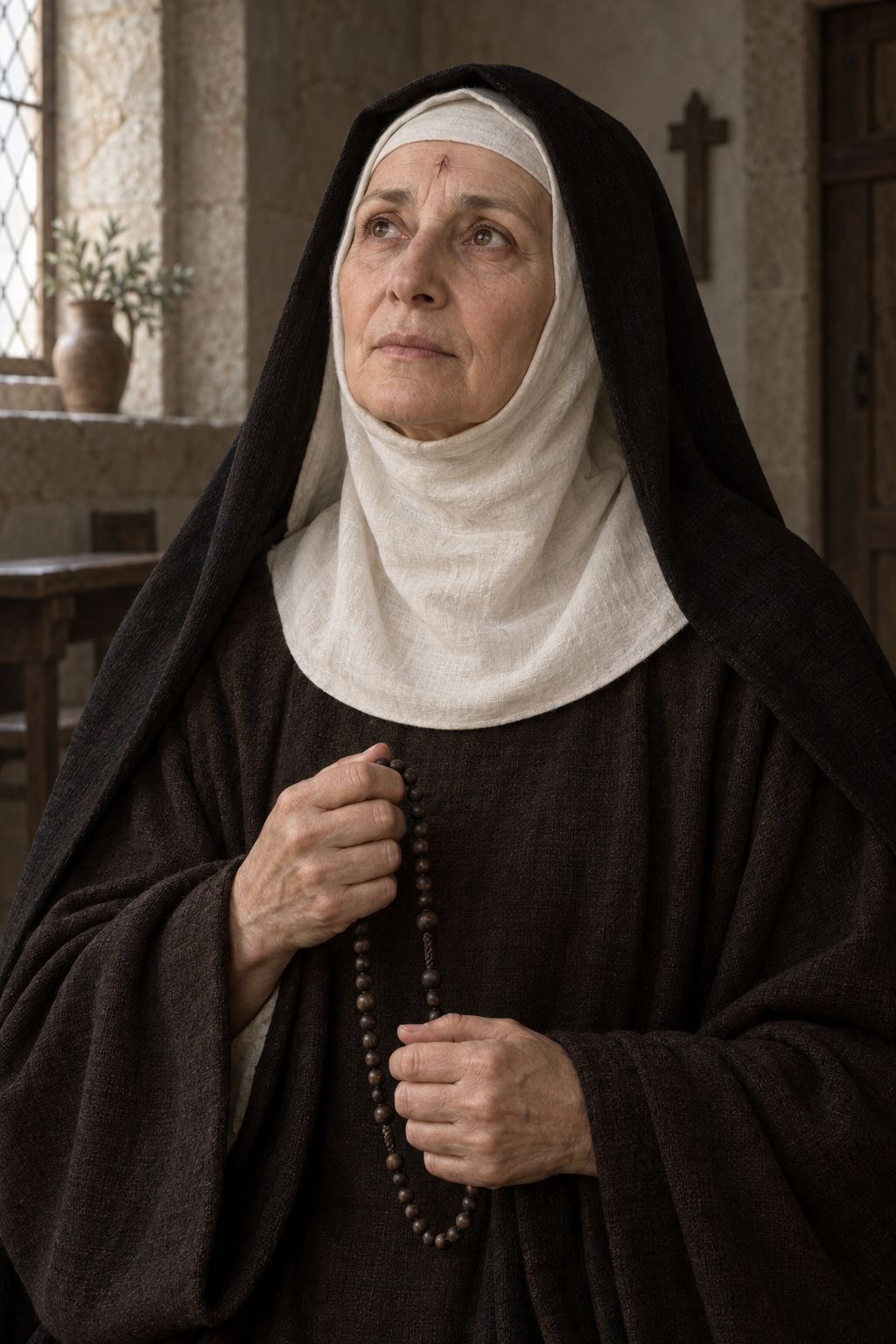
The painted casket preserves the strongest early witness to the bodily sign most closely associated with Rita. Its dialect verse remembers a painful mark on her forehead, interpreted as sharing a thorn from Christ's crown, which she endured for fifteen years. Later accounts supply a Good Friday setting, a sermon, and miraculous changes in the wound, but those narrative details are not independently secured by the early inscription. The wound can therefore be described as early devotional testimony without claiming that a historian can verify its supernatural cause. The same caution governs the present artwork, whose habit, prayer beads, and small forehead mark are iconographic choices rather than proof of her appearance.
Rita's chronology remains disputed even at its endpoint. Official church sources give the night of May 21-22, 1457, and the casket inscription and earliest miracle register also bear the year 1457. Scaraffia notes an alternative 1447 tradition and proposes that the casket's 1457 date may instead mark a solemn translation and the institutional beginning of the cult. The catalog keeps the official 1457 date while making the disagreement visible rather than silently converting debate into certainty. Whatever the precise chronology, notarial miracle records and local images show that devotion gathered around Rita at Cascia during the fifteenth century.
Her local remembrance gradually became an officially recognized and international Catholic cult. A diocesan process opened in 1626, and Urban VIII authorized liturgical celebration for Spoleto and the Augustinian Order in 1627. Leo XIII canonized Rita on May 24, 1900, during the jubilee year. The current calendar for United States dioceses observes Saint Rita of Cascia on May 22 as an optional memorial. Popular devotion calls her the saint of impossible causes and associates her with a rose, but this packet does not convert those broad devotional labels into a formal universal patronage record.
Rita's enduring importance lies partly in the many states of life through which Catholic memory understands her: wife, mother, widow, and religious woman. Her received story places forgiveness inside real conflict rather than presenting peace as the absence of injury. Her early memorials also show how a local community formed a reputation for holiness through images, inscription, notarial records, and recurring feast observance. Reading these layers together allows reverence without erasing the distance between fifteenth-century evidence and seventeenth-century hagiography. That honest distinction strengthens rather than diminishes the example attached to her name: reconciliation pursued with courage, prayer, and clear resistance to revenge.
Wondering how to weigh the stories and sources? Learn how to read a saint biography.