Biography
Romylos of Vidin
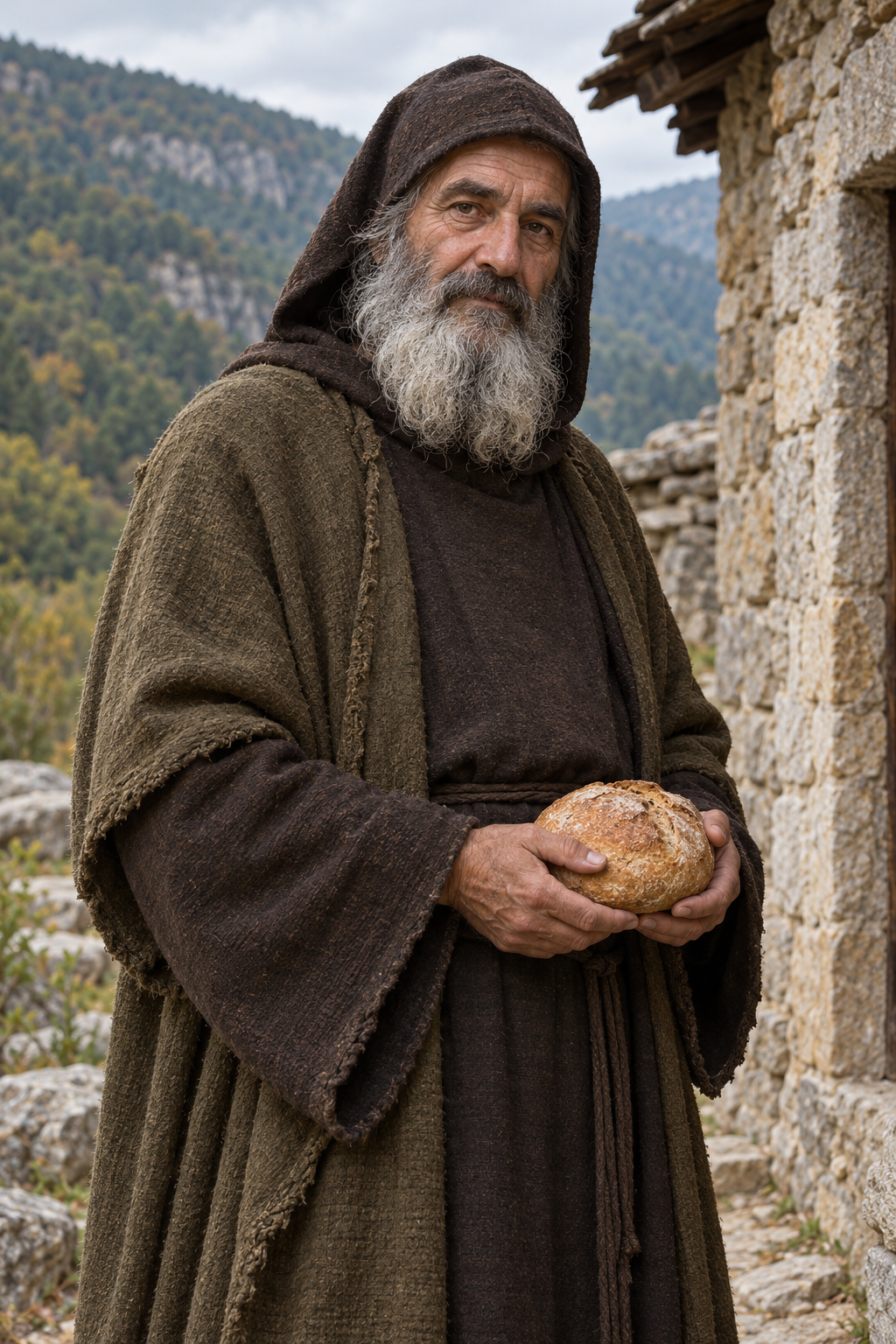
About Romylos of Vidin
Romylos of Vidin spent much of his life moving between monasteries and secluded dwellings in the fourteenth-century Balkans. Born around 1310 in Vidin, into a family of Greek and Bulgarian background, he became a follower of Gregory of Sinai. His route eventually led through Tarnovo, Paroria and Mount Athos to Valona and Ravanica. These journeys placed him among the monks who carried the hesychast tradition across the region.
The received church account describes his refusal of the marriage his parents planned for him. He left home for the Hodegetria monastery at Tarnovo, where he received the monastic name Romanus. Later he asked permission to join Gregory of Sinai at Paroria. His abbot was reluctant to lose him but eventually gave his blessing. Romanus traveled with another monk, Hilarion, and the two entered Gregory’s community.
His early work there was practical and demanding. The account describes him carrying wood, stones and water, helping in the kitchen and bakery, and tending sick monks. The community called him Romanus the Good. He later received the name Romylos when he took the Great Schema, a further commitment in monastic life.
Gregory, his disciple and biographer, also records the severity of this world. Romylos served an infirm elder who punished him for returning late from fishing by leaving him outside overnight in snow. The narrative says he was found half dead. Its admiration for obedience does not make the punishment harmless. Later, Gregory describes Romylos himself rebuking and punishing him for opening a borrowed book without permission. These are episodes in the disciple’s religious account, rather than independently verified reports.
Other passages show a different side of their daily life. Gregory tells of receiving bread from a poor man with leprosy when provisions were scarce. Romylos welcomed this help and rebuked his disciple’s lack of trust. He also required him to share provisions with a newly arrived monk and helped neighbors build their cells. The account connects solitude with concrete obligations toward other people, rather than presenting withdrawal as freedom from their needs.
Travel was not always a freely chosen search for quiet. Kiril Marinow’s comparison of the Lives of Romylos and Theodosius of Tarnovo identifies several pressures behind their movements: the search for teachers, shortages of food, banditry and military danger. In Romylos’s case, threats repeatedly disrupted life at Paroria. The defeat of Christian forces in 1371 preceded his departure from Athos. His itinerary therefore reflects both religious purpose and the difficulty of maintaining a secluded community in insecure surroundings.
On Athos, his best-established association is with the area of Melana near the Great Lavra. Cyril Pavlikianov cautions against treating a connection with the Bulgarian monastery of Zographou as established. The evidence for his movements comes from the Life and from manuscript records that require interpretation. A Slavic colophon naming an elder Romylos may belong to this setting, but identifying its subject and locating the associated settlement are scholarly reconstructions.
Pavlikianov also discusses monastic rules attributed to Romylos, preserved in a manuscript at Hilandar. He suggests that they were composed during a quieter period on Athos, probably between 1367 and 1371, and later reached Hilandar through Slavic scribes. Those proposed dates and the route of transmission remain hypotheses. His article uses an earlier estimate of death around 1385, illustrating the unsettled chronology. The rules’ concern with training monks resembles the practical instruction embedded in Gregory’s narrative, although the two texts belong to different literary forms.
The Life itself survives in Greek and Slavonic. Nevena Gavazova has examined its relationship to John Climacus’s Ladder of Divine Ascent and proposed that the Slavonic text might have preceded the Greek. Her abstract explicitly presents this as a possibility requiring further linguistic comparison, while acknowledging the prevailing view that the Greek came first. The literary relationship is therefore a subject of research, not grounds for assigning an unquestioned original language on the basis of one proposal.
After Valona, Romylos’s final home was Ravanica in Serbia. The chronology of his death remains unsettled: Antonio Rigo’s 2022 edition places it between approximately 1376 and 1380. Its account of the textual history dates Gregory’s Greek Life to the 1380s and identifies him as a disciple who had known Romylos on Athos.
The Orthodox Church in America commemorates him on January 16, but its life gives 1375 as his death year. That difference cautions against treating a single year as certain.
Marinow reads these monastic journeys as evidence of a religious community extending across political boundaries. Admission to a new monastery still depended on acceptance by its superior; shared faith did not make every practical difficulty disappear. Romylos’s life is significant within that wider pattern: a monk could seek teachers, teach others and find refuge among communities beyond his birthplace. The surviving narratives preserve both the mobility of this world and the personal relationships through which its spiritual instruction was passed on.
Wondering how to weigh the stories and sources? Learn how to read a saint biography.