Biography
Rudesind
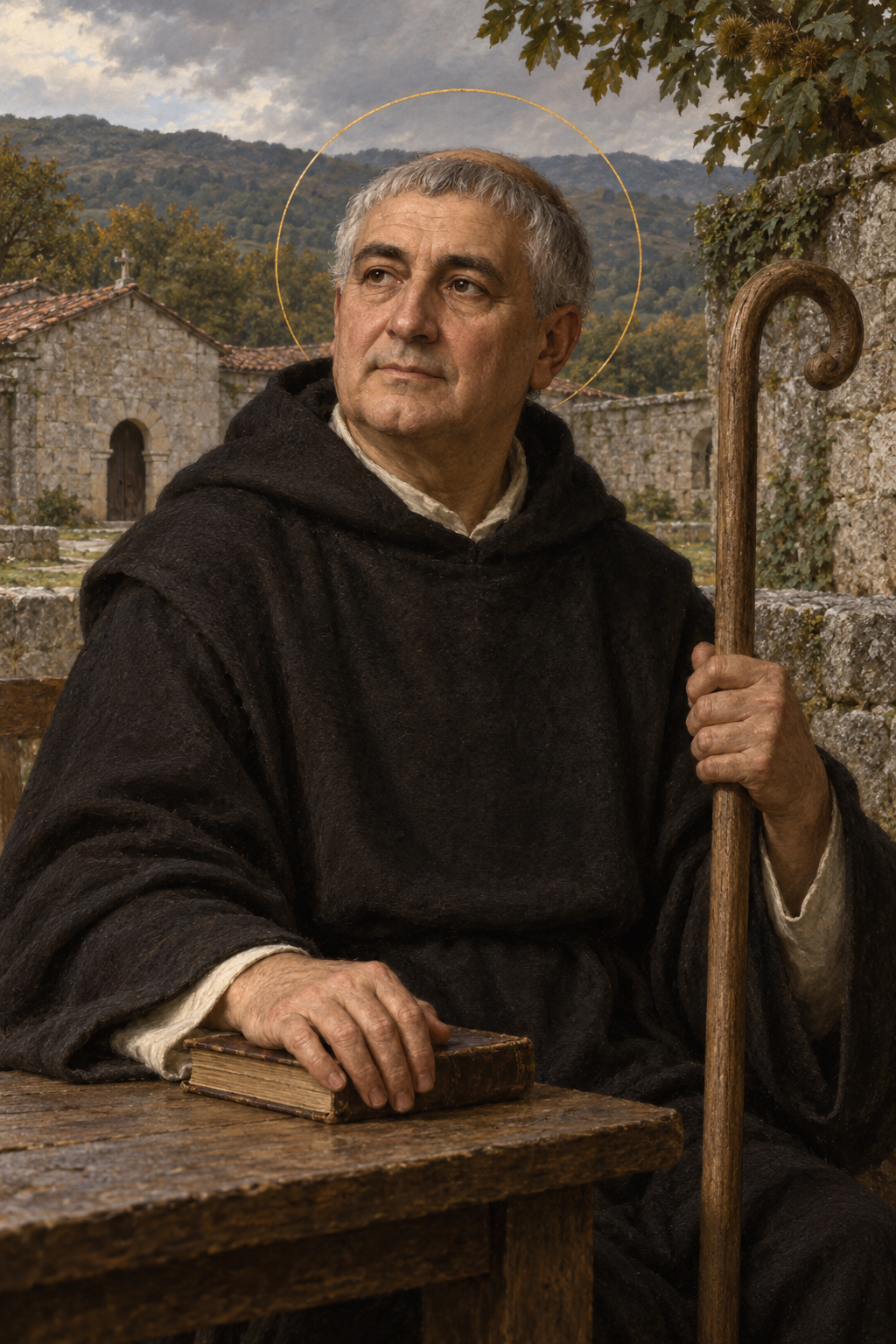
About Rudesind
Rudesind, known in Galicia as Rosendo, was a bishop and monastery founder whose responsibilities reached into the public life of the tenth century. He was born in 907 to Gutierre Menéndez and Ilduara Eriz, members of a powerful family connected with the kings of León. Family resources and relationships helped make his foundations possible, while religious commitments gave them their purpose.
The parish account remembers his education under his uncle Sabarico, bishop of Mondoñedo. It presents a young man trained for religious leadership, with both literary and Christian learning. He succeeded Sabarico while still very young. The see retained the traditional title of Dumio, although its center was then in the region of Mondoñedo. His early episcopal responsibility brought him into contact with the needs of churches and communities across that part of Galicia.
The foundation at Celanova grew through the support of several members of his family. His brother Froila provided land in 936, and Ilduara contributed further resources in 938. Rudesind and royal benefactors added to the endowment. By 942 the new monastery had an established community and buildings. These gifts created the conditions for a common religious life that could continue beyond the founder’s own lifetime.
The later Life gives this foundation a devotional setting. It says that Rudesind was drawn to solitude and prayer and understood the undertaking as a calling from God. He gathered monks from other houses and placed the community under Abbot Franquila. Although a bishop and benefactor, he accepted the religious habit and lived under Franquila’s authority. The biographer emphasizes obedience, humility and worship rather than the privilege of the founder. After Franquila’s death, the monks chose Rudesind as abbot. The story presents active responsibility and a desire for contemplation within the same religious life.
The community belonged to a wider renewal of monastic life. María Dolores Barral Rivadulla describes a meeting of inherited Visigothic traditions and newer models in which Benedict’s Rule held an important place. Celanova’s surviving chapel of Saint Michael provides a material connection with that period. It has often been described as Rudesind’s private oratory. The inscription, however, names Froila, and Barral emphasizes his role in its construction. Scholars have proposed both hospitality and memorial functions for the small building. These interpretations connect the monastery with family remembrance, prayer and the reception of visitors, without making every detail certain.
His duties also reached beyond the monastery. The Diocese of Mondoñedo-Ferrol remembers his work for ecclesiastical reform and his mediation in political disputes. Its description of him as a pacifier reflects the place he acquired in local religious memory. Monastic withdrawal did not remove his influence from the surrounding society.
Documents preserve particular acts of help within that unequal society. Segundo Pérez López records that in 943 Rudesind granted freedom to a woman named Muzalha. He also supplied livestock and property for her support. The act joined a change of legal status with material provision for the future. It is a specific example of manumission, rather than evidence that slavery disappeared from the society in which he lived.
The testament associated with Rudesind shows his concern for the monastery’s future. Its account of the foundation credits Ilduara alongside him and lists the buildings, books, vessels, clothing and agricultural resources that sustained the community. It also names Franquila’s contribution. Rudesind provided for Manilano to continue as abbot and sought protection for the house. The text survives in the damaged Celanova cartulary, rather than as an untouched original. Manuel Díaz y Díaz’s edition explains difficulties in its copied date and later confirmations. These problems require care, but the document remains important evidence for the community’s spiritual and material life.
He also governed the church of Iria during a difficult period. Accounts differ about the dates and character of that responsibility. The cathedral’s summary describes a limited period of administration followed by his return to Celanova. His remembered career moves repeatedly between ecclesiastical government and the community he had founded.
He died at Celanova on March 1, 977. The parish account remembers the monks gathered in prayer and preserves the monastery as his burial place. His tomb became a focus of devotion for people beyond the community. The memory of his work continued through churches, relics and the religious life associated with his name.
Recognition developed in the twelfth century. Pérez López describes the elevation of his cult by the papal legate Jacinto in 1172 and its later confirmation when the same cardinal became Pope Celestine III. Devotion eventually reached Cuba. The cathedral parish of San Rosendo in Pinar del Río also honors him as patron, with a feast on March 1. His memory thus acquired a place far beyond northwestern Iberia.
Mondoñedo-Ferrol continues to honor him as its patron. In 2026 its notice invited the whole diocese to the patronal celebration and announced a pilgrimage to his tomb at Celanova. The connection joins the place where he served as bishop with the monastery where he died. His memory remains tied to communities that seek in his example a pattern of prayer, responsibility and care for others.
Wondering how to weigh the stories and sources? Learn how to read a saint biography.