Biography
Rupert of Salzburg
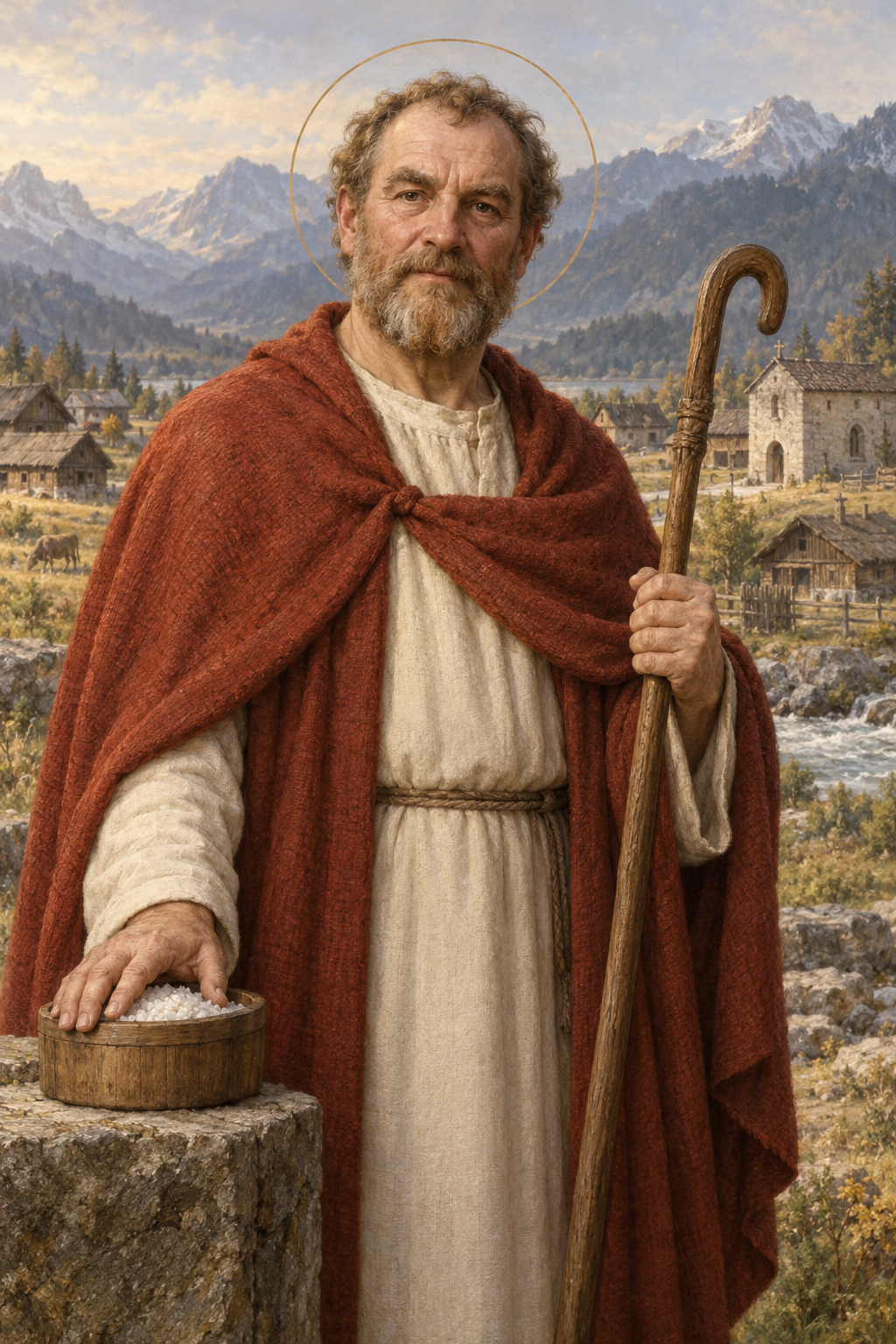
About Rupert of Salzburg
Rupert of Salzburg helped establish the communities from which the Church in Salzburg developed. He came from the Frankish world and was already a bishop when he traveled to Bavaria at Duke Theodo’s invitation. His earlier association was with Worms on the Rhine. The length and exact chronology of his work remain debated, but his foundations at Salzburg and their support from the Bavarian dukes give his life a lasting historical setting.
Bavaria already had Christians when Rupert arrived. Peter Fraundorfer’s study distinguishes the older account, which describes him instructing Theodo in the faith, from a later version that makes the duke’s baptism central. Rupert’s work therefore belonged within an existing Christian landscape. The early accounts remember a journey along the Danube, a stop at Lorch and a church near the Wallersee before he settled at the former Roman city of Iuvavum, now Salzburg.
The setting offered both opportunities and work to be done. The municipal account remembers a traveling bishop establishing centers from which Christian teaching and worship could continue. With ducal permission he developed the former Roman settlement on the Salzach. His work connected religious communities with the political authorities able to provide land and protection. The familiar city that later grew around these foundations should not obscure their much smaller early setting.
Land and income were part of that undertaking. Deutinger records gifts from Theodo and his successor Theotpert, including salt pans at Reichenhall. Rupert also enlarged the foundations’ resources through purchases. These provisions supported communities that needed a settled home. His later association with salt appears in the familiar devotional image of a bishop carrying a salt barrel.
Saint Peter’s became the principal men’s community associated with him. The abbey dates its foundation as a missionary monastery to 696, a received date within the wider debate about Rupert’s chronology. It remembers his work as the beginning of a long institutional life. For centuries, leadership of the monastery and the Salzburg bishopric remained linked. Only in 987 did Saint Peter’s receive a separate abbot. Rupert’s foundation thus helped provide a durable home for worship and learning as well as a base for work beyond its walls.
The women’s community on the Nonnberg formed another part of the same undertaking. The abbey’s history says that Rupert called Erentrudis and her companions to assist his work. It dates their foundation to around 714, with substantial support from the dukes. Erentrudis, remembered as his niece, became the first superior. The religious life that developed at Salzburg therefore depended on women’s leadership as well as the men gathered at Saint Peter’s. Nonnberg acknowledges that evidence for the first generation is limited. Its fuller biography of Erentrudis was written only in the fourteenth century. The sisters’ continuing community preserves her name and the memory of Rupert’s invitation. The abbey remembers the first sisters through prayer, care for people in poverty and education, while acknowledging how little direct testimony survives from their generation.
The biographies of Rupert also developed over time. Fraundorfer traces surviving versions to a lost early account and shows how later writers adapted the saint’s image to their own religious concerns. His remembered role expanded through new narratives and liturgical observance. The stories were meaningful to their communities, but differ as evidence for his lifetime. Later calculations of his death year depended on interpreting a reference to the day of the Resurrection.
The Norwegian church notice gives his birth as around 650 and his death as around 718. Other scholarship leaves the death year unresolved, and accounts differ over whether his final days were at Worms or Salzburg. March 27 became a commemoration associated with his death. The uncertainties do not prevent recognition of the communities he helped form, but they leave the last journey less clear than the later devotional calendar might suggest.
The later memory of the founder became woven into the life of Saint Peter’s. Its medieval community maintained a notable tradition of copying books. Even during the Nazi period, when monks were expelled and property seized, some remained able to continue the common prayer. The abbey’s historical account presents an institution repeatedly changed by events while retaining its religious purpose. This continuing community gives Rupert’s foundation a connection with people far removed from his own century.
Today Rupert is celebrated with Virgil on September 24 in Salzburg and Graz-Seckau. The 2026 celebration began at Saint Peter’s and continued in procession to the cathedral. The church report connects remembrance of the founders with the responsibility of present communities to continue building a life of faith.
The public Rupertikirtag joins that religious feast with the city’s civic life. Craft stalls, music and a traditional fair fill the squares around the cathedral. Salzburg remembers him both through worship and through this shared celebration. The annual gathering belongs to the long reception of his work, in a city whose Christian institutions still look back to the traveling bishop.
Wondering how to weigh the stories and sources? Learn how to read a saint biography.