Biography
Sabbas the Goth
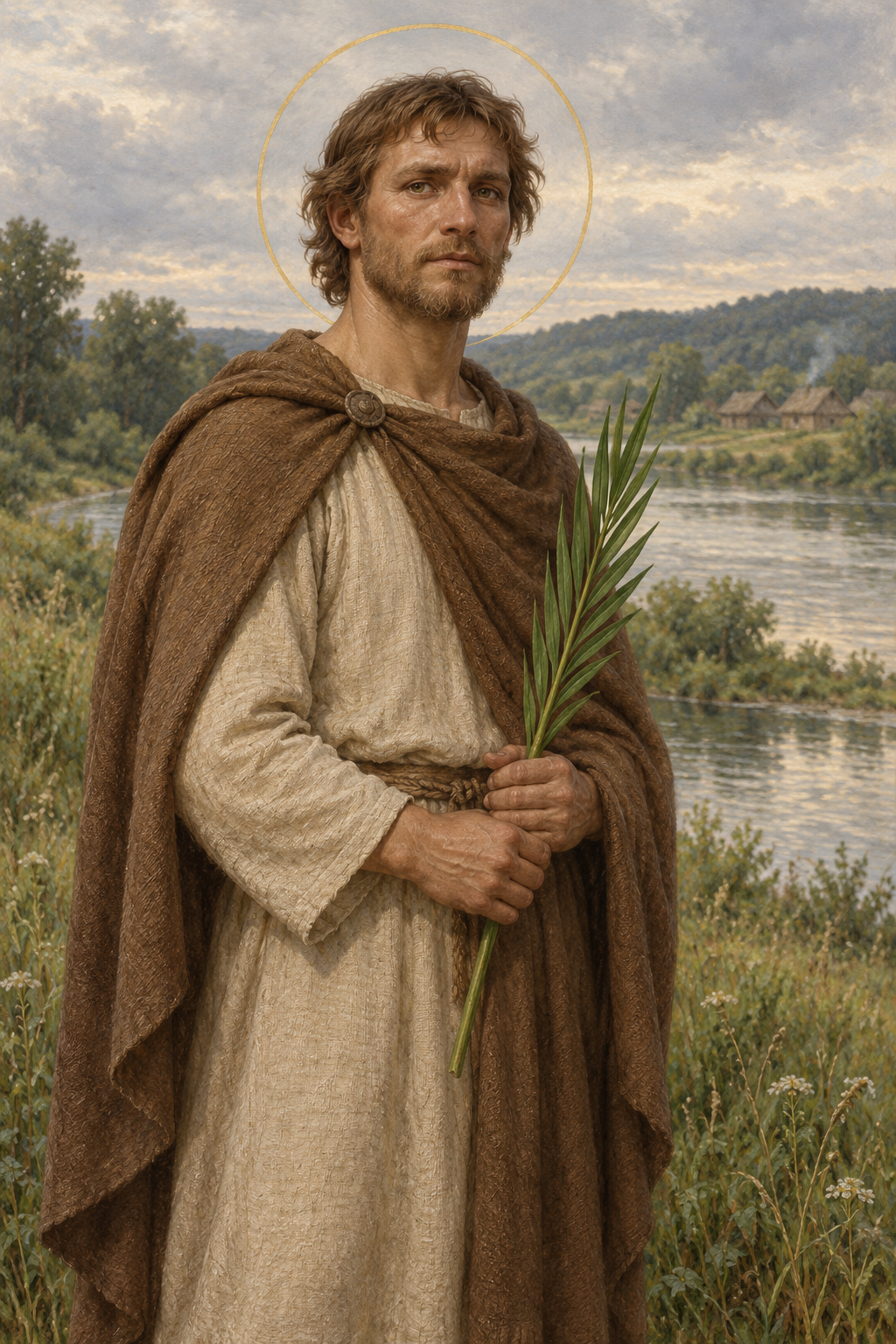
About Sabbas the Goth
Sabbas the Goth was a Christian of the lower Danube region who was drowned during persecution in 372. The early account of his death takes the form of a letter from the Church in Gothia to the Church in Cappadocia. A. D. Panteleev’s historical study places the persecution under Athanaric and notes that most scholars accept a reliable historical core within the martyr narrative.
His life was rooted in a village community. The Orthodox Church in America remembers him as peaceful, temperate and devoted to prayer, singing in church and caring for its welfare. He had few possessions and refused to conceal his Christian allegiance. His neighbors included pagans who wanted to protect Christian relatives and friends when persecution threatened them.
The ancient letter describes an attempt to substitute ordinary meat for sacrificial food, allowing Christians to appear obedient without actually eating an offering to the gods. Sabbas refused the arrangement and publicly opposed it. The villagers expelled him for disrupting their plan, though he was later allowed back. When they next proposed swearing that no Christians lived among them, he insisted that they could not speak for him.
At Easter in 372 he was with the priest Sansala. Amore’s account describes their arrest and Sabbas’s refusal of another demand to eat sacrificial food. The violence was directed at a man whose resistance had remained public even after earlier expulsions. His allegiance to Christ, rather than a dispute about the quality of a meal, lay at the heart of the confrontation.
The church account preserved by the Orthodox Church in America tells of Sabbas being beaten and stretched on the axles of a cart. During the night a woman released him while preparing food for the household. Instead of fleeing, he remained and helped her. The narrative also tells of his body remaining unharmed despite the blows. These are remembered as signs of divine protection within his martyr story.
Atharid ordered his death. The ancient letter says that guards led him to the river Mouseos, where they considered letting him go. Sabbas continued praying and refused escape. They drowned him with a wooden implement placed at his neck. Christians recovered his body, and Junius Soranus, a Roman commander in Scythia, arranged its transfer to Cappadocia with the consent of the clergy.
Basil of Caesarea’s letters show how warmly this gift was received. In Letter 164 he thanks Ascholius for a vivid account of the martyrs and describes his delight at receiving a martyr from beyond the Danube. Reading the report made the sufferings seem present to him. He blessed the person who had prepared the martyr for his struggle.
Basil’s joy also exposed the pain of divisions among Christians. He contrasted the courage of those facing open persecution with churches wounded by disputes and false teaching. His appeal was for prayer and restored peace. Letter 165 again welcomes the newly crowned martyr as a gift from beyond the frontier, comparing the offering to first fruits returned to the land that had provided the seeds.
The transmission of the story carries its own uncertainties. Panteleev identifies two medieval Greek manuscript witnesses and discusses its literary parallels with the Martyrdom of Polycarp. He also notes debate about Sabbas’s ethnic background, despite the letter calling him a Goth. His exact village and family history remain uncertain. The saint must also be distinguished from Sabbas Stratelates, a different martyr with whom later calendars sometimes confused him.
His memory remains especially strong in Romania, where he is called Sava de la Buzău. The Romanian Orthodox Church keeps his feast on 12 April; Slavic usage places it on 15 April and Greek usage on 18 April. The Church in America’s account gives his age at death as thirty-eight. These differing commemorations remember the same lower-Danube martyr.
Modern recognition has given that memory a visible local home. A report attached to Buzău County Council’s 2021 decision honoring Mihai Sălcuțan records the festivities at which Sava was designated spiritual protector of Buzău in May 1996. The report identifies Sălcuțan as a participant in their coordination and a signatory of the dedicatory charter.
The Archdiocese of Buzău and Vrancea also explicitly calls Sabbas its patron. Its report on the 2014 feast at the Church of Saints Anthony and Sava in Focșani describes a community celebrating that shared protection. The church was built between 2002 and 2005, and its painted decoration was completed and blessed in 2008. His ancient name thus belongs to the worship of a living parish.
At a symposium in 2022, Archbishop Ciprian recalled the renewed attention to Sabbas after his inclusion among the Romanian Church’s saints in June 1992. Speakers considered his martyrdom, church music and the children’s cathedral dedicated to him in Buzău. The archbishop also recalled a large cross erected beside the river in 2021. These gatherings continue the commemoration first requested in the Gothic church’s letter: that distant Christians should remember a faithful life together.
Wondering how to weigh the stories and sources? Learn how to read a saint biography.