Biography
Saturnina of Sirit
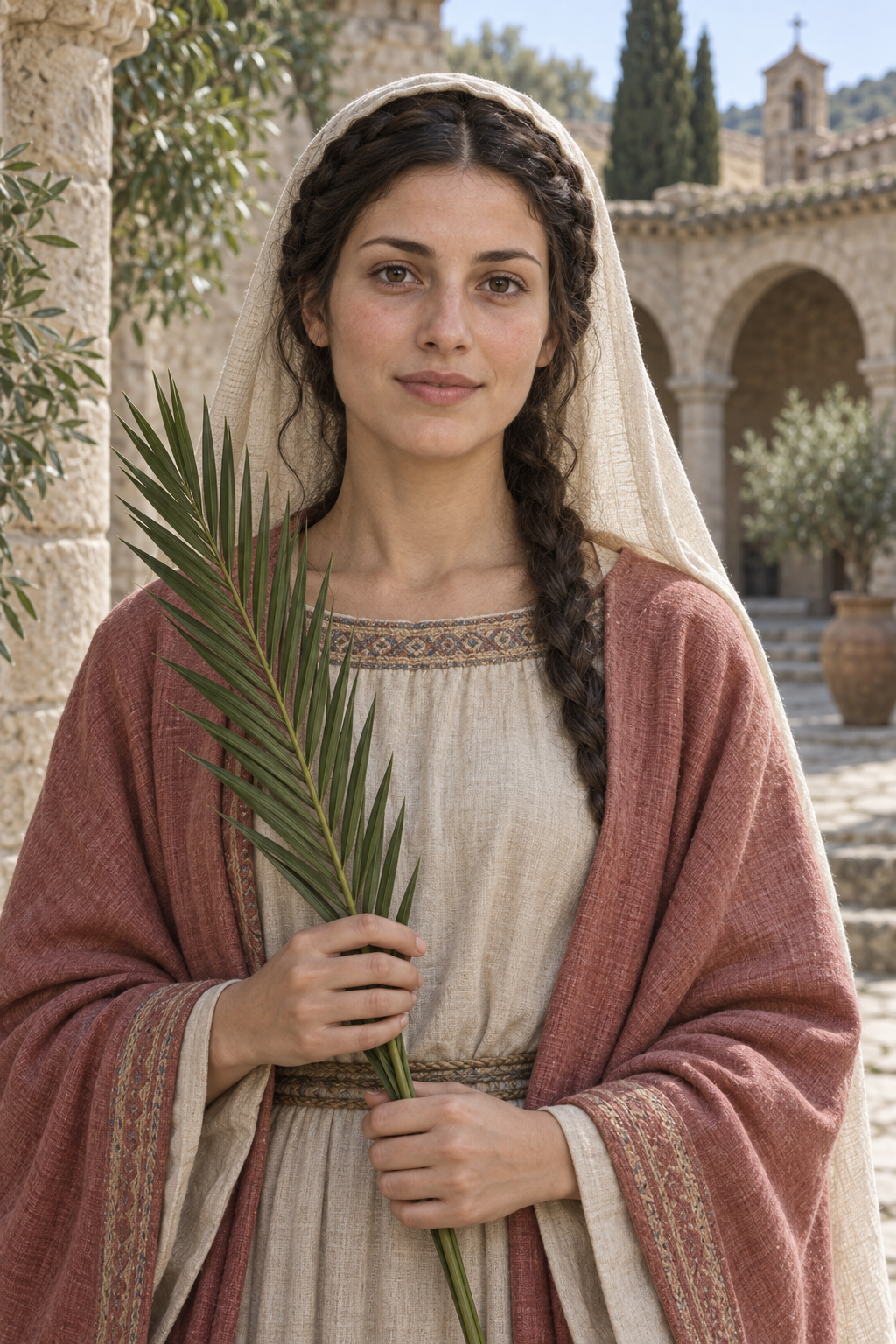
About Saturnina of Sirit
Saturnina is associated with Sains-lès-Marquion, a village in the historic church territory of Cambrai and Arras in present-day northern France. The inherited catalog called her “of Sirit,” placed her in Spain, and also named Wearmouth in England as her place of death. No reliable source reviewed joins those places to this saint. The traceable identity begins with a medieval chronicle of the bishops of Cambrai. It says that a women's monastery once stood at Sains and that Saturnina's body was believed to rest there. This witnesses a medieval local cult, not a contemporary account of her life or death.
The chronicle does not provide Saturnina's family, century, vocation, speeches, travels, or manner of death. Later local legend filled that silence. In the story she is a noble young woman from Germania who vows virginity, flees an arranged marriage, reaches Sains, hides among people tending animals, and is killed by the rejected suitor. These episodes may explain later images of a distaff and flock, but they are legendary. They cannot establish a birth country, a year such as 907, an actual journey route, or the identity and motives of a killer.
The critical Acta Sanctorum notice places Saturnina among the Atrebates, the people associated with the Arras region. It questions how ancient her designation as martyr is, retaining the title in relation to the received story of death while defending virginity rather than on evidence of a Roman persecution. That corrects the inherited biography. Saturnina should not be presented as an early Spanish martyr killed by imperial officials. Virgin and martyr are traditional cult titles; neither supplies an independently documented trial or execution.
The Roman martyrological tradition lists Saturnina at Arras on June 4, and Nominis gives that date. A local tradition at Sains has also observed her in May. This packet records June 4 for the French Roman Catholic listing and does not turn a local devotional date into a universal feast. The village church still bears Sainte-Saturnine's name, demonstrating continuity of dedication. A dedication proves that a community remembers her; it does not verify the legendary narrative attached to the name.
This profile is intentionally shorter than a normal biography. Responsible expansion beyond the surviving evidence would merely retell late legend as fact. What can be said is limited: by the Middle Ages, Sains-lès-Marquion preserved a cult centered on a woman called Saturnina, a monastery was remembered in connection with her body, and later Catholic calendars identified her as a virgin martyr of the Arras region. No quotation, reusable prayer, precise date, personal relationship, or map route can be supplied. Preserving those limits is more faithful than attaching unrelated places and a generic persecution story.
Wondering how to weigh the stories and sources? Learn how to read a saint biography.