Biography
Sebastián de Aparicio
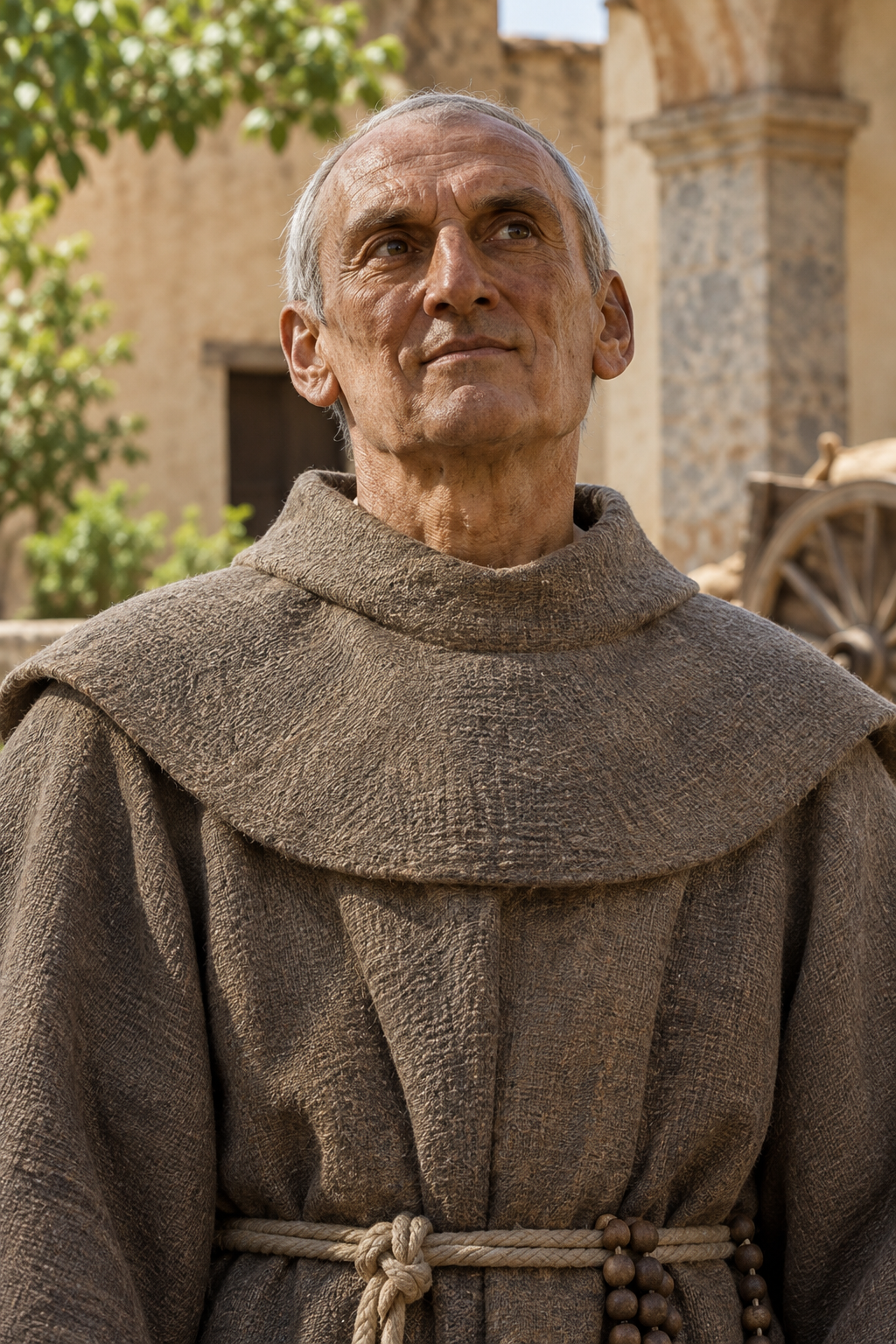
About Sebastián de Aparicio
Sebastián de Aparicio worked as a carter and farmer in New Spain before becoming a Franciscan lay brother. Originally from Gudiña in Galicia, he made his life in a colony where overland transport connected towns, farms and mining settlements. His work took him along routes linking Puebla, Veracruz, Mexico City and the mining region around Zacatecas. He later acquired agricultural property near Mexico City.
His birth date is disputed. Older biographies give January 20, 1502, but historian Montserrat Andrea Báez Hernández argues for 1510–1514, citing an admission record that described him as about sixty in 1574. The disagreement makes precise statements about his age unreliable. He married twice and was widowed twice before entering religious life. He gave property to the Poor Clares and served their community before joining the friars.
Aparicio made his Franciscan profession on June 13, 1575. He served at Tecali, where his duties included work in the kitchen and garden, and later moved to the Franciscan convent in Puebla. There he collected food and other provisions for the community. Oxen and carts, familiar from his earlier working life, remained part of his daily service. He travelled through the surrounding countryside to gather donations and bring them back to the convent.
Stories about his journeys became part of his reputation for holiness. People remembered his austere habits, help to poor households and skill in handling animals. The early testimony also presents a more complicated figure than later devotional portraits suggest. Ragon discusses accounts of restrictions imposed on his wives and questions the way biographers explained his marriages. These accounts survive through sources written to interpret his life and reputation; they do not give direct access to his motives.
Later devotional biographies describe extraordinary events involving his carts, animals and prayers for the sick. These are religious traditions about him, rather than independently established events.
Aparicio died in Puebla on February 25, 1600. Investigations into his reputation began that year, but formal recognition took much longer. Pius VI beatified him on May 17, 1789. Celebrations in Mexico City followed in February 1791.
His reputation also found expression in poetry. The Epílogo métrico, attributed to the Franciscan Francisco de Arrieta, retold his life in 126 five-line stanzas. Literary scholar Esmeralda Brizuela Baiz describes its use of familiar sayings, biblical comparisons and accounts of miracles to praise Aparicio and encourage devotion to him. The poem belongs to the history of his commemoration; its praise and supernatural stories do not independently establish the events of his life.
Artists also helped shape his public memory. A collection of engravings issued for his beatification in 1789 supplied models for paintings in the Conquistadora chapel at San Francisco in Puebla. The engravings were made by Pietro Leone Bombelli for the project directed by the Franciscan Mateo Ximénez. In their study of the chapel, Francisco Javier Pizarro Gómez and Yolanda Fernández Muñoz describe eight large canvases containing thirty-seven scenes. They distinguish an anonymous group from paintings signed by Miguel Gerónimo de Zendejas, whose participation they date to 1802. The pictures celebrate Aparicio through episodes of work, religious service and miraculous tradition.
The Franciscan Province of Saint Anthony in Brazil lists him among its February 25 commemorations as a blessed of the First Order.
Wondering how to weigh the stories and sources? Learn how to read a saint biography.