Biography
Serenus the Gardener
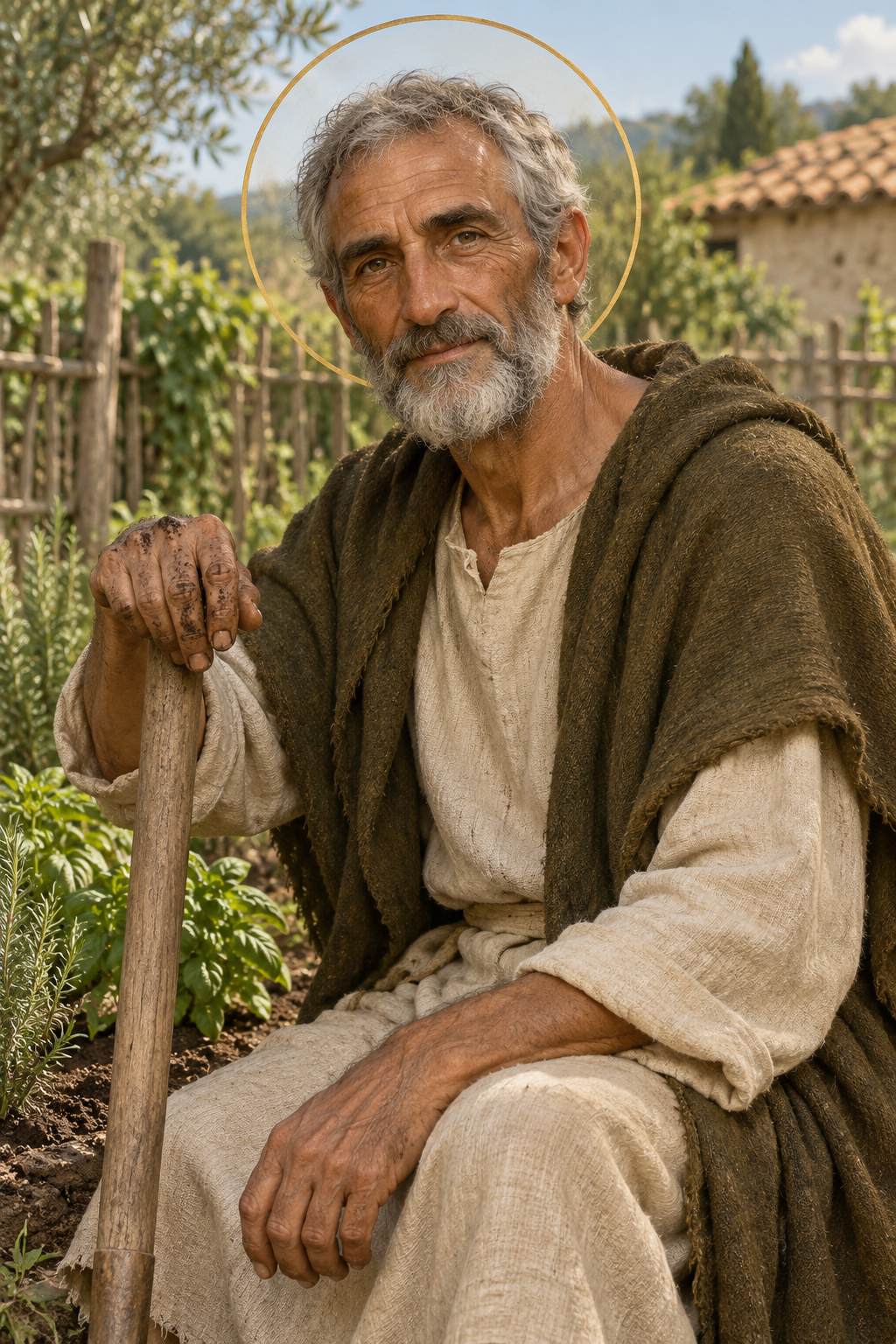
About Serenus the Gardener
Serenus the Gardener, also known as Syneros, is remembered as a martyr of Sirmium, the Roman city at modern Sremska Mitrovica in Serbia. His death is commonly placed around 307, although its exact year is uncertain. The Norwegian Catholic biography preserves several forms of his name and the French form Cerneuf.
The ancient Passion presents him as an older Greek traveler who settled at Sirmium and supported himself by cultivating a garden. When persecution began, he hid for a few months, then returned to his work. One day a married woman entered the garden with two servants. Serenus rebuked her for being there at midday and told her to leave.
In the story, she complained to her husband, an imperial guard, who obtained permission to seek redress. Serenus was brought before the governor. After hearing the gardener’s explanation, the husband fell silent. The governor, however, suspected that such outspoken conduct marked Serenus as a Christian. Serenus acknowledged his faith. Questioned about his earlier concealment, he compared himself to a discarded stone now chosen for God’s building. The governor sentenced him to beheading, and the execution followed.
The existence of an early cult is firmer than the details of this narrative. Tamas’s study identifies inscriptions from the northern cemetery of Sirmium that place burials near the martyr. They attest his veneration in the later fourth century. Her examination distinguishes that evidence from the Passion’s developed plot, which she dates to the later fourth or early fifth century. Even the gardener’s occupation, she cautions, belongs to a literary portrait whose details cannot all be independently verified.
Danny Praet’s study argues that the narrative was composed to provide an existing cult with a story. He identifies parallels with the biblical account of Susanna, including a garden, accusations and a trial. The roles have been changed: the elderly man carries the virtue associated with Susanna, while the unnamed woman is made the accuser. Praet also examines the story’s hostile portrayal of women and its presentation of Christians as the true guardians of Roman morality. This reading challenges older claims that the Passion simply reproduces reliable court proceedings.
Tamas reads the movement from concealment to public confession as a story of spiritual growth. The garden becomes an image of cultivated virtue; martyrdom arrives at the moment appointed by God. She also separates the date of commemoration from the date supplied by the Passion. The calendars and manuscripts do not all agree, and neither the precise day nor the year can be recovered with confidence.
Archaeology reveals how the martyr’s memory shaped a place of burial. Ivana Popović and Snežana Ferjančić describe two inscribed tombstones discovered in 1875 that helped prompt excavations in 1882–1883. A basilica and surrounding graves were recorded in the northern cemetery. The building’s remains were later destroyed, and scholars have differed over its reconstruction. Its former presence is nevertheless supported by the inscriptions and the recorded excavation.
Later excavations recovered additional Christian tombstones. One commemorated Marturius, identified by the authors as a cup-bearer of the emperor Constantius II. Another carried a Greek inscription around a Christian monogram. The slabs carry crosses and the letters alpha and omega in the burial space around the shrine. The authors compare such Christian symbols on other late Roman monuments to help date the cemetery. The investigators leave open whether the basilica was first built under Constantius or had existed earlier.
His remembrance also spread to France. The Norwegian Catholic account reports relic traditions at Clermont and Billom, where he was honored as Cerneuf. A separate local tradition connected him with the evangelization of Auvergne under Austremonius. These stories belong to the later reception of the martyr. The same account notes that confusion between Sirmium and Firmium helped produce a tradition of local veneration at Fermo in Italy. His common Western commemoration falls on 23 February; local traditions preserve other dates, including 10 May at Billom.
At Billom, the church of Saint-Cerneuf became the center of a community of secular canons. Hervé Chopin’s institutional record finds the chapter attested between 1088 and 1099, in a dispute with the monks of Sauxillanges. It distinguishes that documentary evidence from traditional stories assigning the foundation to Charlemagne. The chapter disappeared in 1790, while the church building survived.
The Clermont cathedral’s heritage guide records a celebration of Cerneuf in 1699 and describes the church’s Romanesque crypt and later Gothic nave. It also cites an eighteenth-century report that the canons displayed a precious bust of Charlemagne at the saint’s feast. The present building was substantially altered in the nineteenth century. These successive settings show how a martyr remembered at ancient Sirmium acquired a lasting place in the worship and material heritage of an Auvergne town.
Modern Catholic devotion also names Serenus as a patron of gardeners. Father Silas Henderson’s saint-day profile preserves that association, linking the familiar title to the people who cultivate the soil.
Wondering how to weigh the stories and sources? Learn how to read a saint biography.