Biography
Severinus of Noricum
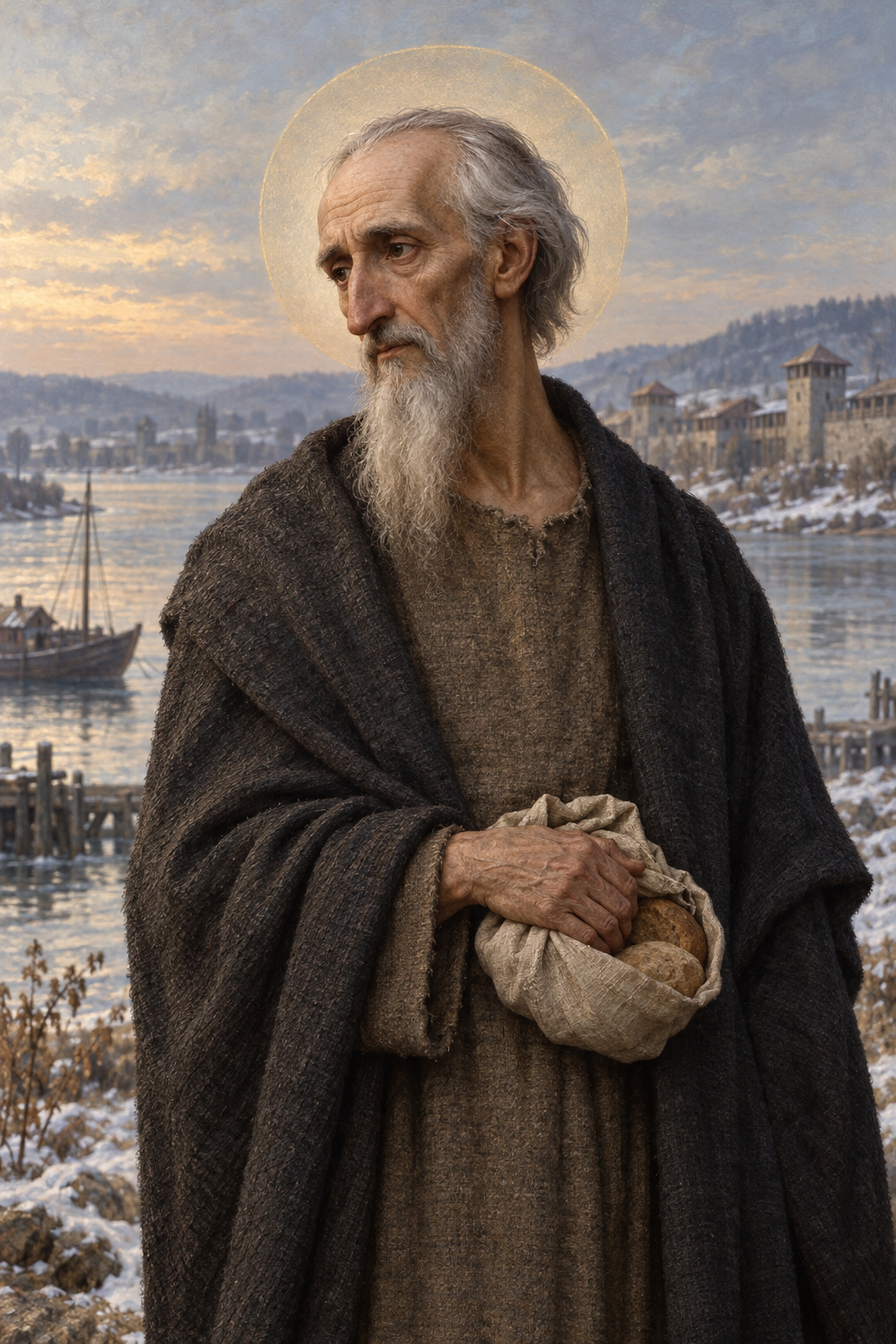
About Severinus of Noricum
Severinus worked among the towns of the Danube frontier during the fifth century, as Roman government in the region weakened and new rulers gained power. His ministry belonged especially to Noricum, on the southern bank of the river. Robert Flierman’s study places his arrival in the 450s and his death in 482. The communities he served faced raids, captivity and shortages as well as the loss of the political order on which they had depended.
His earlier life is uncertain. The Norwegian Catholic account records competing suggestions about his birthplace and describes a tradition of monastic life in the East before his arrival on the Danube. None supplies a secure birthplace or family history. What emerges more clearly is his preference for a monk’s life of prayer and simplicity, combined with a willingness to leave solitude when other people needed help.
Eugippius’s early Life gives this tension a concrete setting near Favianis. Severinus sought a quiet cell away from the crowds, but returned to establish a monastery and teach others. In another passage he firmly refused an invitation to become a bishop. The account presents his authority as that of a monk whose example and counsel drew people to him, rather than as the holder of an episcopal office.
At Favianis, the Life describes a famine and a wealthy widow named Procula who was withholding grain. Severinus rebuked her publicly, and she began sharing her stores with the poor. Boats carrying provisions subsequently arrived after being delayed by ice. The episode links his preaching to a particular demand upon someone who had food while her neighbors were hungry.
The Norwegian account also remembers the severity of his personal discipline. He fasted, wore simple clothing and was said to go barefoot even during the region’s bitter winters. At the same time, his concern for people exposed to violence involved negotiations with rulers, not withdrawal from them. His reputation extended beyond the Catholic communities among whom he lived, reaching rulers whose religious commitments differed from his own.
The Diocese of Linz emphasizes the relationship between his prayer and practical help. It recalls his repeated retreats to a cell near Favianis, identified with modern Mautern on the Danube, alongside his insistence that people with resources support those in need. Its account presents his work in Lauriacum as organized relief for inhabitants and refugees. Concern for those displaced by violence belonged within the same life as the desire for silence.
His death came at Favianis on 8 January 482. Eugippius describes his final illness, the gathering of the brothers and his encouragement to live according to their monastic calling. He received Communion and began a psalm when grief prevented the others from singing. The Life remembers his death within the worship and shared life of the community he had formed.
The monks’ history continued through a much larger displacement. Rajko Bratož’s study describes their departure in 488, when Odoacer ordered the evacuation of the Roman population. The brothers opened Severinus’s grave and carried his remains with them into Italy. They stayed for a time at the place identified with modern San Leo, before finding a more lasting home near Naples.
A noblewoman named Barbaria invited the congregation to settle at Lucullanum. Bratož dates the final settlement and burial there to the pontificate of Gelasius I, between 492 and 496. The bishop of Naples received the remains, which were placed in a mausoleum Barbaria had provided. Severinus’s memory therefore traveled with a displaced community: the monk associated with the Danube became the founding saint of a monastery in southern Italy.
The surviving Life was written by Eugippius in the early sixth century. Flierman reads it as a carefully shaped account that taught Christian communities how to act together, especially through prayer, charity and responsibility for the vulnerable. Its episodes are not arranged as a continuous chronology. They combine memories of the frontier with biblical patterns, miracles and warnings intended for readers living under changed political and religious conditions.
A material connection with that frontier survives at Boiotro, in the part of Passau called Innstadt. The city’s museum guide identifies the fort in Severinus’s Life and associates him with a small monastery within its ruins in the late fifth century. The museum incorporates original Roman foundations beneath a later house. Excavated objects, models and reconstructions place the written account beside the remains of the settlement where he worked. His remembered activity belongs to the history of an inhabited frontier, as well as to a religious tradition.
The Diocese of Linz honors him as its second patron and lists 8 January as his commemoration. It also records traditional patronage of Bavaria, prisoners, winegrowers and linen weavers, with an invocation for fruitful vines. These later associations preserve different aspects of his remembered care for communities and their needs.
Wondering how to weigh the stories and sources? Learn how to read a saint biography.