Biography
Siard of Mariëngaarde
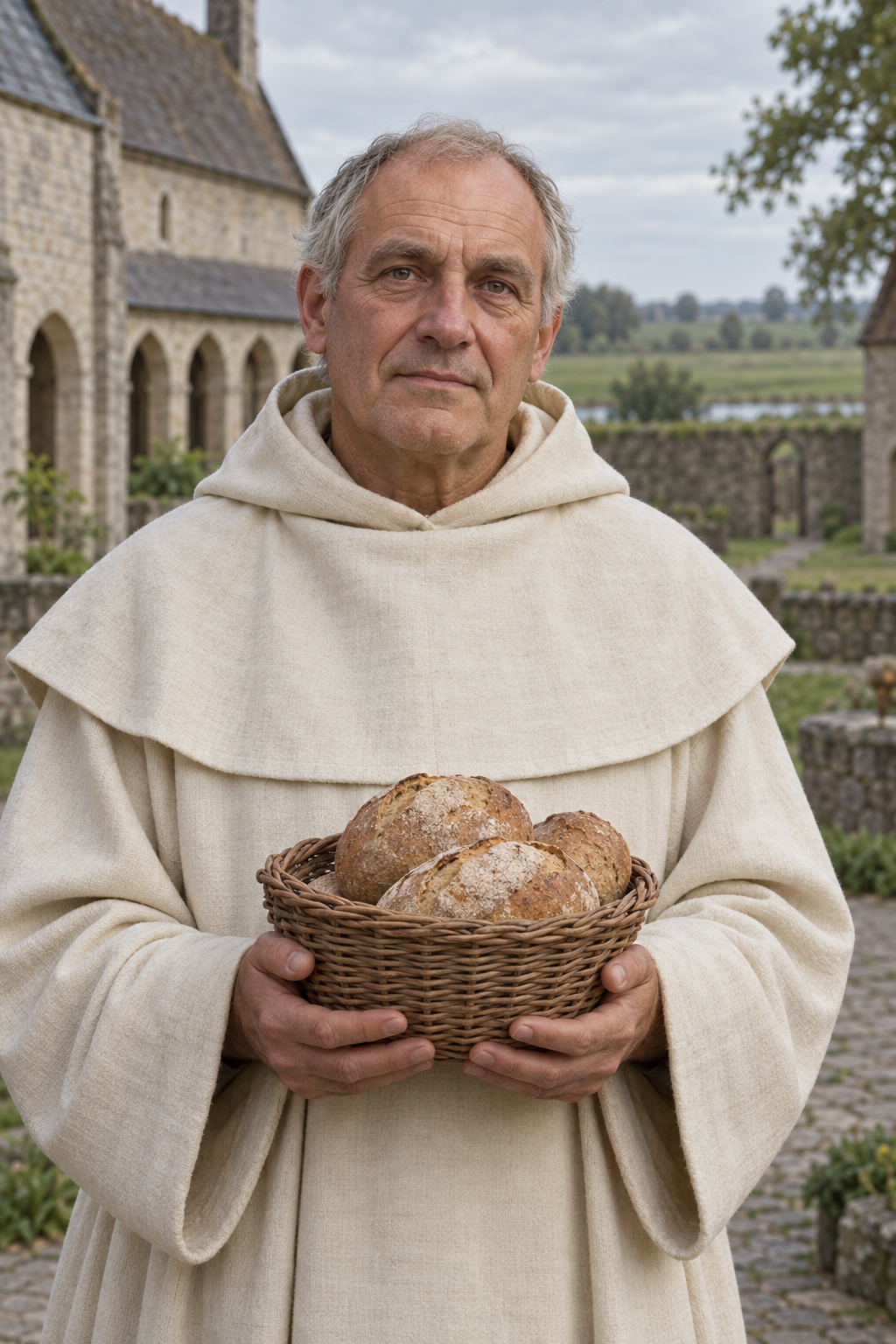
About Siard of Mariëngaarde
Siard of Mariëngaarde led a community whose work reached into the fields and schools of medieval Friesland. He had entered its school as a boy under Frederick of Hallum and later joined its white-robed canons. Elected abbot in 1194, he is remembered for working beside his brothers during the harvest and helping to strengthen the summer dikes. Teaching boys, preaching to adults, and providing for poor people belonged to the same account of his leadership. The basket of bread that became his familiar attribute recalls this practical care.
Mariëngaarde had been founded at Hallum in 1163. Under Frederick, its first abbot, it joined the Premonstratensian order and grew in membership and property. Siard was its fifth abbot. His story survives among the lives of five abbots, but those texts have different purposes. As the historian Freerk Hovinga explains, the lives of Frederick and Siard emphasize sanctity, while the combined account of the three later abbots has more of the character of a chronicle.
The early Life gives that exemplary leadership a domestic setting. It tells how Siard sent part of his own food, including a dish with butter, to a man digging ditches for the monastery. Another episode takes place in the kitchen. Finding a separate pot of food prepared for his illness, Siard pours it into the larger pot for the brothers. The narrative makes the shared meal an expression of common life. These are stories preserved by his religious community, rather than independently documented incidents.
The same text says that he would not enjoy provisions unavailable to the brothers while the community faced the expense of buildings and daily necessities. Its opening account also contrasts patient leadership with harsh correction. Siard is portrayed as a mature abbot who accepted responsibility through the community’s choice. The author uses his example to address the brothers who would hear or read the Life, repeatedly connecting the abbot’s conduct with their own responsibilities.
The surviving text has its own complicated history. The Royal Historical Commission’s repertory records an older dating to about 1260–1270, but also the conclusion of the modern editors that the Life and miracles were composed around 1240, apart from a fifteenth-century chapter. Only one late medieval manuscript preserves the Life, alongside other writings associated with Mariëngaarde. Its copyist already noted that the ending was missing.
Siard’s final year included violence within the community. Fruytier’s historical dictionary entry, citing the chronicler Emo of Wittewierum, describes an attack by a canon while the abbot slept. Other brothers came when he cried out. Siard died at Mariëngaarde on 13 November 1230. The account does not establish that the assault caused his death.
Veneration developed around his grave. Harm Oldenhof’s study of pilgrimage at Hallum traces several relocations within the abbey church, beginning with the move ordered by Siard’s successor, Sibrand. A later move in 1406 was intended to revive devotion after it had declined. People sought help at the tomb and brought candles or wax offerings. After the abbey’s destruction, relics were recovered from its ruins and carried abroad. Visits to the former grave sites continued into the early seventeenth century, according to the pilgrimage study.
The Norbertine account follows two later routes of these relics. One portion passed through the abbey of Saint-Feuillien at Roeulx and the parish of Strépy before reaching Leffe in 1938. Another arrived at Tongerlo in 1617. A shrine was made there two years later, and the relics were protected during the disruptions of the French revolutionary period. Their return to the abbey in the nineteenth century renewed a physical connection with the Frisian abbot.
Tongerlo’s art inventory records the surviving shrine and its restoration in 1860, when a new reclining figure was added. It also identifies the local devotional tradition: young mothers and farmers sought Siard’s protection, and he was invoked against blindness and fever. These are historically recorded forms of intercession, not medical claims. The same inventory lists his feast on 14 November.
The bread basket in his later images provides a quieter link with the life remembered at Mariëngaarde. Hovinga identifies it as a sign of his generosity to poor people.
Wondering how to weigh the stories and sources? Learn how to read a saint biography.