Biography
Silouan the Athonite
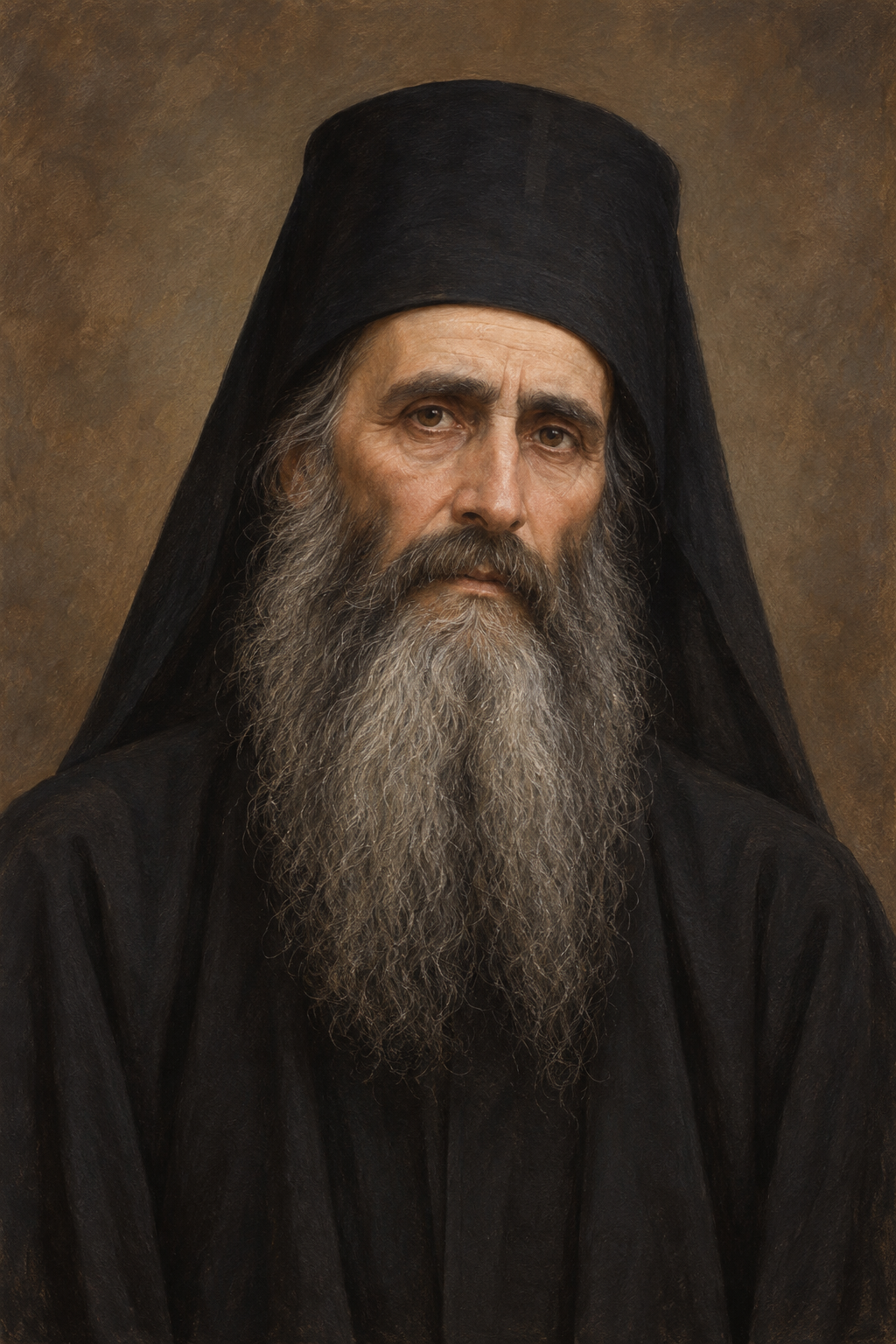
About Silouan the Athonite
Silouan the Athonite was born in Russia in 1866 as Symeon Ivanovich Antonov. He entered the monastery of Saint Panteleimon on Mount Athos in 1892 and died there in 1938. His monastic life combined prayer with practical responsibilities. He worked in the mill and later served as a steward. Historian Antoine-Émile Tachiaos places those duties within a large community that depended on substantial daily labor. Silouan’s counsel to those supervising workers emphasized love, compassion, and prayer for the people in their care.
His contacts extended beyond the monastery through letters. Historian Mikhail Shkarovsky identifies Silouan among the monks maintaining correspondence with Russian emigrants between the world wars. In May 1933, a novice writing from Paris asked him to pray for Archbishop Benjamin, who had recently gone to the United States. The sender enclosed a photograph of the archbishop. Another letter, sent by the theology student Roman Strizhkov from Belgrade in July 1936, discussed a proposed return to Athos and asked for help obtaining books from the monastery shop. These exchanges concerned practical arrangements as well as spiritual needs. Shkarovsky also records correspondence with Vladimir Rodionov, whom Silouan and Sophrony encouraged to deepen his prayer. The monastery was secluded, but its relationships crossed national borders.
Among his correspondents was Nadejda Soboleva, a mother living in Paris. His surviving letters to her acknowledge small gifts of money and promise prayers for her and her son, Boris. In one letter, he explains that the prayer rope he sent had been used in his own prayers. She had wanted an old one rather than a new one. Elsewhere he asks her to pray for him, presenting their relationship as a mutual responsibility rather than a one-sided exchange of advice.
The letters also show him attending to family obligations. When Soboleva considered monastic life, he advised her to ensure that her son was settled first. He encouraged prayer at home and described ordinary work as compatible with remembrance of God. In his final letter to her, dated July 1938, he again sought her prayers for humility. The letters preserve counsel addressed to one household, with its particular worries and decisions.
A further letter, published by Alexander Gurevich, survives through a copy rather than an autograph. Gurevich dates it to May 1938 and identifies its recipient as probably Dimitri Balfour, an English convert to Orthodoxy. The editor traced the copy through an archive in Paris and the monastery of Chevetogne before it reached Viktor Mamontov. Its handwriting was neither Silouan’s nor Sophrony’s. That finding limits what can be said about the physical document without by itself settling the question of authorship. Gurevich supports the attribution by comparing its vocabulary and spiritual concerns with Silouan’s other writings. The case illustrates the care needed when reconstructing his correspondence from dispersed copies.
The Orthodox Encyclopedia notes that Soboleva and her son never met Silouan, despite regarding him as their spiritual father. His influence therefore did not depend entirely on visits to Athos. It also records that only part of his correspondence has been published and that the locations of some originals remain uncertain. Copies passed through recipients, their heirs, and other custodians. His surviving writings are a partial record, preserved through the efforts of several people rather than a complete archive left ready for publication.
The surviving account of his inner life depends heavily on his disciple Sophrony, who preserved his notes and brought them into print. Tachiaos emphasizes that Silouan published nothing during his lifetime and that his spiritual depth remained little known among many of his fellow monks.
The encyclopedia’s literary analysis describes prose that is simple and sometimes uneven, with recurring themes rather than a tightly planned argument. Passages can gradually acquire a measured rhythm. It relates that rhythm to the prayer from which the writing emerged. This helps explain why the texts read differently from a systematic treatise: their repetitions belong to a sustained spiritual concern, not an attempt to arrange every subject into a formal sequence.
Sophrony’s first Russian edition appeared in 1948. The writings later reached readers beyond their original monastic setting. In 1993, Sophrony blessed the formation of an association devoted to making Silouan’s life and teaching better known. Its charter describes a fellowship open to people seeking spiritual guidance and friendship across Christian communities.
His name also became the dedication of a French monastery founded in 1990. The community began with its founder and two novices in a former farm. It brought monks and nuns together and adopted French for its services. Its account identifies Silouan’s intercession for the whole world and love of enemies as central to the teaching it seeks to follow.
At the monastery in Essex, another church was dedicated to Silouan after his recognition as a saint. The dedication reflects the continuing bond between Silouan and the community founded by his disciple.
Wondering how to weigh the stories and sources? Learn how to read a saint biography.