Biography
Simeon of Polirone
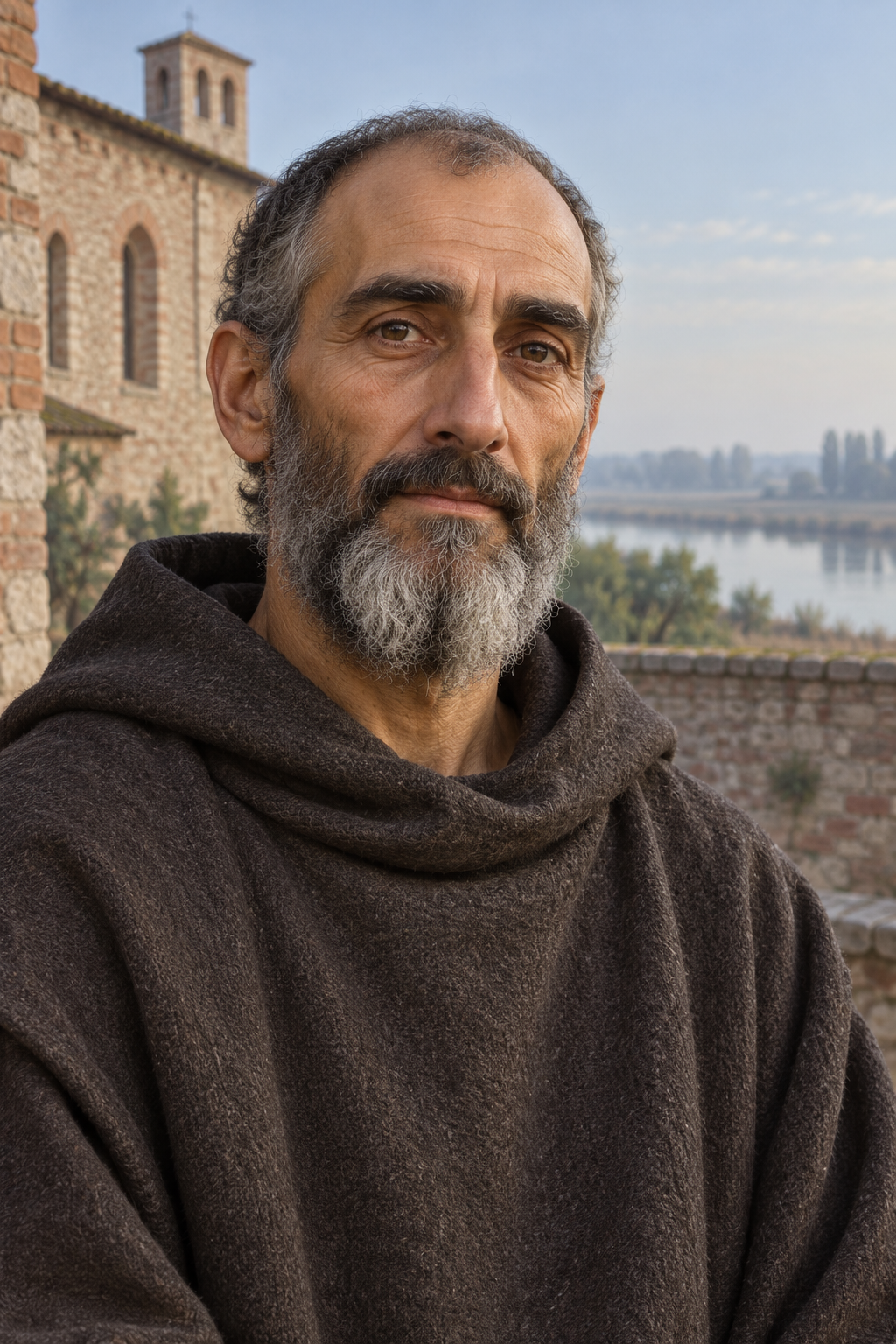
About Simeon of Polirone
Simeon of Polirone spent his last years as a monk at San Benedetto near Mantua, where he died on 26 July 1016. Remembered as a hermit and pilgrim, he became a saint of the community that had received him. The New Catholic Encyclopedia distinguishes that historical setting from the legendary Life through which his earlier journeys are known. Stories of his charity and miracles helped preserve his memory, but they cannot all be read as a documented itinerary.
The Life was written after his death by a monk of Polirone. It presents him as an Armenian nobleman who left an unwanted marriage, adopted monastic life, and traveled through Jerusalem, Rome, and western pilgrimage centers. The Prosopography of the Middle Byzantine Period cautions that these details are known only from that narrative. It also questions a letter attributed to a patriarch of Jerusalem: its contents do not match the Life’s description, and it mentions events the supposed author could not have known. An eastern origin remains plausible, but the scholars judge much of the earlier itinerary to be invention. That distinction leaves his residence at Polirone as the firmer center of his story.
The monastery was still a young foundation when Simeon lived there. Zanichelli’s history places its establishment in June 1007 under the Canossa family. It stood on an island formed where the Po met the Lirone, a setting closely bound to the river landscape. Boniface continued his family’s support through gifts and a new church dedicated to Simeon after the hermit’s death. He also promoted Simeon’s recognition as a saint. The cult thus grew within an institution whose religious life, buildings, and landed support were developing together.
One story gives a concrete image of the charity for which Simeon was remembered. On a winter journey to Boniface at Mantua, he gives his shoes to a poor man and arrives barefoot. The historian Paolo Golinelli points out the resemblance to Martin of Tours giving away part of his cloak. In the account, Boniface offers material for replacement shoes, but Simeon refuses. The episode belongs to a tradition shaped by earlier saints’ lives; its significance lies in the generous figure it presents, rather than proof of every detail of the journey.
Golinelli also demonstrates how that tradition changed. In one manuscript, a journey follows the Po to Gonzaga; a later local version describes marshes and an overland approach suited to a different landscape. Such revisions can make a fifteenth-century setting look like an eleventh-century one. He dates the Life to 1016–1024, while noting scholarly disagreement about the papal letter used in dating it. His comparison explains why careful reading requires attention to both the saint and the people who transmitted his story.
After Simeon’s death, papal involvement gave his cult a more durable form. Odden’s account distinguishes three letters. Benedict VIII authorized Boniface to build a church dedicated to Simeon and place his remains there. Leo IX addressed the church’s consecration and the recognition of the relics. Alexander II later intervened because the earlier instructions had not been fulfilled. These successive actions should not be compressed into a single ceremony following the procedures of a modern canonization. They describe the establishment of a place of worship and the care of the body around which devotion gathered.
The buildings visible today belong to many later phases of the abbey’s history. The new abbey church was probably standing by 1054, but its consecration came only shortly before the community’s affiliation with Cluny in 1077. Later rebuilding, decoration, and scholarship have complicated the reconstruction of the earliest church. The enduring dedication to Simeon can therefore be recognized without imagining that the present basilica is the building he knew.
His memory remained visible in later art. The Italian cultural heritage catalogue identifies a statue of Simeon among the works associated with Antonio Begarelli’s workshop and the commission of 1559. Its account locates his relics in an altar of the basilica and records his invocation against floods of the Po. This is evidence of a local devotional practice, not a claim that a particular flood was miraculously prevented.
For the millennium of his death in 2016, the parish celebrated Simeon as a merciful pilgrim. Its supporting basilica association explicitly identified him as the abbey’s patron, distinguishing him from Benedict, its titular saint. The program connected pilgrimage with prayer and works of mercy. This is how the community chose to interpret his legacy, without resolving the historical questions surrounding each medieval journey.
The same remembrance continued in the patronal feast celebrated at San Benedetto Po on 26 July 2026. Bishop Marco Busca spoke of Simeon as a figure connecting eastern and western Christian spirituality. His homily treated pilgrimage as a life given direction, rather than movement for its own sake. The celebration shows that the remembered pilgrim still has a place in the worship of the community where his earthly journey ended.
Wondering how to weigh the stories and sources? Learn how to read a saint biography.